Source A: Herodotus, Histories 9
At the battle of Plataea (479 BC) the Spartans and Tegeans fought the Persians, who had set up a barrier of wicker shields.
'First the fighting was at the wicker shields. When these had fallen, there was a fierce battle for a long time beside the temple of Demeter, until it came to a shoving match; for the Persians kept grabbing hold of the Greeks' spears and breaking them. In courage and strength the Persians were not inferior, but they had no armour; besides, they lacked skill and were no match for their opponents in technique. They kept dashing out ahead, one at a time or in groups of ten, more or fewer, falling on the Spartans and being killed... What harmed them most was their clothing, which gave them no protection: they were fighting as unarmoured men against hoplites.'
To what extent was heavy equipment an advantage to hoplites in battle? Use Source A as a starting point and your own knowledge.
Model answer
Source A suggests that heavy equipment gave hoplites a decisive advantage. At Plataea the Persians were 'not inferior' in 'courage and strength', but 'they had no armour' and were fighting 'as unarmoured men against hoplites'. When it came to the shoving match, they could only grab at the Greeks' spears and break them, and those who rushed out singly or in small groups were killed. Herodotus says what harmed them most was their clothing, which gave no protection.
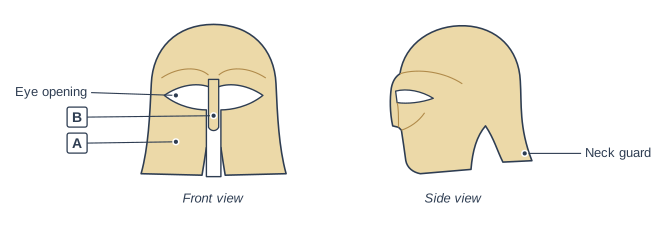
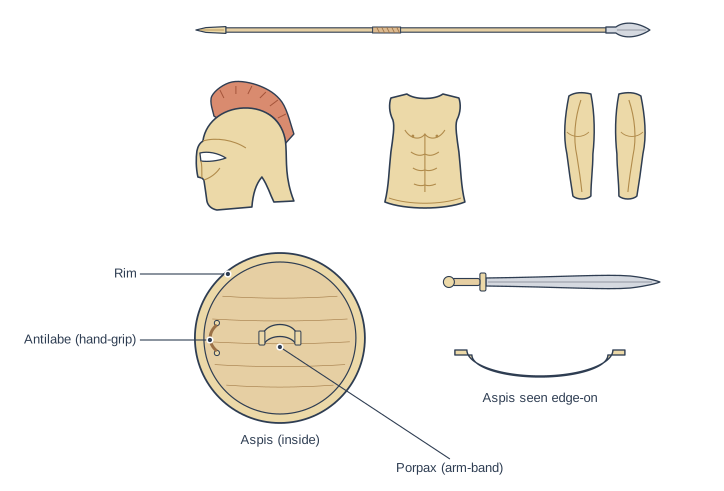
Own knowledge supports this. The hoplite's panoply - a large bronze-faced aspis, Corinthian helmet, cuirass and greaves - protected him from head to shin, and the overlapping shields formed a wall that lightly armed troops could not break. At Marathon the Athenian hoplites charged and defeated the Persian infantry, and at Thermopylae Herodotus says the Greeks' longer spears gave them the advantage in the narrow pass.
However, heavy equipment also had serious disadvantages. The panoply weighed about 20-30 kg, which was exhausting in the heat, and the Corinthian helmet limited sight and hearing. Hoplites were slow and needed flat ground and an unbroken formation. Against mobile light troops they could be helpless: at Sphacteria in 425 BC Athenian light-armed troops wore down the Spartan hoplites with missiles, and Thucydides says their felt caps did not keep out the arrows. Cavalry could also threaten their flanks, as at Delium. Even in Source A, Herodotus stresses the Persians' lack of 'skill' and 'technique', so it was not equipment alone that won.
Overall, heavy equipment was a great advantage in the kind of pitched battle on open ground that Greek hoplites were designed for, especially against unarmoured enemies. But it was only an advantage in the right conditions and with the right training; against light troops, cavalry or in rough country it could become a burden.
Explanation
Strong answers use Source A's contrast between armoured hoplites and unarmoured Persians, then test it with examples where heavy equipment helped (Marathon, Thermopylae) and where it was a handicap (Sphacteria, Delium). A Level 4 answer notices that Herodotus also credits skill, and judges that the advantage depended on terrain and the type of enemy.