
Level:
Correct: 0
Incorrect: 0
Marks: 0/0
Exam Practice
Course:
Topics:
Avg
score:
–
Topics
done:
0/24

The greenhouse effect

Practise 14 exam-style questions on The greenhouse effect for OCR GCSE Combined Science (Chemistry Paper 10). Write your answer as you would in the exam and get it marked in seconds against the mark scheme, point by point, with the Study Helper on hand if you get stuck.

  • 14 questions
  • 1–6 marks each
  • Instant marking
  • No sign-up needed
14 questions, marked as you go

Sample questions with model answers

Here are 4 of the questions in this topic, each with a model answer, an explanation of why it earns the marks and the mark scheme an examiner would use.

Question 1

1 mark

Gases made of single atoms, or of molecules made of two atoms of the same element, do not absorb infrared radiation. Gases made of molecules that contain atoms of different elements do absorb infrared radiation.

Use this information to identify the gas that would add to the greenhouse effect.

Choose your answer.

  • A Ar
  • B Cl₂
  • C N₂
  • D N₂O

Model answer

D

Explanation

Read each formula to see what the particles are: Ar is single atoms, Cl₂ and N₂ are molecules of one element, and N₂O contains two different elements. Only molecules like N₂O, CO₂, CH₄ and H₂O absorb infrared radiation, which is why nitrogen and oxygen, the main gases in the air, are not greenhouse gases.

Mark scheme
  1. 1 mark

    D / N₂O

    The only correct answer is D: each N₂O molecule contains atoms of two different elements (nitrogen and oxygen), so dinitrogen oxide absorbs infrared radiation and is a greenhouse gas. A is not correct because argon is made of single atoms; B is not correct because Cl₂ molecules are made of two atoms of the same element; C is not correct because N₂ molecules are made of two atoms of the same element. ALLOW the letter or the formula. ALLOW N2O. If more than one option is given, do not award the mark.
Question 2

2 marks

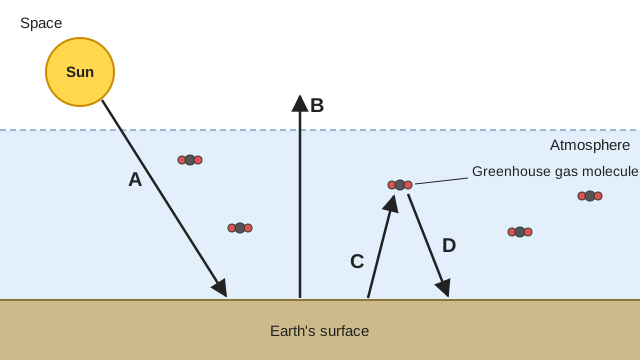
In the diagram, arrows A, B, C and D show four paths taken by radiation.

Suppose that more carbon dioxide is added to the atmosphere.

Give the letter of the arrow that would then show less radiation than before.

Explain your answer.

Diagram. The Sun is at the top left, in space. Below it is a band labelled atmosphere, containing several small molecules; one is labelled greenhouse gas molecule. At the bottom is the Earth's surface. Arrow A goes from the Sun down through the atmosphere to the surface. Arrow B goes from the surface straight up through the atmosphere into space. Arrow C goes from the surface up to the labelled greenhouse gas molecule. Arrow D goes from that molecule down to the surface.

Model answer

B
With more carbon dioxide molecules in the atmosphere, more of the infrared radiation emitted by the Earth's surface is absorbed by them, so less passes straight through the atmosphere into space.

Explanation

Arrow B is infrared radiation from the surface that escapes directly into space. Extra carbon dioxide absorbs more of the surface's infrared radiation (arrow C gets bigger) and emits more back to the surface (arrow D gets bigger), so arrow B gets smaller. Arrow A, the Sun's short-wavelength radiation, is hardly affected.

Mark scheme
  1. 1 mark

    B

    DO NOT ALLOW if more than one letter is given.

  2. 1 mark

    more of the infrared radiation emitted by the surface is absorbed by (the extra) carbon dioxide / greenhouse gas molecules, so less passes straight through the atmosphere into space

    ALLOW more infrared radiation is absorbed (and re-emitted), so less escapes into space. DO NOT ALLOW reflected / blocked by the ozone layer. This mark can be awarded on its own if the explanation is about infrared radiation from the surface escaping directly into space.

Question 3

3 marks

A student uses the school weather station on five clear, calm nights. They record the mass of water vapour in the air and the fall in air temperature overnight.

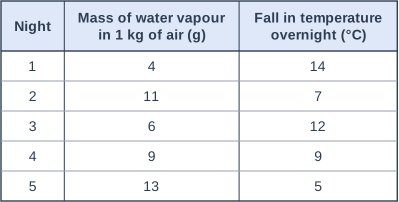
The table shows the results.

Describe the relationship shown by the results.

Explain the relationship in terms of greenhouse gases and radiation.

Table with columns "Night", "Mass of water vapour in 1 kg of air (g)", "Fall in temperature overnight (°C)". Night: 1; Mass of water vapour in 1 kg of air (g): 4; Fall in temperature overnight (°C): 14 | Night: 2; Mass of water vapour in 1 kg of air (g): 11; Fall in temperature overnight (°C): 7 | Night: 3; Mass of water vapour in 1 kg of air (g): 6; Fall in temperature overnight (°C): 12 | Night: 4; Mass of water vapour in 1 kg of air (g): 9; Fall in temperature overnight (°C): 9 | Night: 5; Mass of water vapour in 1 kg of air (g): 13; Fall in temperature overnight (°C): 5.

Model answer

The greater the mass of water vapour in the air, the smaller the fall in temperature overnight: with 4 g of water vapour in each kg of air the temperature fell by 14 °C, but with 13 g it fell by only 5 °C.
At night the ground gets no radiation from the Sun but still emits infrared radiation, so it cools. Water vapour is a greenhouse gas: its molecules absorb some of this infrared radiation and emit infrared radiation in all directions, some back to the ground. So on a humid night less energy escapes into space and the temperature falls less. On a dry night more of the infrared radiation escapes directly into space.

Explanation

The data are not in order, so look at the pairs of values: as the water vapour goes up, the fall in temperature goes down. The explanation is the greenhouse effect on a small scale: water vapour absorbs and re-emits the infrared radiation emitted by the ground. This is why deserts, where the air is very dry, get so cold at night.

Mark scheme
  1. 1 mark

    the greater the mass of water vapour (in the air), the smaller the fall in temperature (overnight) / ORA (allow the reverse argument)

    Max 3 from the four marking points. Max 2 if the relationship is not described. ALLOW negative correlation. ALLOW a description using data from the table, for example 4 g gives a fall of 14 °C but 13 g gives a fall of only 5 °C. IGNORE (inversely) proportional.

  2. 1 mark

    at night the ground loses energy by emitting infrared radiation (and gets no radiation from the Sun)

    ALLOW the ground / surface radiates heat.

  3. 1 mark

    water vapour (molecules) absorb (some of) this infrared radiation

    ALLOW water vapour is a greenhouse gas which absorbs infrared / heat. ALLOW trap for absorb.

  4. 1 mark

    and (re-)emit infrared radiation in all directions, some back to the ground, so the ground and air cool less / ORA (with less water vapour, more infrared radiation escapes directly into space)

    IGNORE reflected / bounced back (these words do not score this mark, but do not cancel a correct answer). DO NOT ALLOW references to the ozone layer.

Question 4

4 marks

Scientists have estimated the mean energy transferred by infrared radiation each second for each square metre of the Earth's surface.

• Infrared radiation emitted by the Earth's surface: 396 J
• Infrared radiation from the surface that passes straight through the atmosphere into space: 40 J
• Infrared radiation that reaches the surface from greenhouse gases and clouds in the atmosphere: 333 J

(Data: Trenberth and others, 2009)

Calculate the percentage of the infrared radiation emitted by the surface that is absorbed in the atmosphere. Give your answer to 2 significant figures.

Calculate the net energy lost by infrared radiation from each square metre of the surface each second.

Suggest how this net loss would change if the atmosphere contained fewer greenhouse gas molecules, and the effect on the temperature of the surface.

Model answer

Infrared radiation absorbed = 396 − 40 = 356 J
Percentage absorbed = 356 ÷ 396 × 100 = 89.9 = 90% (2 significant figures)
Net energy lost by infrared radiation = 396 − 333 = 63 J each second for each square metre

With fewer greenhouse gas molecules, less of the infrared radiation from the surface would be absorbed and less would be sent back down, so the 333 J would be smaller. The surface would lose more energy each second than before, so it would cool and its temperature would fall.

Explanation

The radiation absorbed in the atmosphere is the radiation emitted by the surface minus the part that passes straight through, so 356 J, not 333 J. The net loss compares what the surface emits with what comes back from the atmosphere. Greenhouse gases keep the surface warm by reducing this net loss: fewer of them would mean a larger net loss and a colder surface.

Mark scheme
  1. 1 mark

    infrared radiation absorbed = 396 − 40 = 356 (J); or a correct final answer of 90% with no working

    An answer of 90% with no working scores marking points 1 and 2. An answer of 63 J with no working scores marking point 3. ALLOW 100 − (40 ÷ 396 × 100) = 100 − 10.1 for this mark. ALLOW 1 mark (this marking point only) for 89.9% (correct value not given to 2 significant figures). ALLOW 1 mark for 10% (40 ÷ 396 × 100, the percentage that is not absorbed). 333 ÷ 396 × 100 = 84% scores 0 for the calculation (it is the radiation returned to the surface, not the radiation absorbed).

  2. 1 mark

    evaluation: 356 ÷ 396 × 100 = 90 (%)

    The answer must be given to 2 significant figures for this mark.

  3. 1 mark

    net energy lost = 396 − 333 = 63 (J)

    ALLOW 63 J per second / 63 W for each square metre. DO NOT ALLOW 356 or 23 (396 − 40 − 333).

  4. 1 mark

    less infrared radiation would be absorbed and sent back to the surface (less radiation would reach the surface from the atmosphere), so the net loss would be larger and the surface would cool / its temperature would fall

    Both the larger net loss (or less radiation returned) and the lower temperature are needed. ALLOW ORA (allow the reverse argument) for more greenhouse gases. IGNORE answers about the ozone layer.

Ready to try the rest? Every answer you write is marked against the mark scheme, so you can see exactly where the marks are.

Study Helper Hints first, answers after you try

Stuck on this one? Ask for a hint and I’ll point you in the right direction, without giving the answer away. Once you’ve checked your answer, I’ll show you how the marks are awarded.