
Level:
Correct: 0
Incorrect: 0
Marks: 0/0
Exam Practice
Course:
Topics:
Avg
score:
–
Topics
done:
0/24

Properties of Groups 1, 7 and 0

Practise 14 exam-style questions on Properties of Groups 1, 7 and 0 for OCR GCSE Combined Science (Chemistry Paper 10). Write your answer as you would in the exam and get it marked in seconds against the mark scheme, point by point, with the Study Helper on hand if you get stuck.

  • 14 questions
  • 1–5 marks each
  • Instant marking
  • No sign-up needed
14 questions, marked as you go

Sample questions with model answers

Here are 4 of the questions in this topic, each with a model answer, an explanation of why it earns the marks and the mark scheme an examiner would use.

Question 1

1 mark

Helium, neon, argon, krypton, xenon and radon are elements in Group 0 of the Periodic Table.

Which statement is true for all six of these elements?

Choose your answer.

  • A They are made of molecules containing two atoms.
  • B Their atoms each have eight electrons in the outer shell.
  • C They are colourless gases at room temperature.
  • D They all have the same boiling point.

Model answer

C

Explanation

The noble gases are colourless, monatomic gases with very low boiling points that increase down the group. 'Eight outer electrons' is true for neon to radon but not for helium, whose full outer shell holds only two. A common slip is to think that the noble gases form molecules, as the halogens do.

Mark scheme
  1. 1 mark

    C / they are colourless gases at room temperature

    C is correct: every Group 0 element from helium to radon is a colourless gas at room temperature. A is not correct because the Group 0 elements are monatomic: they exist as single atoms, not molecules; B is not correct because a helium atom has only two electrons, which fill its only shell; D is not correct because the boiling points increase down the group, from −269 °C for helium to about −62 °C for radon. ALLOW the letter or the statement. If more than one option is given, do not award the mark.
Question 2

2 marks

Lithium, sodium and potassium are stored under oil. Rubidium and caesium are supplied in sealed glass tubes filled with argon instead.

Suggest why rubidium and caesium are stored in sealed tubes of argon.

Model answer

Reactivity increases down Group 1, so rubidium and caesium are even more reactive than potassium. They could react with the traces of oxygen and water that dissolve in, or get through, the oil. Argon is a noble gas and is unreactive, so in a sealed tube of argon the metals have nothing to react with.

Explanation

This uses two simple properties at once: the Group 1 metals get more reactive down the group, and the Group 0 elements are unreactive. Many answers say only that rubidium and caesium are 'reactive', which does not explain why oil is good enough for lithium, sodium and potassium but not for them.

Mark scheme
  1. 1 mark

    rubidium and caesium are more reactive (than lithium, sodium and potassium), so they could react with the small amounts of air / oxygen / water in or through the oil

    The comparison (more reactive / reactivity increases down Group 1) is needed. IGNORE they are reactive, without a comparison.

  2. 1 mark

    argon is unreactive / a noble gas, so it does not react with the metals (and keeps air and water away from them)

    DO NOT ALLOW argon is reactive or argon reacts with the oxygen. IGNORE references to the melting point of caesium.

Question 3

3 marks

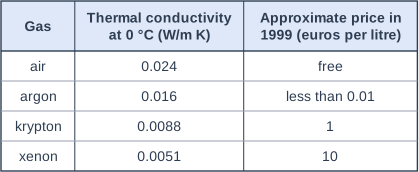
The gap between the two panes of glass in a double-glazed window can be filled with air or with a noble gas. The gas must not react with the glass or with the seals around the edge of the window. The lower the thermal conductivity of the gas, the less heat is lost through the window.

The table shows data-book values of thermal conductivity for the gases and their prices. The prices are approximate prices for small amounts of each gas bought in Europe in 1999.

Explain why argon is suitable for filling the gap, and suggest why most manufacturers use argon rather than krypton or xenon.

Table with columns "Gas", "Thermal conductivity at 0 °C (W/m K)", "Approximate price in 1999 (euros per litre)". Gas: air; Thermal conductivity at 0 °C (W/m K): 0.024; Approximate price in 1999 (euros per litre): free | Gas: argon; Thermal conductivity at 0 °C (W/m K): 0.016; Approximate price in 1999 (euros per litre): less than 0.01 | Gas: krypton; Thermal conductivity at 0 °C (W/m K): 0.0088; Approximate price in 1999 (euros per litre): 1 | Gas: xenon; Thermal conductivity at 0 °C (W/m K): 0.0051; Approximate price in 1999 (euros per litre): 10.

Model answer

Argon is a noble gas, so it is unreactive and will not react with the glass or the seals. Its thermal conductivity (0.016 W/m K) is lower than that of air (0.024 W/m K), so a window filled with argon loses less heat than one filled with air.

Krypton and xenon have even lower thermal conductivities, so they would reduce heat loss more, but they cost far more: about 1 euro and 10 euros per litre, compared with less than 0.01 euros per litre for argon (more than 100 and 1000 times as much). Argon gives a useful improvement at a much lower cost.

Explanation

Choosing a noble gas for a use means checking two things: the noble gases are unreactive, and the data show which one does the job best for a sensible cost. The best answers quote values from the table. Do not say that krypton or xenon would react with the glass or the seals: none of these gases does.

Mark scheme
  1. 1 mark

    argon is unreactive / is a noble gas, so it does not react with the glass or the seals

    Max 2 if no data from the table are used. ALLOW argon does not react with anything / is inert.

  2. 1 mark

    argon has a lower thermal conductivity than air (0.016 compared with 0.024 W/m K), so less heat is lost than with air

    ALLOW argon is a better insulator than air. The comparison with air is needed.

  3. 1 mark

    krypton and xenon cost much more than argon (about 1 and 10 euros per litre, compared with less than 0.01 euros per litre for argon), even though they would reduce heat loss more

    The idea that krypton and xenon are much more expensive is needed for this mark. ALLOW krypton costs more than 100 times as much as argon and xenon more than 1000 times as much. ALLOW krypton and xenon are much rarer in air, so they are much more expensive. IGNORE krypton and xenon are more reactive (none of the three gases reacts with the glass or the seals).

Question 4

4 marks

Some nuclear reactors use liquid sodium metal to carry heat away from the reactor core. The sodium is pumped round sealed pipes at temperatures between about 400 °C and 550 °C. The heat from the sodium is then used to boil water in a separate part of the power station.

Melting point of sodium: 98 °C
Boiling point of sodium: 883 °C

Explain why sodium is suitable for carrying the heat, and why the pipes must keep the sodium completely separate from water and from air.

Model answer

Sodium melts at 98 °C and boils at 883 °C, so it stays a liquid over the whole range of 400-550 °C and can be pumped round the pipes. It is a metal, so it is a good conductor of heat and carries heat away from the core well.

However, sodium reacts violently with water to form sodium hydroxide and hydrogen, which is flammable and could explode. Hot sodium also reacts with oxygen and would burn in air. So the sodium must never come into contact with the water or the air.

Explanation

The physical properties of sodium (a metal with a low melting point and a high boiling point) make it a good liquid coolant, while its chemical properties (reacting with water and with oxygen) make it hazardous. Two marks need data or properties for suitability, and two need the reactions with water and with air: 'sodium is reactive' alone is too vague.

Mark scheme
  1. 1 mark

    sodium is a liquid at 400-550 °C, because this is above its melting point (98 °C) and below its boiling point (883 °C), so it can be pumped round the pipes

    The data or the idea of staying liquid over the whole range is needed. ALLOW sodium has a low melting point and a high boiling point, so it stays liquid.

  2. 1 mark

    sodium is a metal, so it is a good conductor of heat / transfers heat well

    ALLOW sodium conducts heat (thermal energy) well.

  3. 1 mark

    sodium reacts (violently) with water to produce hydrogen, which is flammable / explosive

    ALLOW 2Na + 2H₂O → 2NaOH + H₂. ALLOW sodium reacts vigorously / explosively with water. IGNORE sodium is reactive, on its own.

  4. 1 mark

    sodium reacts with oxygen in the air / would burn in air (forming sodium oxide)

    ALLOW hot sodium catches fire in air. ALLOW 4Na + O₂ → 2Na₂O.

Ready to try the rest? Every answer you write is marked against the mark scheme, so you can see exactly where the marks are.

Study Helper Hints first, answers after you try

Stuck on this one? Ask for a hint and I’ll point you in the right direction, without giving the answer away. Once you’ve checked your answer, I’ll show you how the marks are awarded.