Level:
Correct: 0
Incorrect: 0
Marks: 0/0
Exam Practice
Course:
Topics:
Avg
score:
–
Topics
done:
0/24

Practical skills: analysing and evaluating results

Practise 15 exam-style questions on Practical skills: analysing and evaluating results for OCR GCSE Combined Science (Chemistry Paper 10). Write your answer as you would in the exam and get it marked in seconds against the mark scheme, point by point, with the Study Helper on hand if you get stuck.

  • 15 questions
  • 1–6 marks each
  • Instant marking
  • No sign-up needed
15 questions, marked as you go

Sample questions with model answers

Here are 4 of the questions in this topic, each with a model answer, an explanation of why it earns the marks and the mark scheme an examiner would use.

Question 1

1 mark

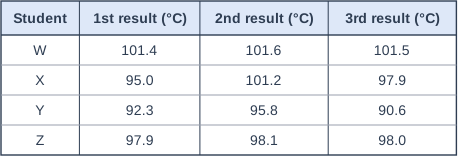
Pure heptane boils at 98 °C. Four students each measure the boiling point of the same sample of pure heptane three times, using distillation apparatus.

The table shows their results.

Whose results are both accurate and precise?

Choose your answer.

  • A W
  • B X
  • C Y
  • D Z
Table with columns "Student", "1st result (°C)", "2nd result (°C)", "3rd result (°C)". Student: W; 1st result (°C): 101.4; 2nd result (°C): 101.6; 3rd result (°C): 101.5 | Student: X; 1st result (°C): 95.0; 2nd result (°C): 101.2; 3rd result (°C): 97.9 | Student: Y; 1st result (°C): 92.3; 2nd result (°C): 95.8; 3rd result (°C): 90.6 | Student: Z; 1st result (°C): 97.9; 2nd result (°C): 98.1; 3rd result (°C): 98.0.

Model answer

D. Z's three results (97.9, 98.1 and 98.0 °C) are close to each other and close to the true boiling point of 98 °C.

Explanation

Accurate results are close to the true value; precise results are close to each other (a small spread). Results can be precise but inaccurate (W, probably a faulty thermometer), or have an accurate mean but poor precision (X). Students often treat accuracy and precision as the same thing.

Mark scheme
  1. 1 mark

    D / Z

    The only correct answer is D: Z's results are all close to the true value of 98 °C (accurate) and close to each other (precise, a spread of only 0.2 °C). A is not correct because W's results are precise (101.4 to 101.6 °C) but all about 3.5 °C above the true value, so they are not accurate (this suggests a systematic error); B is not correct because X's mean (98.0 °C) is close to the true value but the results are spread over 6.2 °C, so they are not precise; C is not correct because Y's results are neither close to 98 °C nor close to each other. ALLOW the letter or the option. If more than one option is given, do not award the mark.
Question 2

2 marks

A student adds 1.0 g of magnesium oxide powder to 25 cm³ of dilute hydrochloric acid in a polystyrene cup.

MgO(s) + 2HCl(aq) → MgCl₂(aq) + H₂O(l)

She records the starting temperature as 19.5 °C and the highest temperature as 31.0 °C.

Later she finds that her thermometer reads 1.5 °C higher than the true temperature at every temperature.

Explain how this error affects her recorded temperatures and the temperature change she calculates.

Model answer

Both recorded temperatures are 1.5 °C too high: the true temperatures were 18.0 °C and 29.5 °C. This is a systematic error because it shifts every reading by the same amount. The temperature change is the difference between the two readings, so the error cancels: 31.0 − 19.5 = 29.5 − 18.0 = 11.5 °C, and the temperature change is still correct.

Explanation

A systematic error shifts every reading by the same amount in the same direction, so it makes each value inaccurate. When the result is a difference between two readings taken with the same instrument, a constant offset cancels. Repeating readings and taking a mean does not remove a systematic error, but it does not affect a difference like this one.

Mark scheme
  1. 1 mark

    both recorded temperatures (19.5 °C and 31.0 °C) are 1.5 °C too high / are inaccurate; this is a systematic (zero) error

    ALLOW 'the true temperatures were 18.0 °C and 29.5 °C'. ALLOW 'every reading is too high by the same amount'.

  2. 1 mark

    the temperature change is a difference (31.0 − 19.5), so the error cancels out and the temperature change (11.5 °C) is still correct / accurate

    DO NOT ALLOW 'the temperature change is 1.5 °C too high' or '3.0 °C too high'. ALLOW 'the temperature change is not affected'.

Question 3

3 marks

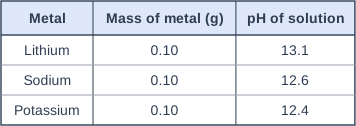
A teacher adds 0.10 g of lithium, 0.10 g of sodium and 0.10 g of potassium to separate 100 cm³ samples of water. When each reaction has finished, a student measures the pH of the solution with a pH meter.

The table shows the results.

Relative atomic mass (Ar): Li = 6.9   Na = 23.0   K = 39.1

The student's hypothesis was: 'The more reactive the metal, the higher the pH of the solution it forms.'

Explain why the results do not support the hypothesis, and why this experiment cannot be used to compare the reactivity of the three metals. Use the relative atomic masses in your answer.

Table with columns "Metal", "Mass of metal (g)", "pH of solution". Metal: Lithium; Mass of metal (g): 0.10; pH of solution: 13.1 | Metal: Sodium; Mass of metal (g): 0.10; pH of solution: 12.6 | Metal: Potassium; Mass of metal (g): 0.10; pH of solution: 12.4.

Model answer

Reactivity increases down Group 1, so potassium is the most reactive, but it gives the lowest pH (12.4) and lithium gives the highest (13.1), so the results do not support the hypothesis.
The metals were used in equal masses, not equal amounts. 0.10 g of lithium is 0.10 ÷ 6.9 = 0.014 mol, but 0.10 g of sodium is only 0.0043 mol and 0.10 g of potassium is only 0.0026 mol.
Each mole of metal makes one mole of hydroxide ions, so the lithium solution contains the most OH⁻ ions in the same 100 cm³ and has the highest pH. The pH measures the concentration of hydroxide ions, not how reactive the metal is, so the experiment cannot compare reactivity.

Explanation

Before using results to test a hypothesis, check that the experiment measures what the hypothesis is about. Here the pH depends on the amount of hydroxide formed, which depends on the number of moles of metal (mass ÷ Ar), and lithium has by far the smallest Ar. Reactivity is shown by how fast or how vigorously a metal reacts, so a valid test would compare rates using equal amounts in moles.

Mark scheme
  1. 1 mark

    reactivity increases from lithium to sodium to potassium, but the pH decreases (from 13.1 to 12.4), so the results do not support the hypothesis

    Max 3. Max 2 if the relative atomic masses (or amounts in moles) are not used. ORA (allow the reverse argument). ALLOW 'potassium is the most reactive but gives the lowest pH'.

  2. 1 mark

    equal masses contain different amounts (numbers of moles / atoms) of each metal: lithium 0.10 ÷ 6.9 = 0.014 mol, sodium 0.0043 mol, potassium 0.0026 mol / lithium has the smallest Ar, so 0.10 g of lithium contains the most atoms

    ALLOW 0.0145 / 0.00435 / 0.00256 mol. ALLOW a correct comparison without the numbers, for example 'there are about five times as many lithium atoms as potassium atoms in 0.10 g', if the Ar values are used.

  3. 1 mark

    so lithium makes the most hydroxide ions (OH⁻) in the same volume (100 cm³), giving the highest concentration of hydroxide ions and the highest pH; the pH depends on the concentration of hydroxide ions, not on how reactive the metal is

    ALLOW 'more alkali / more lithium hydroxide in the same volume, so more concentrated'. IGNORE 'lithium hydroxide is a stronger alkali' (all three hydroxides are strong alkalis).

  4. 1 mark

    a fair comparison of reactivity would use equal amounts (moles) of each metal / reactivity should be compared by how fast the metals react (for example the time to react or the rate of gas production), not by the final pH

    Creditworthy alternative point (max 3 in total).

Question 4

5 marks

A student copper-plates a graphite rod by electrolysis of copper(II) sulfate solution, using the rod as the cathode. She passes a constant current for 25 minutes.

Mass of the dry graphite rod before electrolysis = 12.465 g
Mass of the dry graphite rod after electrolysis = 12.719 g

Relative atomic mass (Ar): Cu = 63.5
The Avogadro constant is 6.02 × 10²³.

Calculate the mean number of copper atoms deposited on the rod each second.

Give your answer in standard form to 2 significant figures.

Model answer

Mass of copper deposited = 12.719 − 12.465 = 0.254 g
Moles of copper = 0.254 ÷ 63.5 = 0.00400 mol
Number of atoms = 0.00400 × 6.02 × 10²³ = 2.408 × 10²¹
Time = 25 × 60 = 1500 s
Atoms per second = 2.408 × 10²¹ ÷ 1500 = 1.605 × 10¹⁸
= 1.6 × 10¹⁸ atoms per second (2 s.f.)

Explanation

Work step by step: mass gained, then moles (mass ÷ Ar), then number of atoms (moles × Avogadro constant), then divide by the time in seconds. The most common errors are leaving the time in minutes and giving the answer to too many significant figures. Check the answer makes sense: even a small mass of copper contains an enormous number of atoms.

Mark scheme
  1. 1 mark

    mass of copper = 12.719 − 12.465 = 0.254 (g); or a correct final answer of 1.6 × 10¹⁸ with no working

    An answer of 1.6 × 10¹⁸ with no working scores 5 marks. ALLOW 1.605 × 10¹⁸ or 1.61 × 10¹⁸ for 4 marks (not to 2 significant figures). ALLOW 4 marks for 9.6 × 10¹⁹ (time used in minutes, so atoms per minute). ALLOW ECF throughout. ALLOW typed forms such as 1.6E18 or '1.6 times 10 to the power 18'.

  2. 1 mark

    moles of copper = 0.254 ÷ 63.5 = 0.00400 (mol); or a correct final answer of 1.6 × 10¹⁸ with no working

    ALLOW 4.00 × 10⁻³ mol.

  3. 1 mark

    number of atoms = 0.00400 × 6.02 × 10²³ = 2.408 × 10²¹; or a correct final answer of 1.6 × 10¹⁸ with no working

    ALLOW 2.41 × 10²¹ / 2.4 × 10²¹.

  4. 1 mark

    time = 25 × 60 = 1500 s and atoms per second = 2.408 × 10²¹ ÷ 1500 = 1.605 × 10¹⁸; or a correct final answer of 1.6 × 10¹⁸ with no working

    Both the conversion to seconds and the division are needed for this mark. ALLOW 1.61 × 10¹⁸.

  5. 1 mark

    1.6 × 10¹⁸ (standard form, 2 significant figures)

    ALLOW ECF for this mark from a valid calculation correctly given in standard form to 2 significant figures (for example 9.6 × 10¹⁹ from using minutes).

Ready to try the rest? Every answer you write is marked against the mark scheme, so you can see exactly where the marks are.

Study Helper Hints first, answers after you try

Stuck on this one? Ask for a hint and I’ll point you in the right direction, without giving the answer away. Once you’ve checked your answer, I’ll show you how the marks are awarded.