Question 1
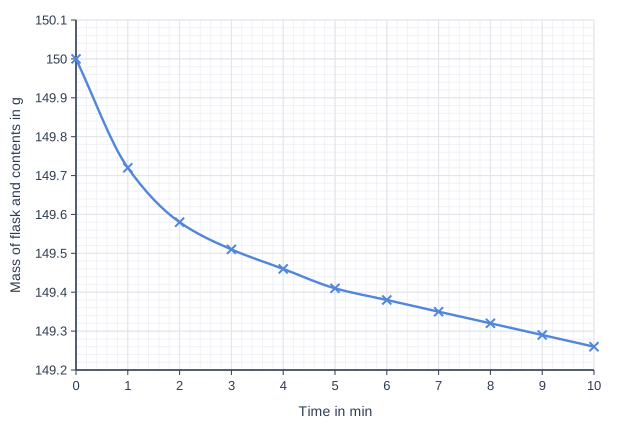
1 markA student adds limestone chips to an excess of dilute hydrochloric acid in an open flask on a balance. She records the mass of the flask and its contents every 30 seconds until the reaction stops.
Which statement describes the gradient of a graph of the mass of the flask and its contents against time?
Choose your answer.
- A It is positive and gets less steep, then becomes zero.
- B It is negative and gets less steep, then becomes zero.
- C It is negative and gets steeper, then becomes zero.
- D It is zero at first, then becomes negative.
Model answer
B. The mass goes down, so the gradient is negative. The reaction is fastest at the start and slows down, so the graph gets less steep, and when the reaction stops the line is horizontal (gradient zero).
Explanation
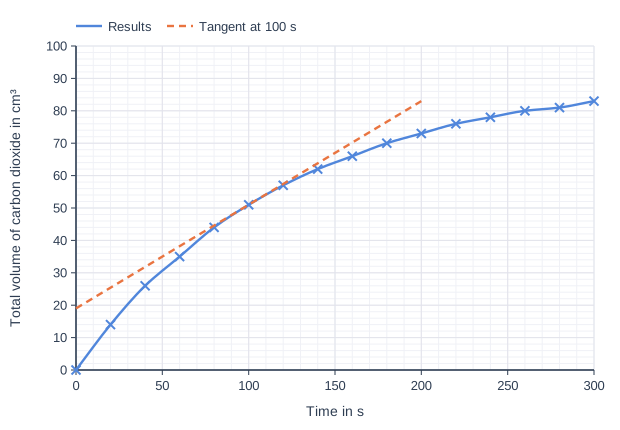
The gradient of a graph of amount against time gives the rate. When the quantity plotted is the mass of the flask, it falls as gas escapes, so the gradient is negative and its size gives the rate. Choosing A comes from thinking of a graph of the mass of carbon dioxide made, which rises.
Mark scheme
-
1 mark
B / it is negative and gets less steep, then becomes zero
The only correct answer is B: the mass falls as carbon dioxide escapes, so the gradient is negative; the rate is greatest at the start and decreases, so the graph gets less steep, and the gradient is zero when the reaction stops. A is not correct because the mass decreases, so the gradient cannot be positive (a graph of mass of carbon dioxide given off would have a positive gradient); C is not correct because the reaction slows down, so the graph becomes less steep, not steeper; D is not correct because the reaction is fastest at the start, so the gradient is not zero at first. ALLOW the letter or the option. If more than one option is given, do not award the mark.