
Level:
Correct: 0
Incorrect: 0
Marks: 0/0
Exam Practice
Course:
Topics:
Avg
score:
–
Topics
done:
0/24

Atmospheric pollutants

Practise 14 exam-style questions on Atmospheric pollutants for OCR GCSE Combined Science (Chemistry Paper 10). Write your answer as you would in the exam and get it marked in seconds against the mark scheme, point by point, with the Study Helper on hand if you get stuck.

  • 14 questions
  • 1–5 marks each
  • Instant marking
  • No sign-up needed
14 questions, marked as you go

Sample questions with model answers

Here are 4 of the questions in this topic, each with a model answer, an explanation of why it earns the marks and the mark scheme an examiner would use.

Question 1

1 mark

A factory heats its buildings with a boiler that burns heavy fuel oil. The waste gases from the boiler contain sulfur dioxide.

Which change would reduce the mass of sulfur dioxide released by the boiler?

Choose your answer.

  • A burning a fuel oil that contains less sulfur
  • B burning the fuel oil at a higher temperature
  • C fitting a catalytic converter to the chimney
  • D supplying more air to the burning fuel oil

Model answer

A: burning a fuel oil that contains less sulfur.

Explanation

Sulfur dioxide comes from sulfur impurities in the fuel: hydrocarbons themselves contain no sulfur. Changing how the fuel burns (temperature or air supply) changes the carbon monoxide, soot and oxides of nitrogen, but every sulfur atom in the fuel still ends up as sulfur dioxide. So the sulfur must be removed from the fuel before it is burned, or the sulfur dioxide removed from the waste gases afterwards.

Mark scheme
  1. 1 mark

    A / burning a fuel oil that contains less sulfur

    The only correct answer is A: the sulfur dioxide forms when sulfur impurities in the fuel oil react with oxygen as it burns, so less sulfur in the fuel means less sulfur dioxide. B is not correct because a higher temperature does not change the amount of sulfur in the fuel, and it increases the oxides of nitrogen formed; C is not correct because a catalytic converter changes carbon monoxide and oxides of nitrogen into carbon dioxide and nitrogen, and does not remove sulfur dioxide; D is not correct because more air makes the combustion more complete (less carbon monoxide and soot), but all the sulfur still forms sulfur dioxide. ALLOW the letter or the option. If more than one option is given, do not award the mark.
Question 2

2 marks

Particulates are tiny solid particles in the air. Scientists group them by size:
• PM10 particles are smaller than 10 μm (0.010 mm) across
• PM2.5 particles are smaller than 2.5 μm (0.0025 mm) across.

Doctors think that PM2.5 particles are more harmful to health than larger particulates.

Suggest why.

Model answer

Larger particles are mostly trapped in the nose, throat and larger airways, but PM2.5 particles are small enough to be breathed deep into the lungs, right down to the alveoli. Some are small enough to pass into the blood, so they can reach the heart and other organs and cause disease there.

Explanation

The smaller a particle, the further it gets into the body: the airways filter out larger particles, but PM2.5 reaches the gas exchange surfaces and can even enter the bloodstream. Small particles also stay in the air for longer. A good answer explains what the smaller size allows the particles to do, rather than just saying they are smaller.

Mark scheme
  1. 2 marks

    1 mark for each, max 2: smaller particles are breathed deeper into the lungs (into the smallest airways / alveoli) / they are not trapped by the nose, throat or larger airways / they can pass from the lungs into the blood (and so reach the heart and other organs) / they stay in the air for longer before settling, so more are breathed in

    ALLOW larger particles are trapped (by hairs or mucus) in the nose or airways, ORA (allow the reverse argument). ALLOW cause more damage to lung tissue / heart disease if linked to reaching deeper or entering the blood. IGNORE 'they are smaller' with no consequence. IGNORE they are harder to see. Max 1 if the two points are the same idea.

Question 3

3 marks

Sulfur dioxide and nitrogen dioxide both react with oxygen and water in clouds to form acids, which fall as acid rain.

Nitrogen dioxide, NO₂, reacts with oxygen, O₂, and water, H₂O. The only product is nitric acid, HNO₃.

Write the balanced symbol equation for this reaction.

Describe one problem caused when acid rain falls on the environment.

Model answer

4NO₂ + O₂ + 2H₂O → 4HNO₃

Acid rain makes lakes and rivers acidic, so fish and other living things in them can die. It also damages trees and wears away limestone buildings.

Explanation

Start by balancing the nitrogen and hydrogen: four HNO₃ need four NO₂ and two H₂O. The oxygen atoms then give 8 + 2 = 10 on the left from NO₂ and H₂O, but 12 are needed on the right, so one O₂ is added. Check: 4 N, 4 H and 12 O on each side. Never change a formula to make an equation balance. For the problem, name what is damaged: answers such as 'it harms the environment' are too vague.

Mark scheme
  1. 1 mark

    correct formulae: NO₂ + O₂ + H₂O → HNO₃

    The reactants may be in any order. ALLOW typed forms, for example NO2 + O2 + H2O -> HNO3. IGNORE state symbols.

  2. 1 mark

    balanced: 4NO₂ + O₂ + 2H₂O → 4HNO₃

    ALLOW correct multiples, for example 8NO₂ + 2O₂ + 4H₂O → 8HNO₃. ALLOW 2NO₂ + ½O₂ + H₂O → 2HNO₃. DO NOT ALLOW changed formulae (for example NO₃ or H₂NO₃).

  3. 1 mark

    a problem caused by acid rain: it damages or kills trees / makes lakes and rivers acidic, so fish and other living things die / wears away (reacts with) limestone or marble buildings and statues / corrodes metals such as iron or steel

    A specific problem is needed. IGNORE pollution / bad for the environment / damages buildings with no material named. DO NOT ALLOW global warming / damage to the ozone layer.

Question 4

4 marks

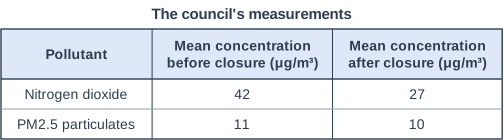
A council closed the road outside a primary school to traffic at the start and end of each school day. The table shows the mean concentrations of two pollutants measured outside the school in the term before and the term after the road was closed.

Calculate the percentage decrease in the concentration of nitrogen dioxide.

Explain why the concentration of nitrogen dioxide fell by a much larger percentage than the concentration of PM2.5 particulates.

The council's measurements. Table with columns "Pollutant", "Mean concentration before closure (μg/m³)", "Mean concentration after closure (μg/m³)". Pollutant: Nitrogen dioxide; Mean concentration before closure (μg/m³): 42; Mean concentration after closure (μg/m³): 27 | Pollutant: PM2.5 particulates; Mean concentration before closure (μg/m³): 11; Mean concentration after closure (μg/m³): 10.

Model answer

Decrease = 42 − 27 = 15 μg/m³
Percentage decrease = 15 ÷ 42 × 100 = 35.7% (about 36%)

Nitrogen dioxide outside the school comes mainly from the vehicles on the road, because it forms when nitrogen and oxygen react at the high temperature in their engines. Closing the road removed most of this source, so the concentration fell a lot. PM2.5 particulates come from many other sources, such as wood-burning stoves, industry and traffic on other roads, and they are so small that they stay in the air for a long time and drift in from far away. So closing one road made little difference to them (only about 9%).

Explanation

For a percentage decrease, divide the decrease by the original (before) value, not by the new value. The explanation depends on where each pollutant comes from: nitrogen dioxide near a road is mostly local traffic, while fine particulates are a mixture from many local and distant sources. This is why traffic schemes improve nitrogen dioxide much more than PM2.5.

Mark scheme
  1. 1 mark

    decrease = 42 − 27 = 15 (μg/m³) and 15 ÷ 42 × 100; or a correct final answer of 36% with no working

    An answer of 36% (35.7%) with no working scores marking points 1 and 2. ALLOW 1 mark for 55.6% (decrease divided by the after value, 15 ÷ 27 × 100). ALLOW 1 mark for 64% (27 ÷ 42 × 100, the percentage remaining).

  2. 1 mark

    evaluation: 35.7 / 36 (%)

    ALLOW 35.71 / 35.7 / 36 / 35.714. IGNORE a minus sign.

  3. 1 mark

    nitrogen dioxide comes mainly from vehicle engines (where nitrogen and oxygen react at high temperature), so with fewer vehicles on the road much less is released near the school

    ALLOW the traffic on this road was the main source of the nitrogen dioxide outside the school.

  4. 1 mark

    fine particulates come from many other sources (for example wood-burning stoves, industry, other roads, natural sources) / are so small that they stay in the air and are carried from far away, so closing one road has little effect

    Fine particulates means the PM2.5 particulates. ALLOW particulates also come from brake and tyre wear on other roads. IGNORE particulates are heavier.

Ready to try the rest? Every answer you write is marked against the mark scheme, so you can see exactly where the marks are.

Study Helper Hints first, answers after you try

Stuck on this one? Ask for a hint and I’ll point you in the right direction, without giving the answer away. Once you’ve checked your answer, I’ll show you how the marks are awarded.