
Level:
Correct: 0
Incorrect: 0
Marks: 0/0
Exam Practice
Course:
Topics:
Avg
score:
–
Topics
done:
0/25

Relative acidity, alkalinity and pH

Practise 11 exam-style questions on Relative acidity, alkalinity and pH for OCR GCSE Chemistry (Paper 1). Write your answer as you would in the exam and get it marked in seconds against the mark scheme, point by point, with the Study Helper on hand if you get stuck.

  • 11 questions
  • 1–4 marks each
  • Instant marking
  • No sign-up needed
11 questions, marked as you go

Sample questions with model answers

Here are 4 of the questions in this topic, each with a model answer, an explanation of why it earns the marks and the mark scheme an examiner would use.

Question 1

1 mark

A student adds a few drops of universal indicator to four colourless solutions, P, Q, R and S. These are the colours she sees.

P: green   Q: purple   R: red   S: orange

Which list shows the solutions in order from the most acidic to the most alkaline?

Choose your answer.

  • A Q, P, S, R
  • B R, P, S, Q
  • C R, S, P, Q
  • D S, R, P, Q

Model answer

C - R, S, P, Q

Explanation

Universal indicator changes colour gradually across the pH scale: red for the most acidic solutions (about pH 1-2), then orange and yellow for less acidic ones, green for neutral (pH 7), then blue, and purple for the most alkaline (about pH 11-14). Reading the colours in that order gives R, S, P, Q. Option A lists the same solutions, but from most alkaline to most acidic.

Mark scheme
  1. 1 mark

    C / R, S, P, Q

    The only correct answer is C: universal indicator is red in the most acidic solutions (lowest pH), orange in less acidic solutions, green in neutral solutions (pH 7) and purple in the most alkaline solutions (highest pH), so the order is R (red), S (orange), P (green), Q (purple). A is not correct because it is the reverse order, from most alkaline to most acidic; B is not correct because P (green) is neutral, so it is less acidic than S (orange); D is not correct because S (orange) is less acidic than R (red). ALLOW the letter or the option. If more than one option is given, do not award the mark.
Question 2

2 marks

Oven cleaner has a pH of 13.5.

A student says:

'Oven cleaner is not an acid, so it is safe to get it on your skin.'

Use the pH of the oven cleaner to explain why the student is wrong.

Model answer

A pH of 13.5 is far above 7, so the oven cleaner is very alkaline. Substances with a very high pH are corrosive and can burn the skin, just as acids with a very low pH can, so it is not safe to get it on your skin.

Explanation

pH measures how acidic or alkaline a solution is: 7 is neutral, below 7 is acidic and above 7 is alkaline. Some people think that only acids are dangerous, but solutions with a pH far from 7 at either end of the scale can damage skin. Oven cleaner, at pH 13.5, is very alkaline and corrosive.

Mark scheme
  1. 1 mark

    a pH of 13.5 means the oven cleaner is (very) alkaline / its pH is far above 7

    Mark the two points independently. ALLOW it is an alkali with a high pH. IGNORE just 'it is not neutral'. DO NOT ALLOW it is acidic / it is slightly alkaline.

  2. 1 mark

    (very) alkaline substances can be just as harmful as acids / can burn or damage skin / are corrosive

    ALLOW alkalis can be as dangerous as acids. ALLOW the further the pH is from 7, the more harmful it can be (at both ends of the scale). IGNORE references to wearing gloves or eye protection on their own.

Question 3

2 marks

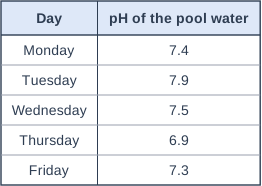
The manager of a swimming pool aims to keep the pH of the water between 7.2 and 7.6. Each morning she measures the pH with a pH meter.

The table shows her readings for one week.

On which day was the water too acidic, and on which day was it too alkaline?

Table with columns "Day", "pH of the pool water". Day: Monday; pH of the pool water: 7.4 | Day: Tuesday; pH of the pool water: 7.9 | Day: Wednesday; pH of the pool water: 7.5 | Day: Thursday; pH of the pool water: 6.9 | Day: Friday; pH of the pool water: 7.3.

Model answer

The water was too acidic on Thursday (pH 6.9, below 7.2). It was too alkaline on Tuesday (pH 7.9, above 7.6).

Explanation

A pH below the target range means the water is more acidic than the manager wants; a pH above the range means it is more alkaline. On Thursday the pH was 6.9, which is below 7, so the water was slightly acidic. On Tuesday the pH was 7.9, which is above 7.6. The other days were all inside the range.

Mark scheme
  1. 1 mark

    too acidic: Thursday

    Mark the two points independently. ALLOW Thursday, pH 6.9 (below 7.2 / below 7). If more than one day is given for 'too acidic', do not award this mark.

  2. 1 mark

    too alkaline: Tuesday

    ALLOW Tuesday, pH 7.9 (above 7.6). If more than one day is given for 'too alkaline', do not award this mark. If the two days are the wrong way round, award 0 marks.

Question 4

3 marks

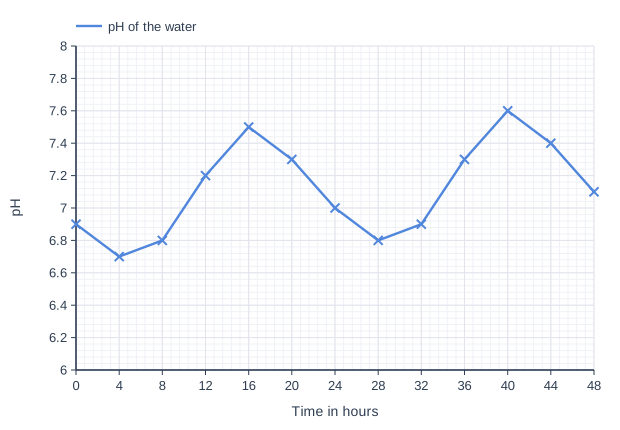
A pH probe connected to a data logger records the pH of the water in a fish tank every 4 hours for 48 hours. The graph shows the results.

Describe how the pH of the water changes over the 48 hours. Use data from the graph, and say when the water is acidic and when it is alkaline.

Line graph of pH (y-axis, 6 to 8) against time in hours (x-axis, 0 to 48). "pH of the water" joins the points (0, 6.9), (4, 6.7), (8, 6.8), (12, 7.2), (16, 7.5), (20, 7.3), (24, 7), (28, 6.8), (32, 6.9), (36, 7.3), (40, 7.6), (44, 7.4), (48, 7.1).

Model answer

The pH goes up and down in a repeating pattern, about once every 24 hours. It falls to its lowest values, pH 6.7 at 4 hours and 6.8 at 28 hours, and rises to its highest values, pH 7.5 at 16 hours and 7.6 at 40 hours. When the pH is below 7, for example from 0 to about 10 hours, the water is slightly acidic; when the pH is above 7, for example at 16 hours and 40 hours, it is slightly alkaline. At 24 hours the pH is 7.0, so the water is neutral.

Explanation

To describe a pattern, say what happens (the pH rises and falls in a daily cycle) and quote values with their times. Then use the pH scale: below 7 is acidic, 7 is neutral and above 7 is alkaline. Here the water swings between slightly acidic and slightly alkaline; the values stay close to 7, so it is never very acidic or very alkaline.

Mark scheme
  1. 1 mark

    the pH rises and falls / goes up and down in a repeating pattern (about once every 24 hours)

    1 mark for each of points 1 to 3. ALLOW the pH increases to a peak and then decreases, twice. IGNORE just 'the pH changes'.

  2. 1 mark

    correct use of data from the graph, for example: the highest pH is 7.6 (at 40 hours) / the lowest pH is 6.7 (at 4 hours)

    ALLOW any pH value correctly read from the graph with its time (to within 0.1). ALLOW the highest values are at 16 and 40 hours and the lowest at 4 and 28 hours.

  3. 1 mark

    the water is (slightly) acidic when the pH is below 7 (for example at 4 hours or 28 hours) and (slightly) alkaline when the pH is above 7 (for example at 16 hours or 40 hours)

    Both acidic and alkaline must be correctly linked to the pH (below 7 / above 7) or to correct times. ALLOW it is neutral at 24 hours (pH 7.0) as extra detail. DO NOT ALLOW the water is acidic when the pH is high.

Ready to try the rest? Every answer you write is marked against the mark scheme, so you can see exactly where the marks are.

Study Helper Hints first, answers after you try

Stuck on this one? Ask for a hint and I’ll point you in the right direction, without giving the answer away. Once you’ve checked your answer, I’ll show you how the marks are awarded.