
Level:
Correct: 0
Incorrect: 0
Marks: 0/0
Exam Practice
Course:
Topics:
Avg
score:
–
Topics
done:
0/25

Practical skills (chemistry PAGs C1-C8)

Practise 22 exam-style questions on Practical skills (chemistry PAGs C1-C8) for OCR GCSE Chemistry (Paper 1). Write your answer as you would in the exam and get it marked in seconds against the mark scheme, point by point, with the Study Helper on hand if you get stuck.

  • 22 questions
  • 1–6 marks each
  • Instant marking
  • No sign-up needed
20 questions, marked as you go

Sample questions with model answers

Here are 4 of the questions in this topic, each with a model answer, an explanation of why it earns the marks and the mark scheme an examiner would use.

Question 1

1 mark

A student needs to warm some ethanol to about 60 °C to dissolve some crystals. Ethanol is highly flammable. It boils at 78 °C.

Which is the safest way to heat the ethanol?

Choose your answer.

  • A a Bunsen burner and gauze
  • B a Bunsen burner flame
  • C an electric water bath
  • D an oil bath heated by a Bunsen burner

Model answer

C

Explanation

Flammable liquids must be kept away from naked flames, so an electrically heated water bath is used. It also heats gently and evenly, and its temperature can be set below the boiling point of the ethanol.

Mark scheme
  1. 1 mark

    C / an electric water bath

    The only correct answer is C: an electric water bath has no flame, so the ethanol vapour cannot catch fire, and the water cannot get hotter than 100 °C, so the ethanol is warmed gently. A is not correct because there is still a naked flame near the flammable ethanol; B is not correct because heating ethanol directly in a flame is the most likely way to set it on fire; D is not correct because the Bunsen burner flame is still near the ethanol, and the hot oil could also catch fire. ALLOW the letter or the option. If more than one option is given, do not award the mark.
Question 2

2 marks

A student compares two brands of sea salt, A and B. She dissolves 10 g samples of salt in water, filters off the insoluble impurities, dries them and weighs them. She tests three samples of each brand.

Mass of insoluble impurities in 10 g of salt:
Brand A: 0.12 g, 0.18 g, 0.15 g (mean 0.15 g)
Brand B: 0.14 g, 0.20 g, 0.17 g (mean 0.17 g)

She concludes that brand B contains more insoluble impurities than brand A.

Explain why her results are not good enough to support this conclusion.

Model answer

The ranges of her results overlap: brand A ranges from 0.12 g to 0.18 g and brand B from 0.14 g to 0.20 g, so one sample of A (0.18 g) has more impurity than one sample of B (0.14 g). The difference between the means, 0.02 g, is smaller than the spread of the results, so it could just be caused by random variation between samples and may not be a real difference.

Explanation

Before deciding that two means are different, compare the difference with the spread (range) of each set of results. If the ranges overlap a lot, the difference may be due to random variation, so more samples would be needed to be confident.

Mark scheme
  1. 1 mark

    the ranges of the results overlap (A 0.12 to 0.18 g, B 0.14 to 0.20 g) / the difference between the means (0.02 g) is smaller than the spread of the results

    ALLOW some samples of brand A have more impurities than some samples of brand B (such as 0.18 g compared with 0.14 g). ALLOW the uncertainty in each mean (± 0.03 g) is larger than the difference between the means. IGNORE only three samples, unless linked to the spread or overlap.

  2. 1 mark

    so the difference could be caused by random variation / random errors (and may not be a real difference)

    ALLOW the difference between the brands is not significant / she needs more samples (of each brand) to be sure. ALLOW the samples may not be representative of each brand.

Question 3

2 marks

A student titrates 25.0 cm³ portions of potassium hydroxide solution with dilute sulfuric acid, which she adds from a burette.

She does not write down any burette readings. At the end of each titration she works out the volume of acid added in her head, and writes down only that volume:

Titration 1: 23.20 cm³   Titration 2: 23.15 cm³   Titration 3: 23.65 cm³

Her teacher tells her to write down the burette reading at the start and at the end of every titration.

Explain why she should do this.

Model answer

The volume of acid added is not read straight from the burette: it is worked out by subtracting the start reading from the end reading, so the two readings are the measurements she actually makes. If she writes them down, she or her teacher can check each subtraction later and find any mistake, for example whether titration 3 (23.65 cm³) is higher because she misread the burette or because she subtracted wrongly in her head.

Explanation

Always record the raw data, the readings taken from the apparatus, at the time you take them; values such as the volume added (the titre) are then calculated from them. If only the calculated value is written down, a slip in a reading or in mental arithmetic can never be found or corrected, and no one else can check the results.

Mark scheme
  1. 1 mark

    the volume of acid added is worked out from the two readings (end reading − start reading) / the burette readings are the measurements she actually makes (the raw data), and the volume is calculated from them

    ALLOW the burette does not always start at 0.00 cm³, so the volume added is found by subtracting the start reading from the end reading. ALLOW the readings are the raw data, which should always be recorded. IGNORE so that the results are more accurate / more reliable / a fair test (unqualified).

  2. 1 mark

    with the readings written down, her subtraction can be checked (by her or by someone else) / a mistake in a reading or in her mental arithmetic can be found and corrected

    ALLOW if she writes down only the volume, a mistake made in her head cannot be found. ALLOW she could find out whether titration 3 is different because she misread the burette or because she subtracted wrongly. ALLOW so that her teacher can check her results.

Question 4

4 marks

A student has this hypothesis:

'Dissolving salt in water raises its boiling point. The more salt there is in 100 cm³ of water, the higher the boiling point.'

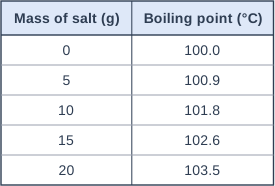
She uses a digital thermometer to measure the boiling point of 100 cm³ of water with different masses of salt dissolved in it. The table shows her results.

Do the results support the hypothesis? Use data from the table in your answer.

Suggest one further investigation the student could do to extend her work.

Table with columns "Mass of salt (g)", "Boiling point (°C)". Mass of salt (g): 0; Boiling point (°C): 100.0 | Mass of salt (g): 5; Boiling point (°C): 100.9 | Mass of salt (g): 10; Boiling point (°C): 101.8 | Mass of salt (g): 15; Boiling point (°C): 102.6 | Mass of salt (g): 20; Boiling point (°C): 103.5.

Model answer

Yes, the results support the hypothesis. With no salt the water boils at 100.0 °C, but with salt dissolved the boiling point is higher, and the more salt there is, the higher the boiling point: it rises from 100.9 °C with 5 g to 103.5 °C with 20 g, about 0.9 °C for every 5 g of salt.
A further investigation: test other substances, such as sugar, to see whether they also raise the boiling point of water.

Explanation

To decide whether results support a hypothesis, describe the pattern and quote values from the table. Here every increase in the mass of salt gives a higher boiling point, so the hypothesis is supported, though results only support a hypothesis rather than prove it. A further investigation extends the work, for example with other solutes or a wider range of masses; simply repeating the same tests does not.

Mark scheme
  1. 1 mark

    yes, the results support the hypothesis

    ALLOW the hypothesis is correct / the results agree with it. IGNORE the results prove the hypothesis. For the further investigation (points 4 to 6): If more than one answer is given, a wrong one cancels a right one.

  2. 1 mark

    the boiling point increases as the mass of salt increases / dissolving salt raises the boiling point above 100 °C

    ALLOW the more salt, the higher the boiling point. ALLOW ORA (allow the reverse argument).

  3. 1 mark

    correct use of data: 100.0 °C with no salt and 103.5 °C with 20 g / the boiling point rises by about 0.9 °C for every 5 g of salt

    ALLOW any correct pair of values from the table that shows the increase. ALLOW a correct difference, such as a rise of 3.5 °C from 0 g to 20 g. ALLOW the boiling point goes up in steps of 0.8 to 0.9 °C.

  4. 1 mark

    further investigation: use other solutes (other salts or other substances, such as sugar) to see whether they also raise the boiling point

    1 mark for any one of points 4 to 6, max 1. If more than one answer is given, a wrong one cancels a right one. The investigation must extend the work, not just repeat it. IGNORE repeat the experiment / take more readings at the same masses.

  5. 1 mark

    further investigation: use other concentrations of salt: masses above 20 g / more masses between 0 g and 20 g / a different volume of water

    ALLOW find out whether the pattern continues with more salt.

  6. 1 mark

    further investigation: find out whether dissolved salt changes the freezing point (melting point) of water

    ALLOW investigate the effect of salt on the temperature at which ice melts.

Ready to try the rest? Every answer you write is marked against the mark scheme, so you can see exactly where the marks are.

Study Helper Hints first, answers after you try

Stuck on this one? Ask for a hint and I’ll point you in the right direction, without giving the answer away. Once you’ve checked your answer, I’ll show you how the marks are awarded.