
Level:
Correct: 0
Incorrect: 0
Marks: 0/0
Exam Practice
Course:
Topics:
Avg
score:
–
Topics
done:
0/25

Choosing purification and chromatographic methods

Practise 13 exam-style questions on Choosing purification and chromatographic methods for OCR GCSE Chemistry (Paper 1). Write your answer as you would in the exam and get it marked in seconds against the mark scheme, point by point, with the Study Helper on hand if you get stuck.

  • 13 questions
  • 1–4 marks each
  • Instant marking
  • No sign-up needed
13 questions, marked as you go

Sample questions with model answers

Here are 4 of the questions in this topic, each with a model answer, an explanation of why it earns the marks and the mark scheme an examiner would use.

Question 1

1 mark

A scientist wants to check whether a sample of a food dye is a pure substance. She uses paper chromatography and runs the dye in three different solvents.

Which result shows that the food dye is pure?

Choose your answer.

  • A a different number of spots in each solvent
  • B one spot in each solvent
  • C one spot in one solvent and two spots in the others
  • D two spots in every solvent

Model answer

B (one spot in each solvent)

Explanation

A pure substance is made of only one substance, so chromatography can never split it into more than one spot. An impure dye might give only one spot in one solvent if its substances happen to move the same distance in that solvent, so testing in several solvents gives stronger evidence. One spot in every solvent shows the dye is pure.

Mark scheme
  1. 1 mark

    B / one spot in each solvent

    The only correct answer is B: a pure substance contains only one substance, so it can only give one spot, whichever solvent is used. A is not correct because any solvent that gives more than one spot shows that the dye contains more than one substance; C is not correct because two spots in a solvent show at least two substances, which happened to move the same distance in the other solvent; D is not correct because two spots show that the dye contains at least two substances. ALLOW the letter or the option. If more than one option is given, do not award the mark.
Question 2

2 marks

A company makes a yellow dye for colouring fabrics. A scientist uses thin layer chromatography (TLC) to check whether a batch of the dye is pure.

When the plate has dried, she can see only one yellow spot.

Before she decides whether the batch is pure, she sprays the plate with a locating agent.

Explain why she does this.

Model answer

The batch might contain impurities that are colourless. Their spots would be on the plate but could not be seen, so seeing only one yellow spot does not show that the dye is pure.

The locating agent makes colourless substances show up as coloured spots. If more than one spot can then be seen, the batch is impure; if there is still only one spot, this is evidence that the batch is pure.

Explanation

A chromatogram only shows the substances that can be seen. An impurity that is colourless, such as a starting material left over from making the dye, gives a spot that stays invisible until a locating agent is used. A pure substance gives only one spot, so the scientist must make every spot visible before she counts them.

Mark scheme
  1. 1 mark

    the batch might contain impurities that are colourless, so their spots cannot be seen (on the dried plate)

    ALLOW a substance in the batch could be colourless / invisible. The idea that some substances may not be seen without the locating agent is needed: IGNORE 'to see the spots' or 'to make the spot clearer' on its own. DO NOT ALLOW 'the yellow dye is colourless' (CON).

  2. 1 mark

    the locating agent makes any colourless substances show up as (coloured) spots, so if there is more than one spot the batch is impure / if there is still only one spot the batch is (likely to be) pure

    The answer must link the spots seen after spraying to whether the batch is pure. ALLOW 'it shows whether there are any other substances (impurities) in the batch'. ALLOW ORA (allow the reverse argument).

Question 3

2 marks

A student has made an impure white solid, Y. She wants to purify Y by crystallisation.

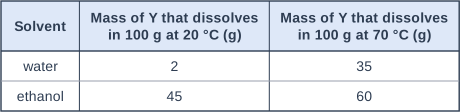
She can dissolve Y in water or in ethanol. The table shows how much Y dissolves in each solvent when cold and when hot.

Explain which solvent the student should use.

Table with columns "Solvent", "Mass of Y that dissolves in 100 g at 20 °C (g)", "Mass of Y that dissolves in 100 g at 70 °C (g)". Solvent: water; Mass of Y that dissolves in 100 g at 20 °C (g): 2; Mass of Y that dissolves in 100 g at 70 °C (g): 35 | Solvent: ethanol; Mass of Y that dissolves in 100 g at 20 °C (g): 45; Mass of Y that dissolves in 100 g at 70 °C (g): 60.

Model answer

She should use water. Y is very soluble in hot water (35 g per 100 g) but only slightly soluble in cold water (2 g per 100 g), so when the hot solution cools, most of the Y comes out as crystals. In ethanol, 45 g of Y stays dissolved in every 100 g of cold ethanol, so most of the Y would stay in the solution and she would get few crystals.

Explanation

Crystallisation works best with a solvent that dissolves a lot of the substance when hot but very little when cold, so that most of it crystallises as the solution cools. The best solvent is not the one that dissolves the most: ethanol dissolves more Y, but most of it stays dissolved when cold (only 15 g per 100 g would crystallise, compared with 33 g per 100 g in water).

Mark scheme
  1. 1 mark

    water, because Y is much more soluble in hot water than in cold water (35 g compared with 2 g), so most of the Y forms crystals when the hot solution cools

    'Water' with no reason scores 0. ALLOW the solubility of Y in water changes a lot with temperature.

  2. 1 mark

    in ethanol, Y is very soluble even when cold (45 g per 100 g), so a lot of the Y would stay dissolved and few crystals would form

    ALLOW the solubility of Y in ethanol changes much less with temperature (45 g to 60 g), so less Y would crystallise out (only 15 g, compared with 33 g in water). DO NOT ALLOW 'ethanol, because more Y dissolves' (CON).

Question 4

3 marks

Raw cane sugar is brown because it contains a brown colouring as well as sugar. Both the sugar and the brown colouring dissolve in water.

A student wants to make white sugar crystals from raw cane sugar. She is given this information:
• the brown colouring sticks to the surface of powdered charcoal
• charcoal does not dissolve in water
• sugar breaks down and turns black if it is heated strongly.

Suggest how the student could obtain white sugar crystals from raw cane sugar. Explain each step.

Model answer

First dissolve the raw sugar in warm water and stir in some powdered charcoal. The brown colouring sticks to the charcoal.

Then filter the mixture. The charcoal does not dissolve, so it stays on the filter paper with the colouring stuck to it. The sugar is dissolved, so a colourless sugar solution passes through.

Finally, crystallise the sugar: warm the filtrate gently to evaporate some of the water, then leave it to cool so that white sugar crystals form, and filter them off. The solution must not be heated strongly or evaporated to dryness, because the sugar would break down and turn black.

Explanation

Filtration only removes substances that do not dissolve, so the dissolved brown colouring cannot be filtered out on its own. The charcoal solves this: the colouring sticks to the insoluble charcoal, so filtering removes both together. Gentle crystallisation then gives the sugar as crystals without heating it strongly enough to break it down. Refineries use a similar idea to make white sugar.

Mark scheme
  1. 1 mark

    dissolve the raw sugar in (warm) water and stir in powdered charcoal, so that the brown colouring sticks to the charcoal

    ALLOW 'add charcoal to the sugar solution'. The idea that the colouring is removed by sticking to the charcoal is needed. DO NOT ALLOW 'filter the solution to remove the brown colouring' with no charcoal (the colouring is dissolved, so it passes through the filter paper).

  2. 1 mark

    filter the mixture: the charcoal (with the colouring on it) stays on the filter paper and the colourless sugar solution passes through (as the filtrate)

    ALLOW filtration. The step must remove the charcoal. DO NOT ALLOW 'the sugar stays on the filter paper' (CON).

  3. 1 mark

    crystallise the sugar: warm the filtrate gently to evaporate some of the water, then leave it to cool so that sugar crystals form / leave the filtrate in a warm place so that the water evaporates slowly

    ALLOW crystallisation. ALLOW filtering off the crystals and drying them afterwards. DO NOT ALLOW heating strongly to evaporate all the water (the sugar would break down and turn black).

Ready to try the rest? Every answer you write is marked against the mark scheme, so you can see exactly where the marks are.

Study Helper Hints first, answers after you try

Stuck on this one? Ask for a hint and I’ll point you in the right direction, without giving the answer away. Once you’ve checked your answer, I’ll show you how the marks are awarded.