
Level:
Correct: 0
Incorrect: 0
Marks: 0/0
Exam Practice
Course:
Topics:
Avg
score:
–
Topics
done:
0/25

Developing the atomic model

Practise 14 exam-style questions on Developing the atomic model for OCR GCSE Chemistry (Paper 1). Write your answer as you would in the exam and get it marked in seconds against the mark scheme, point by point, with the Study Helper on hand if you get stuck.

  • 14 questions
  • 1–6 marks each
  • Instant marking
  • No sign-up needed
14 questions, marked as you go

Sample questions with model answers

Here are 4 of the questions in this topic, each with a model answer, an explanation of why it earns the marks and the mark scheme an examiner would use.

Question 1

1 mark

In 1897, J. J. Thomson found tiny negatively charged particles coming out of atoms. He got the same particles whichever element he used.

What did this show?

Choose your answer.

  • A Atoms are made only of electrons.
  • B Atoms have a negative overall charge.
  • C Electrons are found in the nucleus.
  • D Every atom contains electrons.

Model answer

D (Every atom contains electrons.)

Explanation

Because the same particles came from every element, Thomson concluded that electrons are found in all atoms. This also showed that atoms can be divided into smaller particles, so Dalton's idea of atoms as solid spheres that cannot be divided had to change. Atoms are neutral overall, so they must also contain positive charge.

Mark scheme
  1. 1 mark

    D / every atom contains electrons

    The only correct answer is D: the same negative particles (electrons) came from atoms of every element, so electrons must be part of all atoms. A is not correct because atoms have no overall charge, so they must also contain positive charge; B is not correct because atoms are neutral overall; C is not correct because the nucleus had not been discovered in 1897, and electrons are outside the nucleus. ALLOW the letter or the option. If more than one option is given, do not award the mark.
Question 2

2 marks

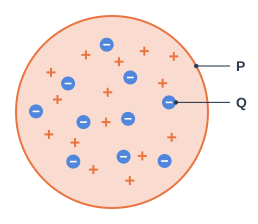
The diagram shows Thomson's model of the atom.

The particles labelled Q are electrons.

Thomson knew that atoms have no overall charge.

Explain why his model includes the part labelled P.

Diagram of a model of the atom: a large shaded sphere containing + signs, with 10 small particles marked − spread through it. Label P points to the large shaded sphere; label Q points to one of the small particles inside the sphere.

Model answer

Part P is a ball of positive charge. The electrons are negatively charged, so the positive charge is needed to cancel out their negative charge, which makes the atom neutral overall.

Explanation

Thomson had found that atoms contain negative electrons, but whole atoms have no charge. So there must also be an equal amount of positive charge. In his plum pudding model this positive charge is spread through a ball, with the electrons dotted through it like plums in a pudding. There is no nucleus in this model.

Mark scheme
  1. 1 mark

    P is (a ball / sphere of) positive charge

    ALLOW 'P is positive'. DO NOT ALLOW 'P is the nucleus' or 'P is made of protons' (CON).

  2. 1 mark

    (the positive charge) cancels out / balances the negative charge of the electrons, so the atom has no overall charge / is neutral

    ALLOW 'the positive and negative charges are equal, so they cancel'. The idea that the electrons are negative must be clear for this mark, but it may be in either marking point.

Question 3

2 marks

Chemists know that atoms contain a nucleus and electrons.

But in particle diagrams of the states of matter, or of the atoms in a chemical reaction, chemists still show each atom as a simple solid ball, like Dalton's model.

Suggest two reasons why chemists still use this simple model.

Model answer

The simple ball model is quicker and easier to draw and understand. It is still good enough to explain how particles are arranged in solids, liquids and gases, and how atoms are rearranged in reactions, because the nucleus and electrons are not needed for these explanations.

Explanation

Scientists choose the simplest model that does the job. To show states of matter or which atoms join together in a reaction, the inside of each atom does not matter, so a solid ball is enough. When chemists need to explain bonding or ions, they use a model with electrons in shells instead.

Mark scheme
  1. 1 mark

    it is simpler / quicker / easier to draw and understand

    1 mark for each of points 1 to 3, max 2. If more than two answers are given, a wrong one cancels a right one.

  2. 1 mark

    it is good enough to explain these things / it still explains how the particles are arranged and move, or how atoms are rearranged in a reaction

    ALLOW 'it still gives correct predictions for states and reactions'.

  3. 1 mark

    the nucleus and electrons are not needed for these explanations / the inside of the atom does not change in these processes

    ALLOW 'the extra detail would not help'. IGNORE 'Dalton's model is correct' (CON with the question).

Question 4

3 marks

A scanning tunnelling microscope makes images of the atoms on the surface of a copper crystal.

In one printed image, the centres of two neighbouring copper atoms are 1.04 cm apart.

The real distance between the centres of these two atoms is 2.6 × 10⁻¹⁰ m.

Use the equation: magnification = image size ÷ real size

Calculate the magnification of the image.

1 m = 100 cm

Model answer

Image size = 1.04 cm = 0.0104 m
Magnification = 0.0104 ÷ 2.6 × 10⁻¹⁰
Magnification = 4 × 10⁷ (40 000 000)

Explanation

Both sizes must be in the same unit before you divide, so change 1.04 cm into 0.0104 m. Then 0.0104 ÷ (2.6 × 10⁻¹⁰) = 4 × 10⁷: the image is forty million times bigger than the real atoms. Dividing without changing the units gives 4 × 10⁹, which is a hundred times too big.

Mark scheme
  1. 1 mark

    unit conversion: 1.04 cm = 0.0104 m / 1.04 × 10⁻² m; or a correct final answer of 4 × 10⁷ with no working

    An answer of 4 × 10⁷ (40 000 000) with no working scores 3 marks. ALLOW 4 × 10⁹ for 2 marks (centimetres not converted to metres: 1.04 ÷ 2.6 × 10⁻¹⁰). ALLOW the real size converted into cm instead (2.6 × 10⁻⁸ cm).

  2. 1 mark

    substitution: 0.0104 ÷ 2.6 × 10⁻¹⁰; or a correct final answer of 4 × 10⁷ with no working

    ALLOW ECF from a wrong unit conversion. ALLOW 1.04 ÷ 2.6 × 10⁻⁸ (both sizes in cm). DO NOT ALLOW the real size divided by the image size for this mark or the next.

  3. 1 mark

    evaluation: 4 × 10⁷ / 40 000 000

    ALLOW ECF from a wrong conversion divided correctly (for example 4 × 10⁸ from 0.104 m). IGNORE a unit or '×' written before the number.

Ready to try the rest? Every answer you write is marked against the mark scheme, so you can see exactly where the marks are.

Study Helper Hints first, answers after you try

Stuck on this one? Ask for a hint and I’ll point you in the right direction, without giving the answer away. Once you’ve checked your answer, I’ll show you how the marks are awarded.