
Level:
Correct: 0
Incorrect: 0
Marks: 0/0
Exam Practice
Course:
Topics:
Avg
score:
–
Topics
done:
0/25

Dot and cross diagrams and models of bonding

Practise 14 exam-style questions on Dot and cross diagrams and models of bonding for OCR GCSE Chemistry (Paper 1). Write your answer as you would in the exam and get it marked in seconds against the mark scheme, point by point, with the Study Helper on hand if you get stuck.

  • 14 questions
  • 1–6 marks each
  • Instant marking
  • No sign-up needed
14 questions, marked as you go

Sample questions with model answers

Here are 4 of the questions in this topic, each with a model answer, an explanation of why it earns the marks and the mark scheme an examiner would use.

Question 1

1 mark

Sodium fluoride, NaF, is an ionic compound used in toothpaste.

Electron arrangements: sodium 2.8.1; fluorine 2.7

In a dot-and-cross diagram of sodium fluoride, the electrons from sodium are drawn as crosses and the electrons from fluorine are drawn as dots. Only the outer shells are shown.

What is drawn in the outer shell of the fluoride ion?

Choose your answer.

  • A 8 dots and 0 crosses
  • B 7 dots and 1 cross
  • C 6 dots and 2 crosses
  • D 1 dot and 7 crosses

Model answer

B (7 dots and 1 cross)

Explanation

The dots and crosses show where each electron came from. Fluorine (2.7) has seven outer electrons of its own, drawn as dots, and gains the one outer electron of a sodium atom (2.8.1), drawn as a cross. The fluoride ion, F⁻, then has a full outer shell of eight electrons.

Mark scheme
  1. 1 mark

    B / 7 dots and 1 cross

    The only correct answer is B: the fluorine atom keeps its own seven outer electrons (dots) and gains one electron from the sodium atom (a cross), giving the fluoride ion eight outer electrons. A is not correct because it leaves out the electron transferred from sodium (and fluorine has only seven outer electrons of its own); C is not correct because a sodium atom has only one outer electron to transfer; D is not correct because it swaps the dots and the crosses. ALLOW the letter or the option. If more than one option is given, do not award the mark.
Question 2

2 marks

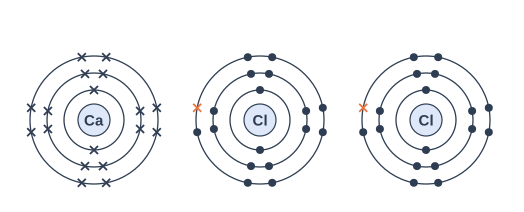
Calcium chloride, CaCl₂, is used as a drying agent in laboratories. It is an ionic compound.

The diagram shows a dot-and-cross diagram of the ions in calcium chloride. The square brackets and the charges have been left out.

Atomic numbers: chlorine 17; calcium 20

Give the charge on the calcium ion and the charge on each chloride ion.

Electron shell diagram: particle with Ca in the centre and electrons 2,8,8 drawn on 3 shells; particle with Cl in the centre and electrons 2,8,8 drawn on 3 shells (1 outer electron drawn as crosses to show it came from another atom); particle with Cl in the centre and electrons 2,8,8 drawn on 3 shells (1 outer electron drawn as crosses to show it came from another atom).

Model answer

Calcium ion: 2+ (20 protons and 18 electrons)
Chloride ion: 1− (17 protons and 18 electrons)

Explanation

Both ions have the electron arrangement 2.8.8, so each has 18 electrons, but they have different numbers of protons. The calcium ion has 20 protons, two more than its electrons, so it is 2+; each chloride ion has 17 protons, one fewer than its electrons, so it is 1−. The charges also explain the formula: one Ca²⁺ balances two Cl⁻.

Mark scheme
  1. 1 mark

    calcium ion: 2+ / Ca²⁺

    ALLOW +2. DO NOT ALLOW 2 with no sign or 2−.

  2. 1 mark

    chloride ion: 1− / − / Cl⁻

    ALLOW −1 / −. DO NOT ALLOW 1+ or 2−. If the two charges are given the wrong way round, award 0 marks.

Question 3

2 marks

Nitrogen gas, N₂, and ammonia, NH₃, are both made of simple molecules.

In dot-and-cross diagrams of both molecules, each nitrogen atom shares three pairs of electrons.

Describe how the three shared pairs are arranged differently in the two molecules.

Model answer

In a nitrogen molecule, all three shared pairs are between the same two nitrogen atoms, which makes a triple bond. In an ammonia molecule, the nitrogen atom shares one pair with each of three different hydrogen atoms, so there are three single bonds.

Explanation

A nitrogen atom (2.5) needs three more electrons for a full outer shell, so it always shares three pairs. In N₂ the other atom is also nitrogen and needs three, so all three pairs are shared between the two atoms. A hydrogen atom can share only one pair, so in NH₃ the nitrogen atom needs three hydrogen atoms.

Mark scheme
  1. 1 mark

    in N₂, all three shared pairs are between the same two (nitrogen) atoms / there is a triple bond

    ALLOW the two nitrogen atoms share three pairs with each other. DO NOT ALLOW N₂ has three single bonds.

  2. 1 mark

    in NH₃, each shared pair is between the nitrogen atom and a different hydrogen atom / there are three single bonds

    ALLOW nitrogen shares one pair with each of three hydrogen atoms. DO NOT ALLOW ammonia has a triple bond.

Question 4

4 marks

Rubies are made mainly of aluminium oxide, Al₂O₃. Aluminium oxide is an ionic compound.

Electron arrangements: aluminium 2.8.3; oxygen 2.6

A dot-and-cross diagram of aluminium oxide shows two aluminium ions and three oxide ions. Electrons from aluminium are drawn as crosses and electrons from oxygen are drawn as dots. Only the outer shells are shown.

Give:
• the charge on each aluminium ion and on each oxide ion
• the number of crosses in the outer shell of each oxide ion
• the total number of electrons transferred from the two aluminium atoms to the three oxygen atoms.

Explain why two aluminium atoms react with three oxygen atoms.

Model answer

Charges: Al³⁺ (3+) and O²⁻ (2−).
Each oxide ion has 2 crosses (and 6 dots) in its outer shell.
Total electrons transferred = 2 × 3 = 6.
Each aluminium atom (2.8.3) loses its 3 outer electrons and each oxygen atom (2.6) gains 2. Two aluminium atoms lose 2 × 3 = 6 electrons, and three oxygen atoms gain 3 × 2 = 6 electrons, so all the electrons lost are gained and the charges balance (6+ and 6−).

Explanation

Aluminium (2.8.3) loses three electrons to form Al³⁺, and oxygen (2.6) gains two to form O²⁻, so each oxide ion has its own six dots plus two crosses. The smallest number of electrons that both can work with is 6: two aluminium atoms give 6 and three oxygen atoms take 6. A common slip is to put 3 crosses in each oxide ion, because aluminium gives 3, but each oxygen atom can only take 2.

Mark scheme
  1. 1 mark

    Al³⁺ (3+) and O²⁻ (2−)

    Both charges are needed for the mark. ALLOW +3 and −2.

  2. 1 mark

    2 crosses (in each oxide ion)

    ALLOW 2 crosses and 6 dots. DO NOT ALLOW 3 crosses.

  3. 1 mark

    6 (electrons transferred in total)

    ALLOW 2 × 3 = 6 or 3 × 2 = 6.

  4. 1 mark

    each aluminium atom loses 3 electrons and each oxygen atom gains 2, so the electrons lost by two aluminium atoms (2 × 3 = 6) are the same as the electrons gained by three oxygen atoms (3 × 2 = 6)

    ALLOW the total positive charge (2 × 3+ = 6+) equals the total negative charge (3 × 2− = 6−). DO NOT ALLOW an answer that only repeats the formula Al₂O₃ with no numbers of electrons or charges.

Ready to try the rest? Every answer you write is marked against the mark scheme, so you can see exactly where the marks are.

Study Helper Hints first, answers after you try

Stuck on this one? Ask for a hint and I’ll point you in the right direction, without giving the answer away. Once you’ve checked your answer, I’ll show you how the marks are awarded.