
Question 1
1 markVanillin is the substance that gives vanilla its flavour. Pure vanillin melts at 81 °C.
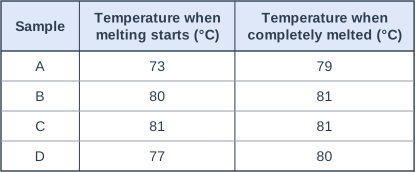
A food scientist tests four samples of vanillin, A, B, C and D. The table shows the temperature at which each sample starts to melt and the temperature at which it has completely melted.
Which sample contains the most impurity?
Choose your answer.
- A sample A
- B sample B
- C sample C
- D sample D
Model answer
A - sample A
Explanation
Impurities lower the temperature at which a solid starts to melt and make it melt over a range of temperatures instead of at one temperature. Sample A starts melting furthest below 81 °C and melts over the widest range, so it is the least pure. Sample C melts sharply at 81 °C, the melting point of pure vanillin, so it is the pure sample.
Mark scheme
-
1 mark
A / sample A
The only correct answer is A: an impurity makes a solid start to melt below the melting point of the pure substance and melt over a range of temperatures, and the more impurity there is, the lower the melting starts and the wider the range. Sample A starts to melt at the lowest temperature (73 °C, 8 °C below 81 °C) and melts over the widest range (73 °C to 79 °C, 6 °C). B is not correct because B melts between 80 °C and 81 °C, very close to 81 °C, so it contains only a little impurity. C is not correct because C melts sharply at 81 °C, so it is pure vanillin. D is not correct because D starts to melt at 77 °C and melts over a range of only 3 °C, so it contains less impurity than A. ALLOW the letter or the option. If more than one option is given, do not award the mark.