
Level:
Correct: 0
Incorrect: 0
Marks: 0/0
Exam Practice
Course:
Topics:
Edexcel GCSE Combined Science (Physics Paper 2) Smart practice A mixed round aimed at your weak spots
Avg
score:
–
Topics
done:
0/25

Vector diagrams, resultant forces and lubrication

Practise 16 exam-style questions on Vector diagrams, resultant forces and lubrication for Edexcel GCSE Combined Science (Physics Paper 2). Write your answer as you would in the exam and get it marked in seconds against the mark scheme, point by point, with the Study Helper on hand if you get stuck.

  • 16 questions
  • 1–6 marks each
  • Instant marking
  • No sign-up needed
16 questions, marked as you go

Sample questions with model answers

Here are 4 of the questions in this topic, each with a model answer, an explanation of why it earns the marks and the mark scheme an examiner would use.

Question 1

1 mark

A student is going to make a scale drawing of two forces acting on an object. The forces are 1200 N and 900 N, at right angles to each other. Her scale drawing must fit on a sheet of A4 paper, which is about 20 cm by 28 cm.

Which scale should she use to make the most accurate scale drawing that fits on the paper?

Choose your answer.

  • A 1 cm = 1 N
  • B 1 cm = 10 N
  • C 1 cm = 100 N
  • D 1 cm = 1000 N

Model answer

C - 1 cm = 100 N.

Explanation

A scale drawing should be as large as the paper allows, so that a small error in measuring a length or an angle is only a small fraction of it. With 1 cm = 100 N the arrows are 12 cm and 9 cm long and fit easily. With 1 cm = 1000 N the drawing would fit but would be too small to measure accurately, and the other two scales make the arrows far too long for the paper.

Mark scheme
  1. 1 mark

    C / 1 cm = 100 N (1)

    The only correct answer is C: the forces are drawn 12 cm and 9 cm long (and their resultant 15 cm), so the drawing fits on the paper and is large enough for lengths and angles to be measured accurately. A is not correct because the 1200 N force would be 1200 cm (12 m) long. B is not correct because the 1200 N force would be 120 cm long, much too long for the paper. D is not correct because the arrows would be only 1.2 cm and 0.9 cm long: the drawing fits, but an error of 1 mm in measuring a length would be about 10% of it, so the result would be much less accurate. Accept the letter or the option. If more than one option is given, do not award the mark.
Question 2

2 marks

A tightrope walker stands at rest in the middle of a tightrope. The rope sags slightly, so each side of the rope makes a small angle with the horizontal.

Explain why the tension in the rope is much larger than the walker's weight.

Model answer

The tension acts along each side of the rope, which is almost horizontal, so most of each tension pulls sideways and only a small component of it acts upwards. The walker is at rest, so the upward components of the two tensions must add up to the walker's weight. Because these components are only a small part of each tension, the tension in the rope must be much larger than the weight.

Explanation

Resolving each tension into horizontal and vertical components shows why: the horizontal components cancel each other, and only the small vertical components support the walker. The flatter the rope, the smaller the vertical components, so the larger the tension needed. This is why tightropes and washing lines are pulled so tight.

Mark scheme
  1. 1 mark

    the tension acts along the rope, almost horizontally, so each tension has only a small vertical (upward) component (1)

    An explanation linking both points. Accept 'most of each tension pulls sideways, and the sideways parts cancel'.

  2. 1 mark

    the walker is in equilibrium, so the vertical components of the two tensions must add up to (balance) the weight; for small components to do this the tensions must be very large (1)

    Accept 'only a small part of each tension holds the walker up, so the tension must be much bigger than the weight'. Do not accept 'the rope has to be strong' with no reference to forces.

Question 3

3 marks

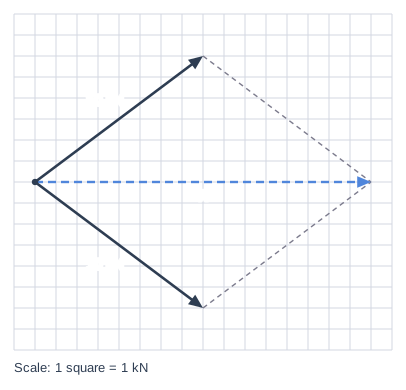
Two tugboats pull a large ship using ropes. Each rope pulls on the ship with a force of 10 kN.

The scale drawing shows the two forces and their resultant, R.

Determine the size of R. Explain why R is smaller than 20 kN.

Scale drawing on a square grid (scale: 1 square = 1 kN). Two force arrows start from the same point: one labelled "10 kN" 10 squares long up and to the right, at 36.9° above the horizontal, and one labelled "10 kN" 10 squares long down and to the right, at 36.9° below the horizontal. Dashed lines complete a parallelogram. A dashed arrow labelled R goes from the starting point to the opposite corner of the parallelogram.

Model answer

R is 16 squares long and the scale is 1 square = 1 kN, so R = 16 kN.
The two forces are not in the same direction: they act at an angle to each other. Each force has a forward component and a sideways component. The sideways components are equal in size and opposite in direction, so they cancel, and only the forward components (8 kN each) add up to give 16 kN, which is less than 10 + 10 = 20 kN.

Explanation

Two forces only add up to their sum when they act in the same direction. Here each rope pulls partly sideways; resolving each force shows the sideways parts cancel, leaving 8 + 8 = 16 kN forwards. The parallelogram on the scale drawing gives the same answer as the components.

Mark scheme
  1. 1 mark

    R = 16 (squares) × 1 kN = 16 kN (1)

    Accept 15.8 to 16.2 kN. An answer in the range 15.8 to 16.2 kN with no working scores marking point 1. 20 kN scores 0.

  2. 1 mark

    the two forces act at an angle to each other / are not in the same direction (1)

    An explanation linking this point and the next. Accept 'one rope pulls up and to the right and the other down and to the right'.

  3. 1 mark

    the sideways components (at right angles to R) of the forces are equal and opposite and cancel, so only the forward components add up / each force has a forward component of only 8 kN (1)

    Accept 'part of each force pulls sideways, and these parts cancel'. Accept a correct use of the drawing, e.g. 'each force is 8 squares forward and 6 squares sideways'. Do not accept 'forces are vectors' alone.

Question 4

4 marks

A badminton player hits a shuttlecock. Just after it leaves the racket, the shuttlecock is moving horizontally to the right at high speed. At this moment, the air resistance on the shuttlecock is much larger than its weight.

Describe the free body force diagram for the shuttlecock at this moment. Your description should include the forces, their directions, the relative lengths of the arrows and the direction of the resultant force.

Model answer

The shuttlecock is drawn as a dot (or a small box) with arrows starting from it. Only two forces act on it. Its weight acts vertically downwards. Air resistance acts horizontally to the left, opposite to its motion. There is no forward force from the racket, because the racket is no longer touching the shuttlecock. The air resistance arrow is much longer than the weight arrow. So the resultant force acts backwards and slightly downwards (to the left and down), which makes the shuttlecock slow down and start to fall.

Explanation

A free body force diagram shows only the forces acting on the object at that moment. Once the shuttlecock has left the racket, the racket's contact force has stopped, so only the weight and the air resistance act; there is no 'force of the hit' carrying it forwards. Combining the two arrows gives a resultant that points backwards and a little downwards, so the shuttlecock slows down and its path curves down. Including a forward force is the most common error.

Mark scheme
  1. 1 mark

    weight acting (vertically) downwards (1)

    A description including any four from the five points; max 4. Accept 'gravitational force / pull of the Earth' for weight.

  2. 1 mark

    air resistance acting (horizontally) to the left / opposite to the direction of motion (1)

    Accept drag for air resistance. Do not accept air resistance acting to the right or upwards.

  3. 1 mark

    there are no other forces: no forward force from the racket / from the hit, because the racket is no longer touching the shuttlecock (1)

    Accept 'only two forces act on it'. Do not award this mark if a forward force (e.g. 'the force of the hit', 'thrust') is included anywhere in the description.

  4. 1 mark

    the air resistance arrow is (much) longer than the weight arrow (1)

    Ignore where the arrows are drawn from.

  5. 1 mark

    the resultant force acts backwards and downwards / to the left and downwards (mostly to the left), so the shuttlecock slows down (and starts to curve downwards) (1)

    The direction is needed for the mark; the effect on the motion is not required. Accept 'diagonally down to the left'. Do not accept 'the resultant force is zero' or 'the resultant force acts to the right / in the direction of motion'.

Ready to try the rest? Every answer you write is marked against the mark scheme, so you can see exactly where the marks are.

Study Helper Hints first, answers after you try

Stuck on this one? Ask for a hint and I’ll point you in the right direction, without giving the answer away. Once you’ve checked your answer, I’ll show you how the marks are awarded.