
Level:
Correct: 0
Incorrect: 0
Marks: 0/0
Exam Practice
Course:
Topics:
Edexcel GCSE Combined Science (Physics Paper 2) Smart practice A mixed round aimed at your weak spots
Avg
score:
–
Topics
done:
0/25

Energy stores and transfers in systems

Practise 14 exam-style questions on Energy stores and transfers in systems for Edexcel GCSE Combined Science (Physics Paper 2). Write your answer as you would in the exam and get it marked in seconds against the mark scheme, point by point, with the Study Helper on hand if you get stuck.

  • 14 questions
  • 1–6 marks each
  • Instant marking
  • No sign-up needed
14 questions, marked as you go

Sample questions with model answers

Here are 4 of the questions in this topic, each with a model answer, an explanation of why it earns the marks and the mark scheme an examiner would use.

Question 1

1 mark

Two magnets are held close together on a table with their north poles facing each other. When they are let go, they push each other apart and speed up as they move away from each other.

Which energy store decreases as the magnets speed up and move apart?

Choose your answer.

  • A magnetic store of the magnets
  • B kinetic store of the magnets
  • C gravitational store of the magnets
  • D thermal store of the table

Model answer

A magnetic store of the magnets

Explanation

Magnets held close together with like poles facing have energy in a magnetic store, just as a stretched spring has energy in an elastic store. When they are let go, the repulsive forces do work, so the magnetic store decreases and the kinetic store of the magnets increases. The thermal store increases a little because of friction, so it cannot be the store that decreases.

Mark scheme
  1. 1 mark

    A / magnetic store of the magnets (1)

    The only correct answer is A: like poles repel, so the magnetic forces push the magnets apart and do work on them; energy is transferred from the magnetic store of the pair of magnets to their kinetic stores. B is not correct because the magnets speed up, so their kinetic store increases; C is not correct because the magnets stay at the same height on the table, so their gravitational store does not change; D is not correct because friction between the magnets and the table warms the surfaces slightly, so the thermal store increases, not decreases. Accept the letter or the option. If more than one option is given, do not award the mark.

Question 2

2 marks

A solar-powered fountain in a garden pond has a solar panel connected to a small electric pump. The pump lifts water to the top of the fountain.

The flow diagram shows how energy is transferred in the fountain.

Give the way energy is transferred at Transfer A and the way energy is transferred at Transfer B.

Flow chart of 4 boxes joined by arrows, read from left to right. The first box is "Sun", which leads (along an arrow labelled "by light") to "Solar panel", which leads (along an arrow labelled "Transfer A") to "Electric motor in pump", which leads (along an arrow labelled "Transfer B") to "Gravitational store of water".

Model answer

Transfer A: electrically, by an electric current in the wires from the solar panel to the pump motor.
Transfer B: mechanically, because the pump exerts a force on the water and lifts it, doing work.

Explanation

The ways energy is transferred include electrically (by a current), mechanically (by a force doing work) and by heating or radiation. From the panel to the motor the energy travels as a current; the pump then pushes the water upwards, so a force does work and the gravitational store of the water increases. Naming a store such as 'kinetic' instead of a way of transferring energy is a common error.

Mark scheme
  1. 1 mark

    (Transfer A) electrically / by an electric current (1)

    1 mark for each transfer. accept by electricity / electrical working; do not accept 'electrical energy store' or 'by heating'.

  2. 1 mark

    (Transfer B) mechanically / by a force doing work (on the water) (1)

    accept the pump pushes / lifts the water, doing work; accept work done (by the pump); do not accept 'kinetic' or 'by movement' on its own, or 'electrically'.

Question 3

3 marks

A battery-powered stair-lift carries a person from the bottom to the top of a flight of stairs.

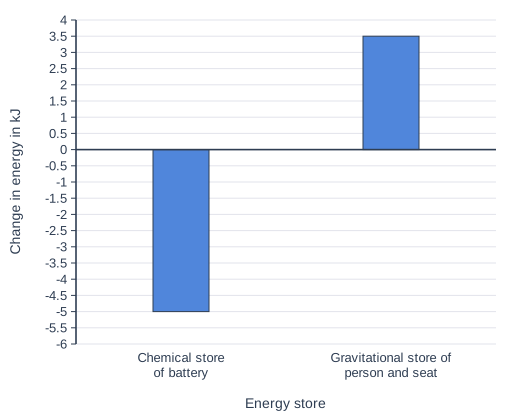
The bar chart shows the changes in two of the energy stores during the journey. Apart from these, the only stores that change are thermal energy stores.

Calculate the total change in the thermal energy stores.

Explain why there is no overall change in the kinetic energy store of the person and the seat.

Bar chart of change in energy in kJ for each energy store: Chemical store of battery -5, Gravitational store of person and seat 3.5.

Model answer

The chemical store of the battery decreases by 5.0 kJ and the gravitational store of the person and seat increases by 3.5 kJ. Energy is conserved, so the thermal stores increase by 5.0 - 3.5 = 1.5 kJ.
The person and the seat start at rest at the bottom and are at rest again at the top, so their kinetic store is zero at both times: the kinetic energy gained as the lift speeds up is transferred away again as it slows down at the top.

Explanation

Energy cannot be created or destroyed, so the decrease in the battery's chemical store must equal the total increase in the other stores: 3.5 kJ in the gravitational store and the rest, 1.5 kJ, dissipated in thermal stores of the motor and surroundings. The kinetic store only matters while the lift is moving; comparing the start and the end, it has not changed. Adding the two bars instead of subtracting is a common error.

Mark scheme
  1. 1 mark

    5.0 - 3.5 / decrease in the chemical store - increase in the gravitational store (1)

    an answer of 1.5 kJ (or 1500 J) with no working scores marking points 1 and 2.

  2. 1 mark

    (the thermal stores increase by) 1.5 (kJ) (1)

    accept 1500 J; accept +1.5 kJ; 8.5 kJ (adding the two changes) scores 0; a decrease of 1.5 kJ does not score MP2.

  3. 1 mark

    the person and the seat are at rest at the start and at the end (of the journey), so their kinetic store is zero at both times (1)

    MP3 is independent of MP1 and MP2. accept the kinetic store increases as the stair-lift speeds up and decreases (by the same amount) as it slows down at the top; do not accept 'it moves at a constant speed' on its own (it must start and stop).

Question 4

4 marks

A climber abseils down a cliff at a steady speed. The rope passes through a metal device clipped to her harness. Friction between the rope and the device controls her speed. When she reaches the bottom, the device is hot.

Explain the energy changes as the climber abseils down the cliff at a steady speed.

Model answer

As the climber moves down the cliff, her gravitational potential energy store decreases. Her speed is steady, so her kinetic energy store does not increase. Instead, the friction force between the rope and the device does work, transferring the energy to the thermal stores of the device and the rope, so the device becomes hot. The decrease in her gravitational store equals the increase in the thermal stores, and some of this energy is then transferred by heating from the hot device and rope to the surrounding air.

Explanation

If the climber fell freely, her gravitational store would be transferred to her kinetic store and she would speed up. Because she moves at a steady speed, her kinetic store stays the same, so the energy from her gravitational store must go somewhere else: friction in the device does work and the energy ends up in thermal stores. Answers that say the energy 'turns into speed' miss the point of the steady speed.

Mark scheme
  1. 1 mark

    the gravitational (potential energy) store of the climber decreases (as she moves down) (1)

    An explanation linking any four of the five points; max 4. accept she loses GPE.

  2. 1 mark

    her kinetic (energy) store does not increase / stays the same because her speed is constant (1)

    the reason (steady speed) is needed for MP2.

  3. 1 mark

    friction between the rope and the device does work / energy is transferred mechanically by the friction force (1)

    accept work is done against friction; ignore air resistance unless friction in the device is also given.

  4. 1 mark

    the thermal stores of the device / rope increase (so the device gets hot) (1)

    allow heat (energy) for thermal (energy store); accept the energy from the gravitational store is transferred to the thermal store of the device.

  5. 1 mark

    energy is then transferred by heating from the hot device / rope to the surroundings / the decrease in the gravitational store equals the increase in the thermal stores (1)

    accept energy is dissipated to the thermal store of the surroundings; accept a correct statement of conservation linked to the stores in this context; 'energy is conserved' alone does not score.

Ready to try the rest? Every answer you write is marked against the mark scheme, so you can see exactly where the marks are.

Study Helper Hints first, answers after you try

Stuck on this one? Ask for a hint and I’ll point you in the right direction, without giving the answer away. Once you’ve checked your answer, I’ll show you how the marks are awarded.