
Level:
Correct: 0
Incorrect: 0
Marks: 0/0
Exam Practice
Course:
Topics:
Edexcel GCSE Combined Science (Physics Paper 2) Smart practice A mixed round aimed at your weak spots
Avg
score:
–
Topics
done:
0/25

Electrical power

Practise 17 exam-style questions on Electrical power for Edexcel GCSE Combined Science (Physics Paper 2). Write your answer as you would in the exam and get it marked in seconds against the mark scheme, point by point, with the Study Helper on hand if you get stuck.

  • 17 questions
  • 1–6 marks each
  • Instant marking
  • No sign-up needed
17 questions, marked as you go

Sample questions with model answers

Here are 4 of the questions in this topic, each with a model answer, an explanation of why it earns the marks and the mark scheme an examiner would use.

Question 1

1 mark

Two resistors, P and Q, are connected in series with a battery, so the current in P is the same as the current in Q.

The resistance of Q is twice the resistance of P.

Which statement about the power transferred in resistor Q is correct?

Choose your answer.

  • A a quarter of the power in P
  • B half the power in P
  • C the same as the power in P
  • D twice the power in P

Model answer

D - twice the power in P.

Explanation

With the same current in both resistors, P = I² × R shows that the power is proportional to the resistance, so Q, with twice the resistance, transfers energy at twice the rate. The p.d. across Q is also twice the p.d. across P, which gives the same result from P = I × V. Choosing 'half' comes from thinking about resistors with the same p.d. instead of the same current.

Mark scheme
  1. 1 mark

    D / twice the power in P (1)

    The only correct answer is D: P = I² × R and the current is the same in both resistors, so the power is proportional to the resistance; doubling the resistance doubles the power. A is not correct because it treats the power as depending on 1 ÷ R², which no power equation gives. B is not correct because the power halves when the resistance doubles only if the p.d. is the same (for example in parallel), but in series the current is the same and the p.d. across Q is twice that across P. C is not correct because the same current does not mean the same power: the power also depends on the resistance. Accept the letter or the option. If more than one option is given, do not award the mark.
Question 2

2 marks

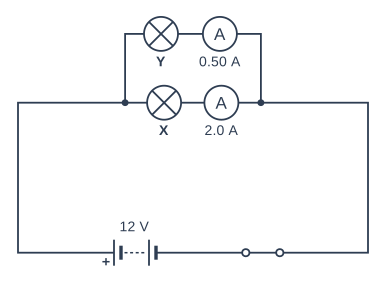
The circuit diagram shows two lamps, X and Y, connected in parallel to a 12 V battery.

The current in lamp X is 2.0 A and the current in lamp Y is 0.50 A.

Explain which lamp transfers energy at the greater rate.

Circuit diagram. Going round the loop from the + terminal of the battery (labelled 12 V): two branches in parallel (one branch has lamp X then an ammeter (reading 2.0 A); the other branch has lamp Y then an ammeter (reading 0.50 A)); then a closed switch; and back to the − terminal of the battery.

Model answer

Lamp X. The lamps are in parallel, so the p.d. across each is 12 V and each coulomb of charge transfers the same energy (12 J) in either lamp. More charge passes through X each second, so X transfers more energy per second: P = I × V gives 2.0 × 12 = 24 W for X but only 0.50 × 12 = 6.0 W for Y.

Explanation

Power depends on both current and p.d. (P = I × V). In parallel the p.d. is the same for both lamps, so the lamp with the larger current has the larger power. A full answer links the larger current to the same p.d. (or calculates both powers) rather than just saying X has more current.

Mark scheme
  1. 1 mark

    lamp X (1)

    An explanation linking. Accept 'X has the greater power'.

  2. 1 mark

    (the p.d. across both lamps is the same / 12 V, but) the current in X is greater, so more charge passes through X each second (each coulomb transferring the same energy) / P = I × V gives 24 W for X and 6.0 W for Y (1)

    Dependent on the first marking point. Accept 'same voltage, bigger current, so bigger power (P = I × V)'. Accept correct powers of 24 W and 6 W. Do not accept 'X has more current' alone (no link to the same p.d. or to power). Ignore references to brightness.

Question 3

3 marks

Two electric convector heaters are designed for the 230 V mains supply.

Heater A has a power of 1.0 kW. Heater B has a power of 2.0 kW.

Explain which heater has the smaller resistance.

Model answer

Heater B has the smaller resistance. Both heaters have the same p.d. of 230 V across them. Heater B has twice the power, so it needs twice the current: I = P ÷ V gives 1000 ÷ 230 = 4.3 A for A and 2000 ÷ 230 = 8.7 A for B. Since R = V ÷ I, the heater with the larger current at the same p.d. has the smaller resistance: B is 230 ÷ 8.7 = 26 Ω and A is 230 ÷ 4.3 = 53 Ω.

Explanation

At a fixed p.d., power is proportional to current (P = I × V), and a smaller resistance lets a larger current pass (V = I × R). So the more powerful heater has the smaller resistance: 26 Ω compared with 53 Ω. Many students expect a 'more powerful' heater to have more resistance; that is only true when the current, not the p.d., is the same.

Mark scheme
  1. 1 mark

    heater B (1)

    An explanation linking. Accept resistances calculated correctly: A 52.9 Ω (53 Ω), B 26.45 Ω (26 Ω).

  2. 1 mark

    (at the same p.d.) heater B has the larger current / I = P ÷ V gives 4.3 A for A and 8.7 A for B (1)

    Accept 'B needs twice the current of A because its power is twice as large at the same p.d.' Accept correct currents for both heaters (4.35 A and 8.70 A).

  3. 1 mark

    R = V ÷ I, so a larger current at the same p.d. means a smaller resistance (1)

    Accept 'a smaller resistance lets a larger current pass at the same p.d., so more energy is transferred per second'. Accept correct calculated resistances from R = V ÷ I as evidence for this mark. Do not accept 'more resistance makes more heat', which is the reverse argument and wrong at the same p.d.

Question 4

4 marks

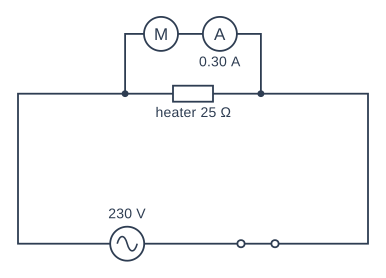
A hair dryer contains a heating element and a motor, connected in parallel to the 230 V mains supply. The circuit diagram shows the heating element as a resistor.

The resistance of the heating element is 25 Ω.

The current in the motor is 0.30 A.

Calculate the total power of the hair dryer when the heating element and the motor are both switched on.

Circuit diagram. Going round the loop from the a.c. power supply (labelled 230 V): two branches in parallel (one branch has a resistor labelled "heater 25 Ω"; the other branch has a motor then an ammeter (reading 0.30 A)); then a closed switch; and back to the supply.

Model answer

Current in the heating element: I = V ÷ R = 230 ÷ 25 = 9.2 A
Total current = 9.2 + 0.30 = 9.5 A
P = I × V = 9.5 × 230
P = 2185 W (about 2.2 kW)

Explanation

In parallel, each part has the full 230 V across it. Find the heating element's current from V = I × R (9.2 A), add the motor's 0.30 A to get 9.5 A, and use P = I × V to get 2185 W. Alternatively add the two powers: 2116 W for the heating element and 69 W for the motor. A common error is to leave out the motor's power.

Mark scheme
  1. 1 mark

    (current in heating element =) 230 ÷ 25 / (power of heating element =) 230² ÷ 25 (1)

    An answer of 2185 (W) with no working scores 4 marks. Allow any correct method for the heating element's current or power.

  2. 1 mark

    9.2 (A) / 2116 (W) (1)

    The heating element's current (9.2 A) or power (2116 W, e.g. from 9.2 × 230 or 9.2² × 25).

  3. 1 mark

    (power of motor =) 0.30 × 230 = 69 (W) / (total current =) 9.2 + 0.30 = 9.5 (A) (1)

    Allow ecf from an incorrect heating element current for the total current.

  4. 1 mark

    (total power =) 2185 (W) (1)

    Accept values that round to 2200 W, e.g. 2185 W, 2190 W, 2.2 kW. Allow ecf from earlier steps (e.g. their total current × 230). 2116 W (motor left out) scores 2 marks.

Ready to try the rest? Every answer you write is marked against the mark scheme, so you can see exactly where the marks are.

Study Helper Hints first, answers after you try

Stuck on this one? Ask for a hint and I’ll point you in the right direction, without giving the answer away. Once you’ve checked your answer, I’ll show you how the marks are awarded.