Level:
Correct: 0
Incorrect: 0
Marks: 0/0
Exam Practice
Course:
Topics:
Edexcel GCSE Combined Science (Physics Paper 2) Smart practice A mixed round aimed at your weak spots
Avg
score:
–
Topics
done:
0/25

Core practical: extension of a spring

Practise 14 exam-style questions on Core practical: extension of a spring for Edexcel GCSE Combined Science (Physics Paper 2). Write your answer as you would in the exam and get it marked in seconds against the mark scheme, point by point, with the Study Helper on hand if you get stuck.

  • 14 questions
  • 1–6 marks each
  • Instant marking
  • No sign-up needed
14 questions, marked as you go

Sample questions with model answers

Here are 4 of the questions in this topic, each with a model answer, an explanation of why it earns the marks and the mark scheme an examiner would use.

Question 1

1 mark

A student investigates how the extension of a spring depends on the force applied to it. She adds slotted masses to a hanger on the spring, one at a time, and measures the length of the spring each time.

What is the dependent variable in this investigation?

Choose your answer.

  • A the mass on the hanger
  • B the original length of the spring
  • C the extension of the spring
  • D the spring constant

Model answer

C - the extension of the spring.

Explanation

The independent variable is the force (changed by adding masses) and the dependent variable is the extension, which the student finds by subtracting the original length from each new length. The spring constant is worked out at the end from the force and extension data.

Mark scheme
  1. 1 mark

    C / the extension of the spring (1)

    The only correct answer is C: the dependent variable is the one that is measured (or worked out from measurements) as the independent variable is changed; here the extension is found from each new length. A is not correct because the mass (and so the force) is what the student changes - the independent variable; B is not correct because the original length is measured once and used to work out each extension; it does not depend on the force; D is not correct because the spring constant is calculated from the results at the end, and for the same spring it is a property of the spring, not a variable that is measured each time. Accept the letter or the option. If more than one option is given, do not award the mark.
Question 2

2 marks

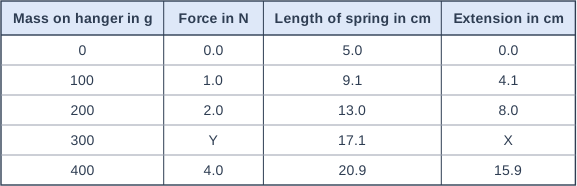
A student measures the length of a spring with no masses, then with different masses on a hanger.

The table shows her results.

Calculate value X and value Y.

(gravitational field strength = 10 N/kg)

Table with columns "Mass on hanger in g", "Force in N", "Length of spring in cm", "Extension in cm". Mass on hanger in g: 0; Force in N: 0.0; Length of spring in cm: 5.0; Extension in cm: 0.0 | Mass on hanger in g: 100; Force in N: 1.0; Length of spring in cm: 9.1; Extension in cm: 4.1 | Mass on hanger in g: 200; Force in N: 2.0; Length of spring in cm: 13.0; Extension in cm: 8.0 | Mass on hanger in g: 300; Force in N: Y; Length of spring in cm: 17.1; Extension in cm: X | Mass on hanger in g: 400; Force in N: 4.0; Length of spring in cm: 20.9; Extension in cm: 15.9.

Model answer

X = extension = length - original length = 17.1 - 5.0 = 12.1 cm
Y = force = weight of the masses = 0.300 kg × 10 N/kg = 3.0 N

Explanation

The extension is the increase in length from the original (unstretched) length of 5.0 cm, not the length itself. The force is the weight of the masses, with the mass in kilograms: 300 g = 0.300 kg, so the force is 3.0 N. Confusing length with extension is the most common error in this practical.

Mark scheme
  1. 1 mark

    X = 12.1 (cm) (1)

    (17.1 - 5.0 =) 12.1 cm; an answer of 12.1 cm with no working scores marking point 1; do not accept 17.1 or 22.1

  2. 1 mark

    Y = 3.0 (N) (1)

    (0.300 × 10 =) 3.0 N; accept 3 N; do not accept 3000 or 30

Question 3

3 marks

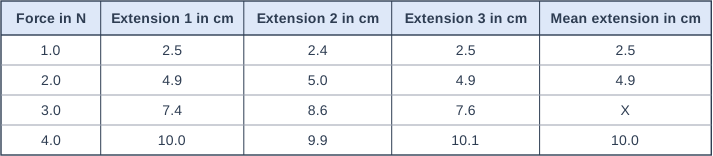
A student measures the extension of a spring three times for each force.

The table shows the results.

Identify the anomalous result, giving a reason for your choice, and calculate value X.

Table with columns "Force in N", "Extension 1 in cm", "Extension 2 in cm", "Extension 3 in cm", "Mean extension in cm". Force in N: 1.0; Extension 1 in cm: 2.5; Extension 2 in cm: 2.4; Extension 3 in cm: 2.5; Mean extension in cm: 2.5 | Force in N: 2.0; Extension 1 in cm: 4.9; Extension 2 in cm: 5.0; Extension 3 in cm: 4.9; Mean extension in cm: 4.9 | Force in N: 3.0; Extension 1 in cm: 7.4; Extension 2 in cm: 8.6; Extension 3 in cm: 7.6; Mean extension in cm: X | Force in N: 4.0; Extension 1 in cm: 10.0; Extension 2 in cm: 9.9; Extension 3 in cm: 10.1; Mean extension in cm: 10.0.

Model answer

The anomalous result is 8.6 cm, the second reading for a force of 3.0 N. It is about 1 cm bigger than the other two readings for 3.0 N (7.4 cm and 7.6 cm), and it does not fit the pattern of about 2.5 cm extension for each 1 N.

X = (7.4 + 7.6) ÷ 2 = 7.5 cm

Explanation

An anomalous result is one that does not fit the pattern of the others - here 8.6 cm is far from the other two repeats and from the trend of 2.5 cm per newton. It should be left out when the mean is calculated, giving (7.4 + 7.6) ÷ 2 = 7.5 cm. Including the anomaly gives 7.9 cm, which is too large.

Mark scheme
  1. 1 mark

    8.6 (cm) / the second extension for 3.0 N (1)

    identifying the anomaly scores this mark; the reason is the next mark point

  2. 1 mark

    it is much larger than the other two readings for 3.0 N / it does not fit the pattern of about 2.5 cm of extension for each newton (1)

    accept 'it is about 1 cm more than the other repeats'; ignore 'it is wrong' or 'it is an outlier' on its own

  3. 1 mark

    X = 7.5 (cm) (1)

    (7.4 + 7.6) ÷ 2 = 7.5; award the mark for the correct answer without working; an answer of 7.9 (cm) (anomaly included) does not score

Question 4

4 marks

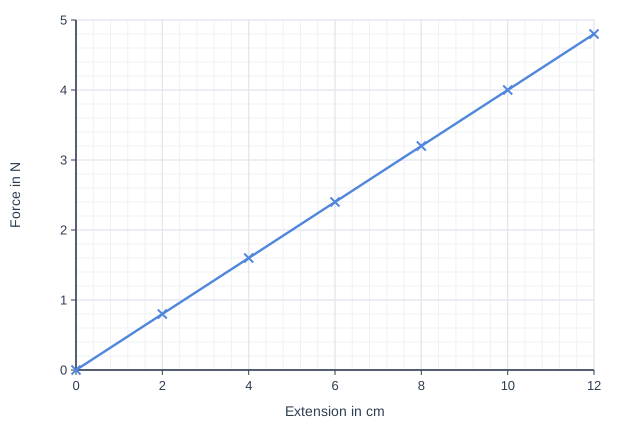
The graph shows a student's force-extension graph for a spring.

The student says: 'The work done in stretching the spring from an extension of 5.0 cm to 10.0 cm is the same as the work done in stretching it from 0 to 5.0 cm, because the extension increases by 5.0 cm each time.'

Use the graph to show that the student is not correct.

Line graph of Force in N (y-axis, 0 to 5) against extension in cm (x-axis, 0 to 12). The line joins the points (0, 0), (2, 0.8), (4, 1.6), (6, 2.4), (8, 3.2), (10, 4), (12, 4.8).

Model answer

From the graph, the force is 2.0 N at an extension of 5.0 cm and 4.0 N at 10.0 cm.
Work done from 0 to 5.0 cm = area of triangle = ½ × 2.0 × 0.050 = 0.050 J
Work done from 0 to 10.0 cm = ½ × 4.0 × 0.10 = 0.20 J
Work done from 5.0 cm to 10.0 cm = 0.20 - 0.050 = 0.15 J

0.15 J is three times 0.050 J, so the student is not correct. The force on the spring is larger during the second 5.0 cm of stretching, so more work is done for the same increase in extension.

Explanation

The work done is the area under the force-extension graph, with the extension in metres. The area from 0 to 5.0 cm is a small triangle (0.050 J), but the area from 5.0 to 10.0 cm is a trapezium (0.15 J) because the force is larger. The same answers come from E = ½ × k × x² with k = 40 N/m.

Mark scheme
  1. 1 mark

    forces read from the graph: 2.0 N at 5.0 cm and 4.0 N at 10.0 cm (1)

    The working must be seen (this is a 'show that' question). accept k = 40 N/m (0.40 N per cm) found from the graph instead of the two readings

  2. 1 mark

    work done from 0 to 5.0 cm = ½ × 2.0 × 0.050 = 0.050 (J) (1)

    accept ½ × 40 × 0.050² = 0.050 J; allow ecf from their readings; values with the extension left in cm (5.0 and 15) are a unit-conversion error that loses this mark only: MP1, MP3 (by ecf) and MP4 can still score, so the answer scores 3 marks; work done calculated without the ½ (e.g. 2.0 × 0.050 = 0.10 J) is a wrong method and does not score MP2 or MP3, but MP1 and a conclusion that compares their values (MP4) can still score

  3. 1 mark

    work done from 5.0 cm to 10.0 cm = ½ × (2.0 + 4.0) × 0.050 / (½ × 4.0 × 0.10) - 0.050 = 0.15 (J) (1)

    accept ½ × 40 × (0.10² - 0.050²) = 0.15 J; allow ecf from their readings

  4. 1 mark

    conclusion: the work done from 5.0 cm to 10.0 cm is three times as much / not the same, because the force is larger during the second 5.0 cm (1)

    a conclusion that compares their two values; ignore 'the student is wrong' with no comparison

Ready to try the rest? Every answer you write is marked against the mark scheme, so you can see exactly where the marks are.

Study Helper Hints first, answers after you try

Stuck on this one? Ask for a hint and I’ll point you in the right direction, without giving the answer away. Once you’ve checked your answer, I’ll show you how the marks are awarded.