
Level:
Correct: 0
Incorrect: 0
Marks: 0/0
Exam Practice
Course:
Topics:
Edexcel GCSE Combined Science (Physics Paper 2) Smart practice A mixed round aimed at your weak spots
Avg
score:
–
Topics
done:
0/25

Magnets and magnetic fields

Practise 16 exam-style questions on Magnets and magnetic fields for Edexcel GCSE Combined Science (Physics Paper 2). Write your answer as you would in the exam and get it marked in seconds against the mark scheme, point by point, with the Study Helper on hand if you get stuck.

  • 16 questions
  • 1–6 marks each
  • Instant marking
  • No sign-up needed
16 questions, marked as you go

Sample questions with model answers

Here are 4 of the questions in this topic, each with a model answer, an explanation of why it earns the marks and the mark scheme an examiner would use.

Question 1

1 mark

Which description is correct for the field lines of a uniform magnetic field?

Choose your answer.

  • A straight, parallel, equally spaced
  • B curved, closest together at the poles
  • C circles, further apart further out
  • D straight, spreading out from a point

Model answer

A - straight, parallel, equally spaced.

Explanation

The spacing of field lines shows the field strength and the lines show its direction. In a uniform field both are the same everywhere, so the lines are straight, parallel and equally spaced, as between two flat magnets with unlike poles facing. Option B is the bar magnet field, a common confusion.

Mark scheme
  1. 1 mark

    A / straight, parallel, equally spaced (1)

    The only correct answer is A: a uniform field has the same strength and direction everywhere, so its field lines are straight, parallel and the same distance apart. B is not correct because this describes the field of a bar magnet, which is strongest near the poles; C is not correct because this describes the field around a long straight wire carrying a current; D is not correct because lines that spread out show a field getting weaker, so it is not uniform. Accept the letter or the option. If more than one option is given, do not award the mark.
Question 2

2 marks

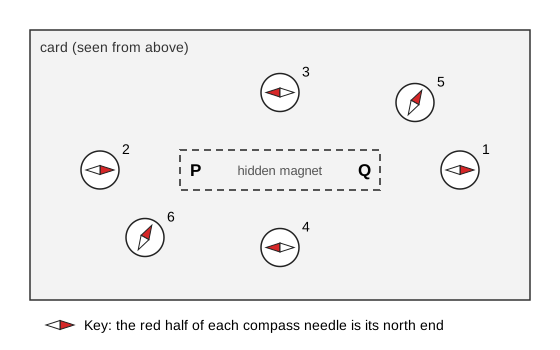
Kofi hides a bar magnet under a sheet of card. He places six plotting compasses on the card around the magnet.

The figure shows the card from above, with the ends of the hidden magnet labelled P and Q, and the needle of each compass.

Deduce which end of the magnet, P or Q, is its north pole. Give a reason for your answer.

A rectangle of card seen from above, with a dashed outline in the middle showing where a bar magnet is hidden underneath. The left end of the outline is labelled P and the right end Q. Six numbered plotting compasses sit on the card around it; a key says that the red half of each needle is its north end. Compass 1 is beyond end Q on the magnet's axis: the red half of its needle points to the right, away from Q. Compass 2 is beyond end P on the axis: the red half points to the right, towards P. Compass 3 (above the middle of the magnet) and compass 4 (below the middle) both have the red half pointing to the left, parallel to the magnet, from the Q end towards the P end. Compass 5, above and to the right of Q, has the red half pointing up and to the right, away from Q. Compass 6, below and to the left of P, has the red half pointing up and to the right, towards P.

Model answer

Q is the north pole. The north end of a compass needle points in the direction of the field, which goes from the north pole to the south pole. The needles near Q (compasses 1 and 5) point away from Q, the needles near P (compasses 2 and 6) point towards P, and compasses 3 and 4 point from the Q end towards the P end.

Explanation

Each needle shows the field direction at that point, and outside a magnet the field runs from N to S. Needles point away from a north pole and towards a south pole, so Q must be the north pole. A common error is to think the north end of a needle points towards a north pole.

Mark scheme
  1. 1 mark

    Q (1)

    accept 'the right-hand end'.

  2. 1 mark

    the north ends of the needles point away from Q / towards P, and the field (outside a magnet) goes from the north pole to the south pole (1)

    Dependent on the first mark. accept any correct reason based on the needles, e.g. 'compass 1 points away from Q and compass 2 points towards P' or 'compasses 3 and 4 point from Q towards P, which is the field direction from N to S'. A reason that only says 'the needles point to it' scores 0 for this mark.

Question 3

3 marks

Asha has two steel bars, A and B, that look identical. One bar is a permanent magnet. The other is not magnetised. She has no other equipment.

When Asha holds one end of bar A against the middle of bar B, the bars attract strongly.

When she holds one end of bar B against the middle of bar A, there is almost no attraction.

Explain which bar is the magnet.

Model answer

Bar A is the magnet. A magnet's poles are at its ends, where its field is strongest, and its field is very weak at its middle. When the end of A (a pole) touches B, it induces magnetism in the steel of B, so B is attracted strongly even at its middle. When the end of B touches the middle of A, there is almost no attraction because the middle of the magnet A has almost no magnetic effect and B is not a magnet itself.

Explanation

An unmagnetised steel bar is attracted to a pole of a magnet anywhere along its length, because the pole induces magnetism in it. But the middle of a magnet has hardly any field, so it barely attracts anything. So the bar whose end attracts strongly is the magnet. Many students wrongly assume both arrangements would give the same result because 'magnets and steel always attract'.

Mark scheme
  1. 1 mark

    bar A is the magnet (1)

    An explanation linking the identification to two of the reasons. If bar B is identified as the magnet, award 0 marks for the whole question.

  2. 1 mark

    the magnetic field of a magnet is strongest at its poles / ends and very weak at its middle (1)

    Any two from this point and the next two; max 2 for the reasons. accept 'the poles of a magnet are at its ends'. Do not award if bar B is identified as the magnet.

  3. 1 mark

    a pole of the magnet induces magnetism in the unmagnetised bar / attracts any part of an unmagnetised (steel) bar, including its middle (1)

    accept 'the end of A attracts B because B is a magnetic material'. Do not award if bar B is identified as the magnet.

  4. 1 mark

    the middle of the magnet has (almost) no pole / weak field, so it hardly attracts the end of the unmagnetised bar (1)

    accept ORA: 'if B were the magnet, its end would attract the middle of A strongly'. Do not award if bar B is identified as the magnet.

Question 4

4 marks

A dip circle is a compass needle that can turn in a vertical plane. When it is lined up with the magnetic field, its north end shows the direction of the Earth's magnetic field at that place, including whether the field points into or out of the ground.

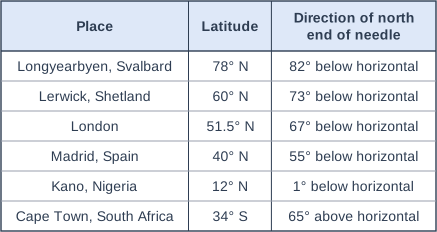
The table shows the direction of the north end of the needle at six places. The values were worked out for 2026 with the British Geological Survey's calculator, which uses the World Magnetic Model.

Explain how these data are evidence that the Earth's core is magnetic.

Table with columns "Place", "Latitude", "Direction of north end of needle". Place: Longyearbyen, Svalbard; Latitude: 78° N; Direction of north end of needle: 82° below horizontal | Place: Lerwick, Shetland; Latitude: 60° N; Direction of north end of needle: 73° below horizontal | Place: London; Latitude: 51.5° N; Direction of north end of needle: 67° below horizontal | Place: Madrid, Spain; Latitude: 40° N; Direction of north end of needle: 55° below horizontal | Place: Kano, Nigeria; Latitude: 12° N; Direction of north end of needle: 1° below horizontal | Place: Cape Town, South Africa; Latitude: 34° S; Direction of north end of needle: 65° above horizontal.

Model answer

The needle lines up with the Earth's magnetic field, so the data show the direction of that field. Near the equator, at Kano, the field is almost horizontal (1°). Further north it gets steeper - 55° at Madrid, 67° in London and 82° in Svalbard - and the north end points down, so the field goes into the Earth. In Cape Town the north end points 65° above the horizontal, so in the south the field comes out of the Earth. This is the same pattern as the field around a bar magnet, with lines coming out of one end, curving round and going back in at the other end. So the field must come from a huge magnet inside the Earth - the core - with its magnetic south pole in the north.

Explanation

A compass needle lines up with the magnetic field. The dip data show the field going into the ground in the north, lying flat near the equator and coming out of the ground in the south: exactly the shape of a bar magnet's field around its middle. That is why scientists concluded that the Earth's core is magnetic. Answers that only describe the numbers, without linking them to a bar-magnet field inside the Earth, cannot get full marks.

Mark scheme
  1. 1 mark

    the needle lines up with / points along the Earth's magnetic field, so the Earth has a magnetic field (1)

    An explanation linking any four from the six points; max 4. Max 3 if the answer does not link the pattern to a magnet inside the Earth (the fifth point).

  2. 1 mark

    the field is (almost) horizontal near the equator / at Kano (1° from horizontal) (1)

    accept 'the needle is nearly horizontal at Kano'.

  3. 1 mark

    the field gets steeper / closer to vertical nearer the poles / the angle increases with latitude, e.g. 82° at Svalbard (1)

    accept any correct comparison using the data, e.g. '55° at Madrid but 73° at Lerwick'.

  4. 1 mark

    in the north the field points down into the Earth but in the south (Cape Town) it points up out of the Earth (1)

    accept 'the needle points below the horizontal in the northern hemisphere and above it in the southern hemisphere'.

  5. 1 mark

    this is the same pattern as the field of a bar magnet / field lines come out of one end and go into the other, so the field must come from a magnet inside the Earth / the core (1)

    accept 'the Earth behaves as if a giant bar magnet were inside it' / 'the field comes from inside the Earth'. Ignore references to gravity.

  6. 1 mark

    the field goes into the Earth in the Arctic, so there is a magnetic south pole in the north (1)

    accept 'the magnetic pole near the geographic north is a south pole' / 'the field comes out of the Earth in the far south'.

Ready to try the rest? Every answer you write is marked against the mark scheme, so you can see exactly where the marks are.

Study Helper Hints first, answers after you try

Stuck on this one? Ask for a hint and I’ll point you in the right direction, without giving the answer away. Once you’ve checked your answer, I’ll show you how the marks are awarded.