
Level:
Correct: 0
Incorrect: 0
Marks: 0/0
Exam Practice
Course:
Topics:
Edexcel GCSE Combined Science (Physics Paper 2) Smart practice A mixed round aimed at your weak spots
Avg
score:
–
Topics
done:
0/25

Electromagnetism and solenoids

Practise 16 exam-style questions on Electromagnetism and solenoids for Edexcel GCSE Combined Science (Physics Paper 2). Write your answer as you would in the exam and get it marked in seconds against the mark scheme, point by point, with the Study Helper on hand if you get stuck.

  • 16 questions
  • 1–6 marks each
  • Instant marking
  • No sign-up needed
16 questions, marked as you go

Sample questions with model answers

Here are 4 of the questions in this topic, each with a model answer, an explanation of why it earns the marks and the mark scheme an examiner would use.

Question 1

1 mark

Isla uses a magnetic field sensor to measure the magnetic field near a long straight wire. Before she switches on the current in the wire, she sets the reading of the sensor to zero.

Suggest why she does this.

Model answer

The sensor already detects the Earth's magnetic field before the current is switched on. Zeroing it removes this, so her readings show only the field produced by the current in the wire.

Explanation

The Earth's magnetic field (and fields from nearby steel or electrical equipment) are always present, and they are often bigger than the field of a wire a few centimetres away. Setting the sensor to zero first removes this background so that the readings are the wire's field alone. 'To make it accurate' is too vague.

Mark scheme
  1. 1 mark

    to remove the effect of the Earth's magnetic field (and other magnetic fields) so the readings show only the field of the wire (1)

    accept 'there is already a magnetic field (from the Earth) before the current flows' / 'to remove the background field'. Do not accept 'to make the readings more accurate' or 'to calibrate the sensor' without reference to another field.
Question 2

2 marks

A plotting compass is placed 5 cm from a long straight wire. When the current in the wire is switched on, the compass needle turns through a small angle.

Give two ways of making the needle turn through a larger angle.

Model answer

Increase the current in the wire, and move the compass closer to the wire.

Explanation

The strength of the magnetic field around a long straight wire depends on the size of the current and on the distance from the wire: a bigger current and a smaller distance give a stronger field, which turns the needle further from north. Reversing the current only reverses the direction of the deflection.

Mark scheme
  1. 1 mark

    increase the current (in the wire) (1)

    Any two from the three points; max 2. accept 'increase the p.d. / voltage of the supply' or 'reduce the resistance in the circuit'.

  2. 1 mark

    move the compass closer to the wire (1)

    accept 'reduce the distance between the compass and the wire'.

  3. 1 mark

    pass the wire under the compass more than once / use a loop or coil of wire near the compass (1)

    accept any other valid way of making the field at the compass stronger. Do not accept 'reverse the current' (the needle turns the other way, not further) or 'use a bigger compass'.

Question 3

3 marks

Two long straight wires, A and B, are parallel to each other. They carry currents of the same size. Point M is exactly halfway between the wires.

When the currents are in the same direction, the magnetic field at M is zero. When the currents are in opposite directions, the field at M is strong.

Explain these observations.

Model answer

Each wire has a circular magnetic field around it, and at M both fields are equally strong because the currents are the same and M is the same distance from each wire. When the currents are in the same direction, the circles go round the same way, so between the wires the field from A points one way and the field from B points the opposite way: they cancel and the field at M is zero. When the currents are in opposite directions, the fields at M point the same way, so they add together and the field is twice as strong as that of one wire.

Explanation

Magnetic fields from different currents combine: where they point the same way they add, and where they point in opposite directions they cancel. Using the right-hand grip rule on each wire shows that between the wires the fields are opposite for currents in the same direction and the same for opposite currents. The same idea explains why the field inside a solenoid is strong.

Mark scheme
  1. 1 mark

    each wire has a circular magnetic field around it, and the fields of the two wires at M are equally strong (same current, same distance) (1)

    An explanation linking. accept 'the fields from A and B have the same strength at M'.

  2. 1 mark

    currents in the same direction: the two fields at M point in opposite directions, so they cancel (1)

    accept 'the field from A is up and the field from B is down at M (or the reverse), so they cancel'.

  3. 1 mark

    currents in opposite directions: the two fields at M point in the same direction, so they add (to give twice the field of one wire) (1)

    accept 'reinforce' / 'combine'. Do not accept 'the currents add' or 'the currents cancel'.

Question 4

4 marks

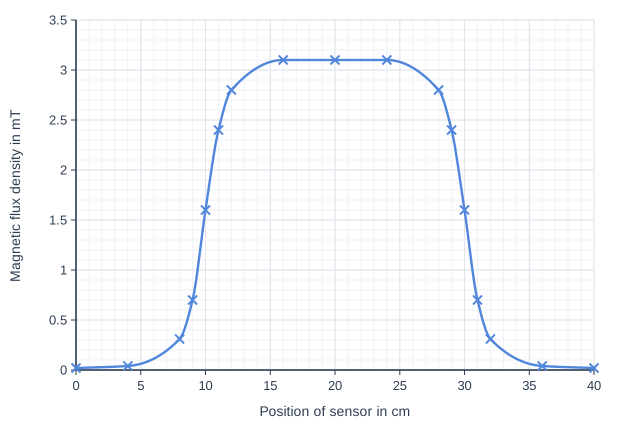
Hannah moves a magnetic field sensor along the axis of a long solenoid that carries a current. She starts outside one end, moves the sensor through the middle of the coil and out of the other end.

The solenoid is 20 cm long. Its ends are at the 10 cm and 30 cm marks on her scale.

The graph shows her results.

Describe what the graph shows about the magnetic field inside and outside the solenoid.

Line graph of magnetic flux density in mT (y-axis, 0 to 3.5) against position of sensor in cm (x-axis, 0 to 40). The line is a smooth curve through (0, 0.02), (4, 0.04), (8, 0.31), (9, 0.7), (10, 1.6), (11, 2.4), (12, 2.8), (16, 3.1), (20, 3.1), (24, 3.1), (28, 2.8), (29, 2.4), (30, 1.6), (31, 0.7), (32, 0.31), (36, 0.04), (40, 0.02).

Model answer

Inside the solenoid the field is strong and almost uniform: from about 15 cm to 25 cm the flux density stays at about 3.1 mT. Near the ends it falls quickly, to about 1.6 mT (half the middle value) at 10 cm and 30 cm. Outside the solenoid the field is much weaker: it falls to about 0.3 mT at 8 cm and 32 cm and is almost zero further away.

Explanation

The flat part of the graph shows the strong, almost uniform field along the centre of the solenoid, where the fields of all the turns add together. Outside, the fields of the turns largely cancel, so the field is much weaker and soon becomes very small. Good answers quote readings from the graph rather than only saying 'high' and 'low'.

Mark scheme
  1. 1 mark

    the field is (almost) uniform / constant along the middle of the solenoid, e.g. from about 15 cm to 25 cm (1)

    Any four from the five points; max 4. accept 'the reading stays about the same inside'.

  2. 1 mark

    the field is strongest inside the solenoid, about 3.1 mT (1)

    accept values from 3.0 to 3.2 mT.

  3. 1 mark

    at the ends (10 cm and 30 cm) the field is about half its value in the middle / about 1.6 mT (1)

    accept values from 1.4 to 1.8 mT; accept 'the field falls quickly near the ends'.

  4. 1 mark

    the field outside the solenoid is (much) weaker (1)

    accept 'the field is weak outside'.

  5. 1 mark

    the field outside falls to almost zero within a few centimetres of each end, e.g. about 0.3 mT at 8 cm / 32 cm (1)

    accept any correct reading outside the coil, e.g. 'about 0.04 mT at 4 cm'. The field outside is not exactly zero.

Ready to try the rest? Every answer you write is marked against the mark scheme, so you can see exactly where the marks are.

Study Helper Hints first, answers after you try

Stuck on this one? Ask for a hint and I’ll point you in the right direction, without giving the answer away. Once you’ve checked your answer, I’ll show you how the marks are awarded.