Level:
Correct: 0
Incorrect: 0
Marks: 0/0
Exam Practice
Course:
Topics:
Avg
score:
–
Topics
done:
0/21

Types of feedback

Practise 20 exam-style questions on Types of feedback for AQA GCSE Physical Education (Paper 2). Write your answer as you would in the exam and get it marked in seconds against the mark scheme, point by point, with the Study Helper on hand if you get stuck.

  • 20 questions
  • 1–9 marks each
  • Instant marking
  • No sign-up needed
20 questions, marked as you go

Sample questions with model answers

Here are 4 of the questions in this topic, each with a model answer, an explanation of why it earns the marks and the mark scheme an examiner would use.

Question 1

1 mark

Which type of feedback is most suitable for motivating a beginner?

Choose your answer.

  • Negative
  • Intrinsic
  • Positive
  • Knowledge of performance

Model answer

Positive

Explanation

Positive feedback tells the performer what they did well, which builds confidence and motivation and reinforces the correct action. Negative feedback can demotivate a beginner, beginners cannot yet interpret intrinsic feedback well, and detailed knowledge of performance can overload them.

Mark scheme
  1. 1 mark

    Positive

    If more than one option is given, 0 marks.

Question 2

2 marks

Give two ways that a performer could receive extrinsic feedback during a match.

Model answer

A performer could receive extrinsic feedback from their coach shouting comments from the side of the pitch, or from the scoreboard showing the score.

Explanation

Extrinsic feedback is any information about performance that comes from outside the performer: coaches, teammates, the crowd, scoreboards, statistics and video. A common mistake is to give the feel of a movement, which is intrinsic feedback.

Mark scheme
  1. 1 mark

    From the coach / manager, e.g. comments or instructions from the side of the pitch / at half-time

  2. 1 mark

    From teammates / captain

  3. 1 mark

    From the crowd's reaction / cheering

  4. 1 mark

    From the scoreboard / clock / match statistics / video replays at half-time

    Max 2 marks. Do not accept 'the feel of the movement' (intrinsic).

Question 3

3 marks

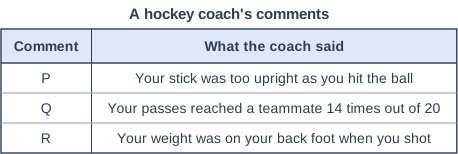
A hockey coach made three comments to a player after a training drill. The table shows the comments, labelled P, Q and R.

State whether each comment gives knowledge of results or knowledge of performance.

A hockey coach's comments. Table with columns "Comment", "What the coach said". Comment: P; What the coach said: Your stick was too upright as you hit the ball | Comment: Q; What the coach said: Your passes reached a teammate 14 times out of 20 | Comment: R; What the coach said: Your weight was on your back foot when you shot.

Model answer

P gives knowledge of performance, Q gives knowledge of results and R gives knowledge of performance.

Explanation

Comments P and R are about the quality of the player's technique (stick angle and weight distribution), so they give knowledge of performance. Comment Q is about the outcome of the passes (14 out of 20 reached a teammate), so it gives knowledge of results. A common mistake is to treat any comment with a number as knowledge of performance.

Mark scheme
  1. 1 mark

    P = knowledge of performance

    Accept 'KP'.

  2. 1 mark

    Q = knowledge of results

    Accept 'KR'.

  3. 1 mark

    R = knowledge of performance

    Accept 'KP'.

Question 4

6 marks

Lily is a beginner learning to serve in volleyball.

Evaluate the use of different types of feedback for Lily.

Model answer

Feedback can be positive or negative, knowledge of results (KR) or knowledge of performance (KP), and intrinsic or extrinsic. As Lily is a beginner, positive feedback would be very effective. If her coach says 'Great - you hit the ball with the heel of your hand', it reinforces the correct action and builds her confidence and motivation. Negative feedback should be used carefully, because a beginner makes many errors and constant criticism could demotivate her; it should be constructive and combined with praise.

KR, such as whether the serve landed in the court, is simple and easy for Lily to understand, and it motivates her when the serve goes in. However, it does not tell her why a serve went into the net, so she would also benefit from simple KP, such as 'toss the ball a little lower', which helps her correct her technique. The KP must be brief, as too much detail could overload her.

Extrinsic feedback from her coach is essential, because Lily does not yet know what a good serve feels like, so she cannot rely on intrinsic feedback. As she practises, she will start to recognise the feel of a good contact, and intrinsic feedback will become more useful.

Overall, Lily would benefit most from positive, extrinsic feedback, using KR together with simple KP, with negative feedback kept constructive and limited.

Explanation

Strong answers cover all three pairs of feedback types, apply each to Lily's serve and judge how useful each one is for a beginner, ending with a clear conclusion. A common mistake is to define the types of feedback without evaluating them for a beginner.

Mark scheme
  1. 6 marks

    Levels of response (6 marks). AO1 = 1, AO2 = 2, AO3 = 3.
    Level 3 (5-6 marks): Knowledge of types of feedback is accurate and generally well detailed. Application to Lily as a beginner learning to serve is mostly appropriate, clear and effective. Evaluation is thorough, reaching valid and well-reasoned conclusions for different types of feedback. The answer is generally clear, coherent and focused, with appropriate use of terminology throughout.
    Level 2 (3-4 marks): Knowledge of types of feedback is evident but is more detailed for some types than others. There is some appropriate and effective application to Lily, although not always balanced and presented with clarity. Any evaluation is clear but reaches valid conclusions for some types of feedback more than others. The answer lacks coherence in places, although terminology is used appropriately on occasions.
    Level 1 (1-2 marks): Knowledge of types of feedback is limited. Application to Lily is either absent or inappropriate. Evaluation is poorly focused or absent, with few or no reasoned conclusions. The answer as a whole lacks clarity and has inaccuracies. Terminology is either absent or inappropriately used.
    0 marks: no relevant content.

    Possible content may include:
    AO1 - positive / negative; knowledge of results / knowledge of performance; intrinsic / extrinsic.
    AO2 - positive: praise for a good contact with the heel of the hand; negative: the toss was too high; knowledge of results: whether the serve landed in the court; knowledge of performance: comments on the toss, arm swing or contact; extrinsic: from the coach; intrinsic: the feel of the contact.
    AO3 - positive feedback motivates a beginner, builds confidence and reinforces the correct action; negative feedback could demotivate her, so it should be limited and constructive; knowledge of results is simple and motivating when the serve goes in, but does not explain why it failed; knowledge of performance helps her correct technique but must be simple to avoid overload; extrinsic feedback is essential because she does not yet know what a good serve feels like; intrinsic feedback becomes more useful as she improves; conclusion, e.g. mainly positive, extrinsic feedback, with knowledge of results and simple knowledge of performance.
    Credit other suitable responses relevant to the question.

Ready to try the rest? Every answer you write is marked against the mark scheme, so you can see exactly where the marks are.

Study Helper Hints first, answers after you try

Stuck on this one? Ask for a hint and I’ll point you in the right direction, without giving the answer away. Once you’ve checked your answer, I’ll show you how the marks are awarded.