Practise 19 exam-style questions on Technology in sport for AQA GCSE Physical Education (Paper 2). Write your answer as you would in the exam and get it marked in seconds against the mark scheme, point by point, with the Study Helper on hand if you get stuck.
19 questions
1–9 marks each
Instant marking
No sign-up needed
19 questions, marked as you go
Sample questions with model answers
Here are 4 of the questions in this topic, each with a model answer, an explanation of why it earns the marks and the mark scheme an examiner would use.
Question 1
1 mark
Which one of these is a positive impact of technology on a sponsor/company?
Choose your answer.
its logo is shown on screen every time a decision is reviewed
performance analysis helps a performer improve their technique
small clubs cannot afford the technology used by elite clubs
its name is linked with a review system that makes a wrong decision
Model answer
Its logo is shown on screen every time a decision is reviewed.
Explanation
Companies can sponsor the technology itself, such as replay graphics or timing systems, so their brand is seen by the audience every time it is used. Being linked with a system that gets a decision wrong is a negative for the sponsor. The other options describe impacts on performers and on the sport.
Mark scheme
1 mark
its logo is shown on screen every time a decision is reviewed / logo shown during reviews
Do not accept: performance analysis (impact on performers), small clubs cannot afford it (negative impact on the sport), linked with a wrong decision (negative impact on the sponsor). If more than one option is given, 0 marks.
Question 2
3 marks
Explain how technology can have a positive impact on a sport.
Model answer
Technology makes officials' decisions more accurate, so results are fairer and the sport's credibility improves. Replays and reviews also add excitement for viewers, which attracts sponsors and more money into the sport. Cheating such as diving can be spotted and punished, so it happens less.
Explanation
For the sport as a whole, technology brings fairness and credibility, deters cheating, raises standards and can make the sport more attractive to the media and sponsors. Keep the focus on the sport rather than on one individual. Each point should explain why the change is good for the sport.
Mark scheme
1 mark
decisions are more accurate, so results are fairer
1 mark
fairer results improve the sport's credibility / reputation
1 mark
reviews and replays make the sport more exciting to watch, attracting viewers, sponsors and money
1 mark
cheating or gamesmanship, eg diving, can be detected and punished, so it is reduced
1 mark
performance analysis and better equipment raise the standard of performance in the sport
Accept any other suitable explanation. max 3
Question 3
3 marks
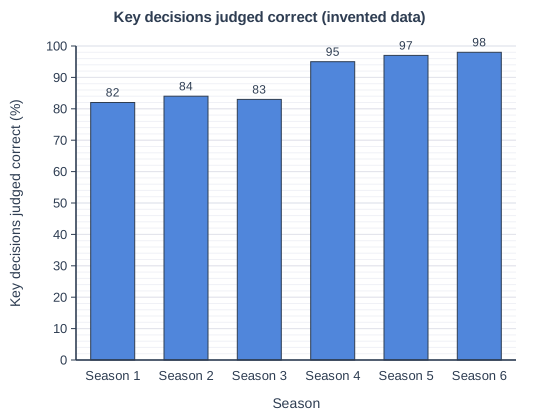
The bar chart shows the percentage of key decisions judged to be correct in an invented professional league over six seasons. A video review system was introduced at the start of Season 4.
Using the bar chart, describe the effect of the review system. Explain one positive and one negative impact of the review system on officials.
Model answer
After the review system was introduced, the percentage of correct decisions rose from 83% in Season 3 to 95% in Season 4, and kept rising to 98% by Season 6. A positive impact is that officials make fewer mistakes, so they face less criticism. A negative impact is that their authority is undermined when their decisions are overturned in front of everyone.
Explanation
Describe the change at the point the technology was introduced, using figures (83% to 95%), and note the continued improvement. Then link the data to officials: fewer mistakes is positive, but over-reliance and having decisions overturned are negatives. Make sure the impacts are on officials, not on performers or spectators.
Mark scheme
1 mark
correct decisions rose from 83% in Season 3 to 95% in Season 4 (a rise of 12 percentage points) and continued to rise to 98% in Season 6
Description: 1 mark. Figures must be correct.
1 mark
Positive: officials make fewer mistakes, so they receive less criticism or abuse / their credibility and confidence improve
Positive impact: max 1.
1 mark
Negative: officials may become reliant on the technology / their authority is undermined when decisions are overturned / 2% of decisions are still wrong, so officials are still blamed
Negative impact: max 1. Accept any other suitable impact on officials.
Question 4
4 marks
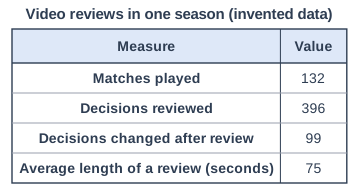
The table shows invented data from one season of a professional rugby league after a video review system was introduced.
Calculate the percentage of reviewed decisions that were changed. Then use the data to evaluate the impact of the review system on the sport.
Model answer
Percentage changed = 99 ÷ 396 × 100 = 25%.
This means one in four of the reviewed decisions was wrong and was corrected, so results in the league were fairer and the sport's credibility improved. However, there were 3 reviews per match (396 ÷ 132), each lasting 75 seconds on average, adding about 225 seconds (3.75 minutes) per match, which slows the game down. Also, 75% of reviewed decisions were already correct, so many reviews were unnecessary. Overall, correcting 99 wrong decisions is worth the extra time.
Explanation
Percentage = part ÷ whole × 100, so 99 ÷ 396 × 100 = 25%. For the evaluation, use the data on both sides: more correct results against extra time per match (3 reviews × 75 s = 225 s). Using figures from the table, rather than general points about technology, is what earns the evaluation marks.
Mark scheme
1 mark
25% (99 ÷ 396 × 100)
Calculation: 1 mark. Correct answer with no working scores the mark.
1 mark
one in four reviewed decisions was wrong and corrected, so results are fairer / the sport's credibility improves
Evaluation: sub-max 3.
1 mark
there were 3 reviews per match (396 ÷ 132), adding about 225 seconds / 3.75 minutes per match (3 × 75 s), which slows the game and may frustrate spectators
Accept 'almost 4 minutes per match'.
1 mark
75% of reviewed decisions were already correct, so many reviews were unnecessary / it shows officials are usually right
1 mark
a justified judgement, eg the gain in fairness from correcting 99 decisions outweighs the extra time
Evaluative points must use the data. Accept any other suitable point. max 4
Ready to try the rest? Every answer you write is marked against the mark scheme, so you can see exactly where the marks are.
Ctrl + Enter to check
Study HelperHints first, answers after you try
Stuck on this one? Ask for a hint and I’ll point you in the right direction, without giving the answer away. Once you’ve checked your answer, I’ll show you how the marks are awarded.