
Level:
Correct: 0
Incorrect: 0
Marks: 0/0
Exam Practice
Course:
Topics:
Avg
score:
–
Topics
done:
0/21

Energy use and a balanced diet

Practise 22 exam-style questions on Energy use and a balanced diet for AQA GCSE Physical Education (Paper 2). Write your answer as you would in the exam and get it marked in seconds against the mark scheme, point by point, with the Study Helper on hand if you get stuck.

  • 22 questions
  • 1–9 marks each
  • Instant marking
  • No sign-up needed
20 questions, marked as you go

Sample questions with model answers

Here are 4 of the questions in this topic, each with a model answer, an explanation of why it earns the marks and the mark scheme an examiner would use.

Question 1

1 mark

Fat provides more energy than carbohydrate. However, fat can only be used as an energy source:

Choose your answer.

  • at low intensity
  • at high intensity
  • during short sprints
  • when no protein is available

Model answer

at low intensity

Explanation

Fat provides more energy than carbohydrate, but only at low intensity, such as walking or slow jogging. Carbohydrate is the main and preferred energy source for all types of exercise, of all intensities, so it fuels high-intensity work such as sprinting.

Mark scheme
  1. 1 mark

    at low intensity

    If more than one option is given, 0 marks.
Question 2

2 marks

Explain why the average adult male requires more Kcal per day than the average adult female.

Model answer

On average, males are taller and heavier than females and have more muscle mass. A larger, more muscular body uses more energy to maintain and move, even at rest, so males need about 2,500 Kcal per day compared with 2,000 Kcal for females.

Explanation

Energy needs depend on gender and height. Males are, on average, larger and more muscular, and muscle uses more energy than fat, so the average requirement is 500 Kcal higher. These are averages: an active female athlete may need more than an inactive male.

Mark scheme
  1. 1 mark

    On average, males are taller/larger/heavier (height is a factor)

  2. 1 mark

    On average, males have more muscle mass, which uses more energy, even at rest

    Accept 'higher metabolic rate'.

  3. 1 mark

    A larger body uses more energy to maintain and to move, so more Kcal are needed

    Max 2. Do not accept 'men eat more' or 'men are more active' without reference to body size or muscle.

Question 3

3 marks

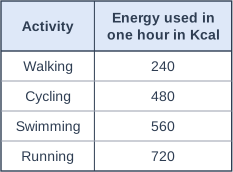
The table shows the approximate energy used in one hour of different activities by a 16-year-old (invented data).

Lucy is 16. She swims for 1.5 hours every day. Use the table to calculate the energy Lucy uses swimming each day, and explain why she may need more than the average female requirement of 2,000 Kcal per day.

Table with columns "Activity", "Energy used in one hour in Kcal". Activity: Walking; Energy used in one hour in Kcal: 240 | Activity: Cycling; Energy used in one hour in Kcal: 480 | Activity: Swimming; Energy used in one hour in Kcal: 560 | Activity: Running; Energy used in one hour in Kcal: 720.

Model answer

560 × 1.5 = 840 Kcal.
The number of Kcal a person needs depends on energy expenditure. Lucy uses about 840 Kcal a day swimming on top of her normal needs, so she is likely to need more than 2,000 Kcal to have enough energy for training.

Explanation

Multiply the energy used per hour by the number of hours: 560 × 1.5 = 840 Kcal. The 2,000 Kcal figure is an average; a person's needs depend on age, gender, height and energy expenditure, so a teenager who trains every day needs more. A common error is to add 560 and 1.5.

Mark scheme
  1. 1 mark

    560 × 1.5

    Method.

  2. 1 mark

    840 Kcal

    Correct answer with no working scores 2 marks.

  3. 1 mark

    Her energy expenditure is high because of her training, so she needs extra Kcal to provide energy for swimming (on top of her normal needs) / she is still growing (age), so needs energy for growth

    Explanation: 1 mark. Do not accept 'because she is female'.

Question 4

4 marks

Explain how a balanced diet helps a performer to recover between training sessions.

Model answer

Carbohydrate replaces the energy used in training, so the performer has enough energy for the next session. Protein repairs the muscle tissue damaged during training, so the muscles recover and grow stronger. Vitamins and minerals keep the body systems working efficiently and maintain general health, so the performer is less likely to be ill and miss training.

Explanation

Each nutrient has a role in recovery: carbohydrate restores energy, protein repairs muscle tissue, and vitamins and minerals keep the body systems healthy. An explanation needs both the role and how it helps the performer recover. Saying 'a balanced diet is healthy' scores nothing on its own.

Mark scheme
  1. 1 mark

    Carbohydrate replaces the energy used in training

    Award up to 4 marks for explained points; a nutrient with its correct role and the effect on recovery is needed for each mark.

  2. 1 mark

    So the performer has enough energy for the next session / is not fatigued

  3. 1 mark

    Protein is used for the growth and repair of muscle tissue damaged in training

  4. 1 mark

    So the muscles recover and adapt (become stronger) before the next session

  5. 1 mark

    Vitamins and minerals keep the body systems working efficiently / maintain general health, so the performer is less likely to be ill and miss training

  6. 1 mark

    A balanced diet provides the nutrients needed for hydration / replaces fluids lost in sweat

    Max 4.

Ready to try the rest? Every answer you write is marked against the mark scheme, so you can see exactly where the marks are.

Study Helper Hints first, answers after you try

Stuck on this one? Ask for a hint and I’ll point you in the right direction, without giving the answer away. Once you’ve checked your answer, I’ll show you how the marks are awarded.