Level:
Correct: 0
Incorrect: 0
Marks: 0/0
Exam Practice
Course:
Topics:
Avg
score:
–
Topics
done:
0/21

Arousal and the inverted-U theory

Practise 22 exam-style questions on Arousal and the inverted-U theory for AQA GCSE Physical Education (Paper 2). Write your answer as you would in the exam and get it marked in seconds against the mark scheme, point by point, with the Study Helper on hand if you get stuck.

  • 22 questions
  • 1–9 marks each
  • Instant marking
  • No sign-up needed
20 questions, marked as you go

Sample questions with model answers

Here are 4 of the questions in this topic, each with a model answer, an explanation of why it earns the marks and the mark scheme an examiner would use.

Question 1

1 mark

Which one of these skills is likely to need the highest level of arousal for the best performance?

Choose your answer.

  • A free throw in basketball
  • A clean and jerk in weightlifting
  • An archery shot
  • A putt in golf

Model answer

A clean and jerk in weightlifting

Explanation

A clean and jerk is a gross skill - a powerful, explosive movement using large muscle groups - so it is performed best at a high level of arousal. The other three are fine skills that need precision and control; high arousal would cause muscle tension and loss of concentration, so they need a low arousal level. Always link a skill, not a whole sport, to an arousal level.

Mark scheme
  1. 1 mark

    A clean and jerk in weightlifting

    Accept 'clean and jerk' or 'the weightlifting one'. If more than one option is given, 0 marks.

Question 2

2 marks

A cricket fielder has not been involved in the game for a long time. The ball is then hit high towards him for a catch.

Explain how being under-aroused could affect the fielder's attempt to take the catch.

Model answer

Because he has been inactive, he may be bored and not concentrating on the ball when it is hit. This means he reacts slowly and moves late, so he misjudges the catch and drops it.

Explanation

Under-arousal means the performer is not alert or ready, so attention drifts and reactions are slow - a common problem for fielders or goalkeepers who are rarely involved. On the inverted-U this is the left side of the curve, where performance is low. Don't describe anxiety or tension: those are effects of over-arousal.

Mark scheme
  1. 1 mark

    He may not be alert / ready / focused on the ball / may lack concentration

    Accept 'bored / switched off'.

  2. 1 mark

    So he reacts slowly / moves late / misjudges the flight of the ball / drops the catch

    Must describe an effect on the catch.

  3. 1 mark

    He may lack effort / motivation, so does not move or dive for the ball

    Max 2 marks. Answers describing over-arousal (anxiety, tension) score 0.

Question 3

3 marks

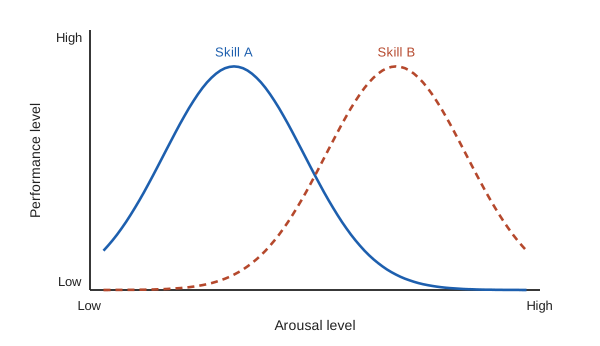
Figure 1 shows inverted-U curves for two skills, A and B. One curve is for an archer releasing an arrow and the other is for a rugby player pushing in a scrum.

State which skill is shown by each curve. Justify your answer.

Graph of performance level against arousal level (both low to high) with two inverted-U curves: "Skill A" (solid) peaks at a lower arousal level and "Skill B" (dashed) peaks at a higher arousal level.

Model answer

Skill A is the archer releasing an arrow and Skill B is the rugby player pushing in a scrum. Releasing an arrow is a fine skill that needs a steady hold and great precision, so it is performed best at a low level of arousal, which is where curve A peaks. Pushing in a scrum is a gross skill that uses large muscle groups to produce strength and power, so it is performed best at a high level of arousal, which is where curve B peaks.

Explanation

Fine skills have a lower optimal arousal level than gross skills, so the curve that peaks further left belongs to the fine skill. High arousal helps a powerful gross skill such as a scrum, but would make an archer tense and shaky. Remember the justification must link the skill type to the arousal level, not just name the sport.

Mark scheme
  1. 1 mark

    Skill A is the archery release and Skill B is the scrum

    Both must be correct for this mark.

  2. 1 mark

    Releasing an arrow is a fine skill / needs precision / accuracy / a steady hold, so it is performed best at a lower arousal level, where curve A peaks

    If the skills are matched to the wrong curves, a justification point can still be credited only if it correctly links the skill to its skill type and arousal level.

  3. 1 mark

    Pushing in a scrum is a gross skill / uses large muscle groups / needs strength and power, so it is performed best at a higher arousal level, where curve B peaks

Question 4

6 marks

A weightlifter is preparing for her final lift in a competition.

Using the inverted-U theory, analyse how her level of arousal could affect her performance of the lift.

Model answer

Arousal is a physical and mental state of alertness or readiness. The inverted-U theory says that performance improves as arousal increases up to an optimal level, after which further arousal causes performance to fall.

A weightlifting lift is a gross skill: it uses large muscle groups to produce maximal, explosive force. This means her optimal level of arousal is relatively high. If she is under-aroused, perhaps because she feels the competition is already won or lost, she will not be ready to give maximum effort. She may drive the bar up too slowly and fail to complete the lift, so her performance is low.

At her optimal level of arousal she will be alert, focused and 'psyched up', so she can apply maximum power at the right moment while keeping good technique, giving her best performance.

However, the pressure of a final lift, with the crowd watching and a medal at stake, could push her past her optimal point. If she becomes over-aroused she may feel anxious, her muscles may be too tense and she may lose concentration on her technique. She might rush the lift, lose balance under the bar or drop it, so performance falls again and she risks injury.

Because the lift is a gross skill, she can cope with a higher arousal level than a performer of a fine skill, but it must still be controlled. Overall, she needs a high but controlled level of arousal to lift her best.

Explanation

A top answer explains all three parts of the curve (under-aroused, optimal, over-aroused) and applies each to the lift. Classifying the lift as a gross skill shows why her optimal arousal is high, and analysing the pressure of a final lift shows how she could still go past it. Avoid simply describing the graph without linking it to the weightlifter.

Mark scheme
  1. 6 marks

    Levels of response (6 marks). AO1 = 1, AO2 = 2, AO3 = 3.
    Level 3 (5-6 marks): Knowledge of arousal and the inverted-U theory is accurate and generally well detailed. Application to the weightlifter's lift is mostly appropriate, clear and effective. Analysis is thorough, reaching valid and well-reasoned conclusions about the effects of under-arousal, optimal arousal and over-arousal on the lift. The answer is generally clear, coherent and focused, with appropriate use of terminology throughout.
    Level 2 (3-4 marks): Knowledge of arousal and the inverted-U theory is evident but is more detailed for some parts of the theory than others. There is some appropriate and effective application to the weightlifter's lift, although not always presented with clarity. Any analysis is clear but reaches valid conclusions for some levels of arousal more than others. The answer lacks coherence in places, although terminology is used appropriately on occasions.
    Level 1 (1-2 marks): Knowledge of arousal and the inverted-U theory is limited. Application to the weightlifter's lift is either absent or inappropriate. Analysis is poorly focused or absent, with few or no reasoned conclusions. The answer as a whole lacks clarity and has inaccuracies. Terminology is either absent or inappropriately used.
    0 marks: no relevant content.

    Possible content may include: AO1 - arousal is a physical and mental state of alertness / readiness; inverted-U: performance increases with arousal up to an optimal (moderate) point, then decreases; under-arousal and over-arousal both lead to low performance; gross skills need high arousal, fine skills low arousal. AO2 - a lift is a gross skill using large muscle groups and explosive power; under-aroused: not ready, lifts too slowly / without enough power, fails the lift; optimal: alert, focused, drives the bar up powerfully with good technique; over-aroused: anxious, too tense, rushes, loses balance or technique, drops the bar. AO3 - because the lift is a gross skill her optimal arousal is relatively high, so being 'psyched up' helps; but the pressure of a final lift (crowd, medal) could push her beyond her optimum; over-arousal would reduce performance and could cause injury; if she has already won or cannot win she may be under-aroused and fail to give maximum effort; judgement: she needs a high but controlled arousal level. Credit other suitable responses relevant to the question.

Ready to try the rest? Every answer you write is marked against the mark scheme, so you can see exactly where the marks are.

Study Helper Hints first, answers after you try

Stuck on this one? Ask for a hint and I’ll point you in the right direction, without giving the answer away. Once you’ve checked your answer, I’ll show you how the marks are awarded.