
Level:
Correct: 0
Incorrect: 0
Marks: 0/0
Exam Practice
Course:
Topics:
Avg
score:
–
Topics
done:
0/21

Intrinsic and extrinsic motivation

Practise 19 exam-style questions on Intrinsic and extrinsic motivation for AQA GCSE Physical Education (Paper 2). Write your answer as you would in the exam and get it marked in seconds against the mark scheme, point by point, with the Study Helper on hand if you get stuck.

  • 19 questions
  • 1–9 marks each
  • Instant marking
  • No sign-up needed
19 questions, marked as you go

Sample questions with model answers

Here are 4 of the questions in this topic, each with a model answer, an explanation of why it earns the marks and the mark scheme an examiner would use.

Question 1

1 mark

Which one of these is a possible disadvantage of overusing extrinsic rewards?

Choose your answer.

  • The performer may become reliant on rewards
  • The performer's intrinsic motivation becomes stronger
  • The performer will always enjoy the sport more
  • The performer no longer needs feedback

Model answer

The performer may become reliant on rewards

Explanation

If extrinsic rewards are overused, a performer can come to depend on them and lose interest when they stop. Overuse can also undermine intrinsic motivation - it weakens it rather than making it stronger, which is the misconception in the second option.

Mark scheme
  1. 1 mark

    The performer may become reliant on rewards

    Accept a clear shortened form, e.g. 'reliant on rewards'. If more than one option is given, 0 marks.
Question 2

2 marks

Explain how an extrinsic reward could lead to a performer becoming intrinsically motivated.

Model answer

Winning a medal can make a performer feel proud and satisfied with what they have achieved. They may then want to feel that sense of achievement again, so they keep training for their own satisfaction rather than for the medal itself.

Explanation

The specification notes that extrinsic rewards may result in feelings of pride and self-satisfaction. These are intrinsic feelings, so a reward can help build intrinsic motivation - as long as it is not overused.

Mark scheme
  1. 1 mark

    An extrinsic reward (e.g. winning a medal / receiving praise) can give the performer feelings of pride / self-satisfaction / personal achievement

  2. 1 mark

    They then want to experience that feeling again, so they train / take part for their own satisfaction (motivation from within)

Question 3

3 marks

Pat is 62 and still races in local cycling events, even though she no longer wins any prizes.

Explain how intrinsic motivation helps Pat to keep taking part.

Model answer

Intrinsic motivation comes from within. Pat races because she enjoys it and feels a sense of personal achievement when she finishes or beats her own time on a course. Because her motivation does not depend on prizes, not winning does not put her off, so she keeps taking part.

Explanation

Pat is a good example of why intrinsic motivation is seen as more effective: it does not depend on rewards, so it keeps people taking part for years. Apply the definition to Pat by naming what she gets from within, such as enjoyment or pride.

Mark scheme
  1. 1 mark

    Intrinsic motivation comes from within / is for enjoyment / pride / self-satisfaction / personal achievement

  2. 1 mark

    Applied to Pat, e.g. she enjoys racing / feels proud of finishing / of beating her own best time on a course

    Must be applied to Pat or cycling.

  3. 1 mark

    She does not rely on prizes / extrinsic rewards, so not winning does not stop her taking part

  4. 1 mark

    Intrinsic motivation is more likely to lead to continued effort and participation

    Max 3 marks.

Question 4

4 marks

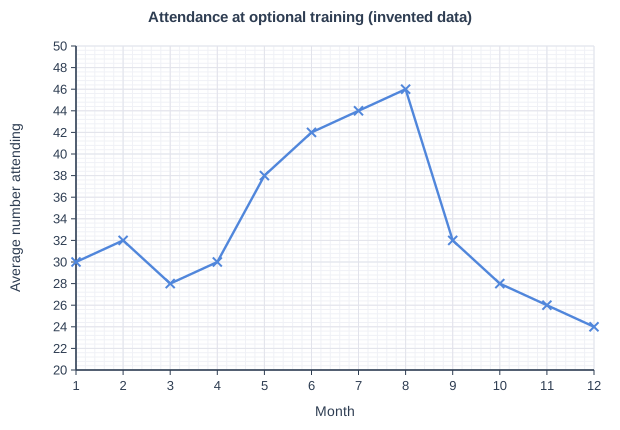
A junior tennis club recorded the average number of members attending its optional training sessions each month for a year. In months 5 to 8, members collected points for attending, which they could swap for prizes. The points scheme stopped after month 8. The graph shows the results.

Analyse the data. Explain what it suggests about the use of extrinsic rewards.

Attendance at optional training (invented data). Line graph of average number attending (y-axis, 20 to 50) against month (x-axis, 1 to 12). The line joins the points (1, 30), (2, 32), (3, 28), (4, 30), (5, 38), (6, 42), (7, 44), (8, 46), (9, 32), (10, 28), (11, 26), (12, 24).

Model answer

Before the points scheme, attendance was steady at about 30 members a month. While the scheme ran, attendance rose every month, reaching 46 in month 8. When the scheme stopped, attendance dropped sharply to 32 in month 9 and kept falling to 24 by month 12, lower than before the scheme started. This suggests that the extrinsic rewards only increased participation while they were available: members became reliant on the prizes. Because attendance fell below its original level, the rewards may even have undermined the members' intrinsic motivation, which is more likely to lead to continued participation.

Explanation

Describe the three phases with data: steady at about 30, rising to 46 with rewards, then falling to 24 without them. The fall below the starting level is the key evidence that the rewards created reliance and may have weakened intrinsic motivation. Always explain what the pattern shows, not just what it is.

Mark scheme
  1. 1 mark

    Months 1 to 4: attendance was steady at about 30 (between 28 and 32)

    Data quoted must be correct.

  2. 1 mark

    Months 5 to 8 (points scheme): attendance rose to a peak of 46 in month 8

  3. 1 mark

    After the scheme stopped, attendance fell to 24 by month 12 / to below the level before the scheme

  4. 1 mark

    This suggests extrinsic rewards increase participation only while they are given / members became reliant on the rewards

  5. 1 mark

    Attendance fell below its original level, suggesting the rewards undermined members' intrinsic motivation / intrinsic motivation is more likely to lead to continued participation

    Max 4 marks. At least one mark must come from an explanation (the last two points) for full marks.

Ready to try the rest? Every answer you write is marked against the mark scheme, so you can see exactly where the marks are.

Study Helper Hints first, answers after you try

Stuck on this one? Ask for a hint and I’ll point you in the right direction, without giving the answer away. Once you’ve checked your answer, I’ll show you how the marks are awarded.