Practise 18 exam-style questions on Hydration and dehydration for AQA GCSE Physical Education (Paper 2). Write your answer as you would in the exam and get it marked in seconds against the mark scheme, point by point, with the Study Helper on hand if you get stuck.
18 questions
1–9 marks each
Instant marking
No sign-up needed
18 questions, marked as you go
Sample questions with model answers
Here are 4 of the questions in this topic, each with a model answer, an explanation of why it earns the marks and the mark scheme an examiner would use.
Question 1
1 mark
Which one of these performers is most likely to become dehydrated?
Choose your answer.
A marathon runner on a hot day
A darts player in a cool hall
A snooker player in a match
A golfer putting on a cold morning
Model answer
A marathon runner on a hot day
Explanation
Dehydration is caused by excessive loss of body water, mainly through sweating. A marathon runner works continuously for hours and sweats heavily in the heat, so loses the most water. The other performers work at low intensity in cool conditions, so sweat much less - although dehydration would still affect their reactions and decisions.
Mark scheme
1 mark
A marathon runner on a hot day
Accept 'marathon runner'. If more than one option is given, 0 marks.
Question 2
2 marks
Explain how dehydration could affect the performance of a basketball point guard, whose role is to read the game and pass to teammates.
Model answer
Dehydration slows her reactions and leads to poorer decisions. She may be slower to spot a free teammate or react to a defender stepping in, so her passes are more likely to be intercepted, or she may choose the wrong pass and lose possession.
Explanation
As well as physical effects, dehydration slows reactions (increased reaction time) and causes poorer decisions. For a playmaker, who constantly makes quick decisions under pressure, this can cost the team possession. Linking the effect to the role is what earns the second mark.
Mark scheme
1 mark
Dehydration slows reactions / increases reaction time / leads to poorer decisions
Do not accept 'decreases reaction time'.
1 mark
Applied: e.g. she is slower to spot an open teammate or react to a defender, so passes are intercepted / chooses the wrong pass or play, losing possession
Must be linked to the point guard's role.
Question 3
3 marks
Explain how dehydration affects the blood of a 10,000 m runner, and why this reduces her performance.
Model answer
Dehydration makes her blood thicker, so it flows more slowly around her body. Less oxygen reaches her working leg muscles, so she tires sooner and has to slow down.
Explanation
Thicker blood (increased viscosity) flows more slowly, so less oxygen reaches the muscles - a big problem in a 10,000 m race, which is mainly aerobic. The explanation must link the change in the blood to the performance, not just state that she will run slower.
Mark scheme
1 mark
The blood thickens (increased viscosity)
1 mark
Which slows blood flow
1 mark
So less oxygen is delivered to the working muscles / waste such as carbon dioxide is removed more slowly, so she fatigues and has to slow down
Must be linked to her running performance. Do not credit the effect on performance without the explanation of reduced oxygen delivery or waste removal.
Question 4
4 marks
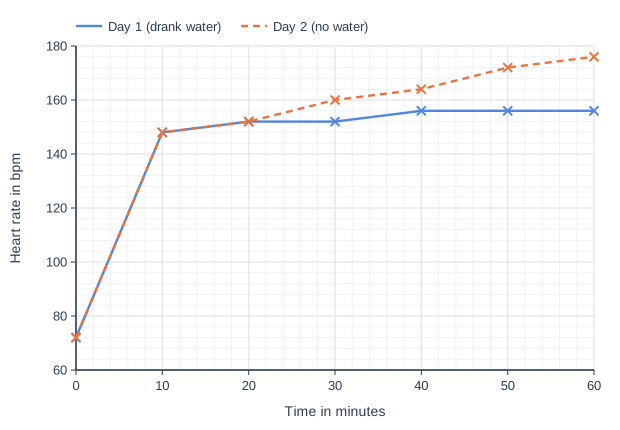
Ola ran on a treadmill at the same steady speed for 60 minutes on two different days. On Day 1 she drank water every 15 minutes. On Day 2 she drank nothing. The graph shows her heart rate on each day (invented data).
Compare Ola's heart rate on the two days and explain the difference. Use data from the graph in your answer.
Model answer
For the first 20 minutes Ola's heart rate was the same on both days, 148 bpm at 10 minutes and 152 bpm at 20 minutes. After that, on Day 1 it levelled off at about 156 bpm, but on Day 2 it kept rising, reaching 176 bpm at 60 minutes - 20 bpm higher than on Day 1. On Day 2 she drank nothing, so she became dehydrated. Her blood became thicker and flowed more slowly, so her heart had to work harder and beat faster to deliver enough oxygen to her muscles at the same speed.
Explanation
When speed is the same, a rising heart rate shows the body is under more strain. Dehydration thickens the blood and raises body temperature, so the heart must beat faster to supply the muscles. Use data from both lines in a comparison, and notice that the difference only appears as water loss builds up.
Mark scheme
1 mark
Her heart rate was the same on both days for the first 20 minutes (148 bpm at 10 minutes, 152 bpm at 20 minutes)
Comparison using data: sub-max 2 marks. Accept values within 2 bpm of those plotted.
1 mark
After 20 minutes it rose steadily on Day 2, reaching 176 bpm at 60 minutes, but levelled off at about 156 bpm on Day 1 / it was 20 bpm higher on Day 2 at 60 minutes
1 mark
On Day 2 she became dehydrated, so her blood thickened (increased viscosity) and flowed more slowly
Explanation: sub-max 2 marks.
1 mark
So her heart had to work harder / beat faster to deliver enough oxygen to her muscles / her body temperature rose, sending more blood to the skin
Max 4.
Ready to try the rest? Every answer you write is marked against the mark scheme, so you can see exactly where the marks are.
Ctrl + Enter to check
Study HelperHints first, answers after you try
Stuck on this one? Ask for a hint and I’ll point you in the right direction, without giving the answer away. Once you’ve checked your answer, I’ll show you how the marks are awarded.