
Level:
Correct: 0
Incorrect: 0
Marks: 0/0
Exam Practice
Course:
Topics:
Avg
score:
–
Topics
done:
0/21

Engagement patterns of different social groups

Practise 26 exam-style questions on Engagement patterns of different social groups for AQA GCSE Physical Education (Paper 2). Write your answer as you would in the exam and get it marked in seconds against the mark scheme, point by point, with the Study Helper on hand if you get stuck.

  • 26 questions
  • 1–9 marks each
  • Instant marking
  • No sign-up needed
20 questions, marked as you go

Sample questions with model answers

Here are 4 of the questions in this topic, each with a model answer, an explanation of why it earns the marks and the mark scheme an examiner would use.

Question 1

1 mark

Amira plays in a netball league. During the month of Ramadan she fasts from dawn until sunset, so she finds it hard to train and play matches during the day.

Which factor affecting engagement in physical activity and sport does this show?

Choose your answer.

  • familiarity
  • religion/religious festivals
  • media coverage
  • socio-economic factors

Model answer

Religion/religious festivals.

Explanation

Ramadan is a religious festival during which many Muslims fast in daylight hours, which lowers energy levels for training and daytime matches. This is the religion/religious festivals factor. Clubs can respond by being inclusive, for example by moving training to after sunset. Socio-economic factors are about money, so they do not apply here.

Mark scheme
  1. 1 mark

    religion/religious festivals / religion / religious festival

    Accept 'culture/religion'. Do not accept familiarity, media coverage or socio-economic factors. If more than one option is given, 0 marks.
Question 2

3 marks

Identify three factors that may reduce the engagement of disabled people in physical activity and sport.

Model answer

1. A lack of accessibility, for example no ramps, lifts or accessible changing rooms.
2. A lack of adapted activities or inclusive clubs.
3. Few disabled role models because disability sport gets little media coverage.

Explanation

The factors in the specification apply to every social group, so for disabled people think about access to buildings and transport, whether activities are adapted, the cost of specialist equipment, and whether disabled role models are visible in the media. Each answer must be a different factor: 'no ramps' and 'no lifts' are both accessibility, so they score only once.

Mark scheme
  1. 1 mark

    lack of accessibility / facilities, changing rooms or transport not accessible

    One mark per different factor, max 3. Factors may be named on their own as the command is 'Identify'.

  2. 1 mark

    lack of adaptability/inclusiveness / few adapted activities or inclusive clubs

  3. 1 mark

    few role models / little media coverage of disability sport

    Accept role models and media coverage as separate factors.

  4. 1 mark

    negative attitudes / stereotyping (by others, or low confidence of the person)

  5. 1 mark

    socio-economic factors / cost of specialist equipment, eg a sports wheelchair / low disposable income

  6. 1 mark

    lack of familiarity with disability sports / education, eg lack of trained coaches or limited opportunities in school

    Accept any other suitable factor. Do not credit 'disability' on its own. max 3

Question 3

3 marks

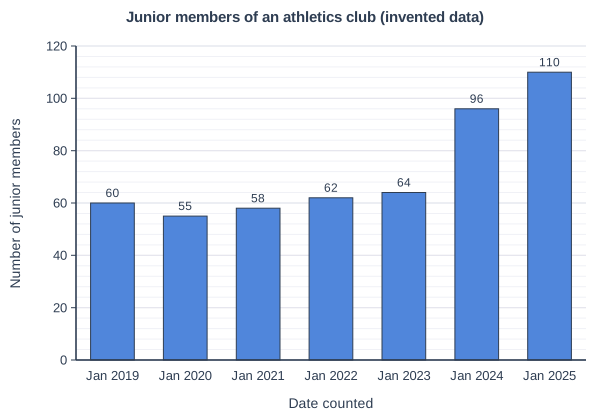
The bar chart shows the number of junior members at an invented athletics club, counted each January. In the summer of 2023, a sprinter who trained at the club won a gold medal at a major championship that was shown live on national television.

Using the bar chart, describe the change in membership after 2023 and suggest two reasons for it.

Junior members of an athletics club (invented data). Bar chart of number of junior members for each date counted: Jan 2019 60, Jan 2020 55, Jan 2021 58, Jan 2022 62, Jan 2023 64, Jan 2024 96, Jan 2025 110.

Model answer

Membership rose sharply after 2023, from 64 in January 2023 to 96 in January 2024, an increase of 32, and then to 110 in January 2025. The sprinter became a local role model, so young people were inspired to copy them by joining the club. The live television coverage also raised the profile of athletics, so more young people wanted to try it.

Explanation

Membership was steady (55-64) until 2023, then jumped by 32 members (a 50% rise) in one year. Role models and media coverage are both factors in the specification that can increase engagement, especially when the performer is local. Quote the figures before and after the event to describe the change.

Mark scheme
  1. 1 mark

    description using data: membership rose sharply from 64 in January 2023 to 96 in January 2024 (an increase of 32 / 50%) and then to 110 in January 2025

    Description: sub-max 1. Figures must be correct.

  2. 1 mark

    the sprinter acted as a role model, so young people were inspired to copy them / take up athletics at the same club

    Reasons: sub-max 2.

  3. 1 mark

    media coverage on national television raised the profile of athletics / the club, so more young people knew about it and wanted to try it

  4. 1 mark

    the club became better known locally / may have attracted sponsorship or run extra sessions, making it more accessible

    Accept any other suitable reason linked to the scenario. max 3

Question 4

4 marks

A national governing body has found that people from ethnic minority backgrounds are under-represented among the players and coaches in its sport.

Explain how role models and racial stereotyping may affect the engagement of people from ethnic minority backgrounds in the sport.

Model answer

In this sport there may be few players, coaches or officials from ethnic minority backgrounds, and those there are may get little media coverage. People from these backgrounds may therefore see no role models who share their background, so they may feel the sport is not for people like them and be less inspired to take it up or to train as coaches.

Racial stereotyping can also reduce engagement. Some people wrongly believe that those from certain ethnic backgrounds are naturally suited to some sports and not to others. Teachers, coaches or friends may then steer them towards other sports, and if they think they would be the only person from their background at a club, or worry about racist abuse, they may avoid joining.

Explanation

Race/religion/culture is one of the social groups in the specification, and role models, media coverage and stereotyping are factors that link to it. When people see successful performers and coaches who share their background, they are more likely to believe a sport is open to them; when they do not, or when stereotypes suggest they belong in other sports, engagement falls. Racial stereotypes are generalisations, not facts, so write 'some people believe ...' rather than stating them as true. Each pair of marks needs the factor and its effect on engagement.

Mark scheme
  1. 1 mark

    Role models: few visible players / coaches / officials from the same ethnic background in the sport / performers from that background receive little media coverage

    Role models (including media coverage): sub-max 2.

  2. 1 mark

    Role models: so people may feel the sport is 'not for people like them' / are less inspired to take it up / see no pathway into playing or coaching

    Accept the converse: high-profile performers from the same background, seen in the media, can inspire people to take up the sport.

  3. 1 mark

    Stereotyping: some people hold racial stereotypes that people from certain ethnic backgrounds are naturally suited to some sports or positions and not to others

    Stereotyping: sub-max 2.

  4. 1 mark

    Stereotyping: so teachers, coaches, peers or family may steer them towards other sports / they lack the confidence to try this sport / they fear being the only one from their background, or racist abuse, so avoid joining or drop out

    Accept culture/religion points within this sub-max if linked to engagement, eg a club that does not respect religious dress or festivals may feel unwelcoming. Answers that themselves state a stereotype as fact (eg 'people of one ethnic group are naturally better at sprinting') score 0 for that point; credit qualified statements ('some people believe ...'). max 4

Ready to try the rest? Every answer you write is marked against the mark scheme, so you can see exactly where the marks are.

Study Helper Hints first, answers after you try

Stuck on this one? Ask for a hint and I’ll point you in the right direction, without giving the answer away. Once you’ve checked your answer, I’ll show you how the marks are awarded.