Practise 25 exam-style questions on Performance-enhancing drugs for AQA GCSE Physical Education (Paper 2). Write your answer as you would in the exam and get it marked in seconds against the mark scheme, point by point, with the Study Helper on hand if you get stuck.
25 questions
1–9 marks each
Instant marking
No sign-up needed
20 questions, marked as you go
Sample questions with model answers
Here are 4 of the questions in this topic, each with a model answer, an explanation of why it earns the marks and the mark scheme an examiner would use.
Question 1
1 mark
Which one of these is a disadvantage to the sport, rather than to the performer, of performers taking PEDs?
Choose your answer.
the performer may be banned
the performer may suffer health problems
the sport loses credibility because results cannot be trusted
the performer may have to pay a fine
Model answer
The sport loses credibility because results cannot be trusted.
Explanation
The specification separates disadvantages to the performer (cheating, health risks, fines, bans, reputational damage) from disadvantages to the sport or event (reputation and credibility). When performers are caught doping, people stop trusting results and records, so the whole sport suffers.
Mark scheme
1 mark
the sport loses credibility because results cannot be trusted / loses credibility
Bans, health problems and fines are disadvantages to the performer. If more than one option is given, 0 marks.
Question 2
3 marks
Explain how blood doping increases a performer's red blood cell count.
Model answer
Blood is removed from the performer a few weeks before a competition and frozen. Over the next few weeks the body makes new red blood cells to replace the lost blood. Just before the competition the frozen blood is thawed and injected back in, so the performer has more red blood cells than normal.
Explanation
The key to blood doping is timing: the body replaces the removed blood before it is put back, so re-injecting it raises the red blood cell count above normal, increasing oxygen-carrying capacity. Many students forget the replacement step, which is what makes the extra cells possible.
Mark scheme
1 mark
blood is removed from the performer a few weeks before competition and frozen / stored
1 mark
the body replaces the lost blood / makes new red blood cells, so the red blood cell count returns to normal
1 mark
just before competition the stored blood is (thawed and) re-injected
1 mark
so the performer now has more red blood cells than normal / a higher red blood cell count
Accept 'increases oxygen-carrying capacity' as part of this point only if a higher red blood cell count is stated. Accept any other suitable explanation. max 3
Question 3
3 marks
Compare blood doping and taking EPO as ways of improving performance.
Model answer
Both blood doping and EPO increase the red blood cell count, so the blood can carry more oxygen, and both mainly benefit endurance performers such as long-distance cyclists. The difference is that EPO is a drug, a hormone that makes the body produce more red blood cells, whereas blood doping is a method in which the performer's own blood is removed, stored and re-injected. Blood doping also carries a risk of infection.
Explanation
A comparison needs similarities and differences. Both raise oxygen-carrying capacity and thicken the blood; the difference is how - EPO stimulates the body to make red blood cells, while blood doping adds stored blood back in. The specification calls blood doping a prohibited method rather than a prohibited substance.
Mark scheme
1 mark
Similarity: both increase the red blood cell count / oxygen-carrying capacity
1 mark
Similarity: both benefit endurance performers, eg marathon runners or long-distance cyclists / both thicken the blood, risking heart attack or embolism
1 mark
Difference: EPO is a drug (peptide hormone) that makes the body produce more red blood cells, whereas blood doping is a method that re-injects the performer's own blood that was removed and stored earlier
1 mark
Difference: blood doping carries a risk of infection from removing, storing and re-injecting blood
Answers giving only similarities or only differences max 2. Accept any other suitable comparison. max 3
Question 4
4 marks
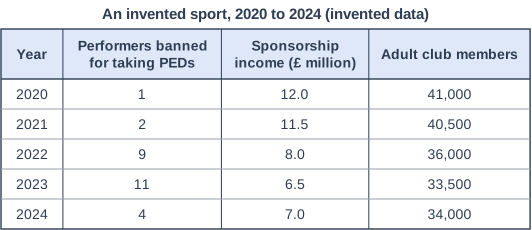
The table shows invented data for an invented sport over five years.
Using the data, analyse the impact on the sport of its performers taking PEDs.
Model answer
The number of performers banned rose sharply from 2 in 2021 to 9 in 2022 and 11 in 2023. Over the same years, sponsorship income fell from £11.5 million to £6.5 million and adult membership fell from 40,500 to 33,500. This suggests the doping cases damaged the sport's reputation, so sponsors did not want to be linked with cheating and withdrew their money. The sport also lost credibility, so fewer people wanted to take part. When bans fell to 4 in 2024, sponsorship and membership began to recover slightly, which shows a sport's reputation can slowly be rebuilt.
Explanation
Analyse the data by linking the columns: as bans rise, sponsorship and membership fall, and both recover a little when bans fall. Then explain the link using the specification's disadvantages to the sport - reputation and credibility. Strong answers quote figures and may note that a link in data does not prove cause.
Mark scheme
1 mark
the number of performers banned rose sharply from 2 in 2021 to 9 in 2022 and 11 in 2023
Use of data: sub-max 2. Figures must be correct.
1 mark
at the same time sponsorship income fell from 11.5 to 8.0 million pounds (and to 6.5 million in 2023) / adult members fell from 40,500 to 33,500
1 mark
the sport's reputation was damaged, so sponsors did not want their brand linked with cheating and withdrew money
Analysis: sub-max 3.
1 mark
the sport lost credibility, so fewer people wanted to take part / parents may have stopped their children joining clubs
1 mark
when bans fell in 2024 (to 4), sponsorship and membership began to recover slightly (7.0 million pounds, 34,000 members), suggesting the reputation can slowly recover
1 mark
the data shows a link but does not prove that PEDs caused the falls - other factors may be involved
Accept any other suitable analytical point using the data. max 4
Ready to try the rest? Every answer you write is marked against the mark scheme, so you can see exactly where the marks are.
Ctrl + Enter to check
Study HelperHints first, answers after you try
Stuck on this one? Ask for a hint and I’ll point you in the right direction, without giving the answer away. Once you’ve checked your answer, I’ll show you how the marks are awarded.