
Level:
Correct: 0
Incorrect: 0
Marks: 0/0
Exam Practice
Course:
Topics:
AQA GCSE Citizenship Studies (Paper 2) Smart practice A mixed round aimed at your weak spots
Unit 1
Life in modern Britain
What are the principles and values that underpin British society?
Principles and values of British society
What do we mean by identity?
Identity and diversity in the UK
What is the role of the media and the free press?
The media and a free press
What is the UK's role in key international organisations?
The UK and international organisations
How can citizens make their voice heard and make a difference in society?
Making your voice heard in society
Unit 2
Rights and responsibilities
What laws does a society require and why?
Why society needs laws
What are a citizen's rights and responsibilities within the legal system?
The justice system: police, courts and tribunals
Legal ages and the UK's legal systems
How has the law developed over time, and how does the law protect the citizen and deal with criminals?
How rights and laws have developed
Crime and punishment
What are the universal human rights and how do we protect them?
Universal human rights
How do citizens play a part to bring about change in the legal system?
Citizens and change in the legal system
Avg
score:
–
Topics
done:
0/12

The media and a free press

Practise 16 exam-style questions on The media and a free press for AQA GCSE Citizenship Studies (Paper 2). Write your answer as you would in the exam and get it marked in seconds against the mark scheme, point by point, with the Study Helper on hand if you get stuck.

  • 16 questions
  • 1–8 marks each
  • Instant marking
  • No sign-up needed
16 questions, marked as you go

Sample questions with model answers

Here are 4 of the questions in this topic, each with a model answer, an explanation of why it earns the marks and the mark scheme an examiner would use.

Question 1

1 mark

What is meant by the term 'public interest' when it is used about stories in the media?

Model answer

A story is in the public interest when the public has a right to know about it because it affects them, for example when it exposes crime or wrongdoing by people in power or warns people about a danger to their health or safety.

Explanation

The public interest is about what the public needs to know, not what it finds interesting. It can justify the media investigating and publishing stories that intrude on someone's privacy, for example to expose crime, protect health and safety or stop the public being misled. Defining it as 'what the public is interested in' is the most common error and scores 0.

Mark scheme
  1. 1 mark

    Information that the public has a right or a need to know because it affects them or society, e.g. exposing crime or wrongdoing, protecting public health and safety, or stopping the public being misled by people in power.

    Award 1 mark for a definition or an example that serves as a definition. An example serves as a definition if it shows why the public needs to know, e.g. 'reporting that a company has been selling unsafe food' or 'exposing a politician who has misused public money'. Do not accept 'stories the public are interested in' or 'what people want to read': what interests the public is not the same as the public interest.
Question 2

2 marks

Which two of the following are examples of censorship?

Choose two answers.

A A court orders that the media must not name a 15-year-old involved in a criminal case.
B A newspaper prints a letter from a reader who disagrees with its editor.
C A television debate invites speakers with opposing views.
D The Advertising Standards Authority bans a misleading advert.
E A newspaper publishes a correction to an inaccurate story.
F A citizen journalist posts a video of a protest online.

Model answer

A A court orders that the media must not name a 15-year-old involved in a criminal case.
D The Advertising Standards Authority bans a misleading advert.

Explanation

Censorship means an authority stopping something from being published or shown: a court reporting restriction and the ASA banning an advert both do this. Printing readers' letters and inviting opposing speakers are examples of the media as a forum for debate, a correction is the press being accountable for a mistake, and a citizen journalist's video is freedom of expression.

Mark scheme
  1. 2 marks

    A and D (A court orders that the media must not name a 15-year-old involved in a criminal case; The Advertising Standards Authority bans a misleading advert)

    1 mark for each correct option, max 2. Accept the letters or the option texts, in either order. If more than two options are given, each extra option cancels one correct one. Count every option the student gives: with exactly two, 1 mark for each correct one; with three, the number of correct ones among them minus 1; with four or more, 0 marks.

Question 3

4 marks

Source A

How young people get their news

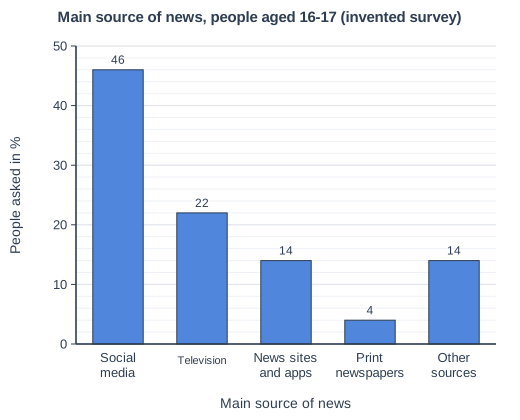
In an invented survey, 500 people aged 16 and 17 in one town were asked for their main source of news. Source A is a bar chart of the results ('other sources' includes radio, podcasts, family and friends).

The survey also found that:

• 3 in 10 had shared a news story online without checking whether it was true
• most said the posts they saw were chosen for them by the app they used.

Referring to Source A, discuss how the media can influence the opinions of young people.

Main source of news, people aged 16-17 (invented survey). Bar chart of people asked in % for each main source of news: Social media 46, Television 22, News sites and apps 14, Print newspapers 4, Other sources 14.

Model answer

Source A shows that social media is by far the most common main source of news for these young people (46%), so it is likely to have the biggest influence on their opinions. Because most said their posts are chosen by the app, algorithms show them stories similar to ones they have already liked. This can create an 'echo chamber' where they mainly see views they already agree with, so their opinions may become more one-sided. The survey also found that 3 in 10 had shared a story without checking it, which shows how misinformation can spread quickly and shape opinions on issues such as health or elections. Influencers and viral videos can also set the agenda, deciding which issues young people think are important. In contrast, 22% rely mainly on television news, which Ofcom requires to be accurate and impartial, so these young people are more likely to hear balanced views. Only 4% rely on printed newspapers, which can take political sides, although their stories are often shared on social media. The media can also influence young people positively, for example by informing them about issues and encouraging them to take part in campaigns or register to vote.

Explanation

Level 2 needs the data in Source A to be used and explained: why social media's large share matters, how algorithms and unchecked sharing shape opinions, and how regulated TV news differs. Describing the bar chart without explaining influence stays in Level 1. Positive influences can be credited as well as negative ones.

Mark scheme
  1. 4 marks

    Levels of response (4 marks).
    Level 2 (3-4 marks): Good application of knowledge and understanding of the concepts. Response clear and relevant to the concepts surrounding the citizenship context.
    Level 1 (1-2 marks): Basic application of knowledge and understanding of the concepts. Response muddled and lacking relevance to the concepts surrounding the citizenship context.
    0 marks: Nothing to credit.

    Max 2 if the answer makes no use of Source A. Indicative content (not exhaustive; credit other relevant points):
    - Social media is the main source for the largest group (46%), so it is likely to have the greatest influence.
    - Posts chosen by the app (algorithms) show users more of what they already like, which can create echo chambers or filter bubbles and make opinions more one-sided.
    - Sharing without checking (3 in 10) shows how misinformation and disinformation can spread and shape opinions.
    - Influencers, viral videos and campaigns can set the agenda, deciding which issues young people think are important.
    - Television (22%) must be accurate and impartial under Ofcom's rules, so it may give more balanced information; printed newspapers (4%) can take political sides, but their stories are often shared online.
    - Positive influence: informing young people about issues, encouraging participation (e.g. campaigns, registering to vote), giving a forum for young people's own views.
    - Media literacy, fact-checking and checking more than one source can reduce negative influence.
    Level 2 answers use the data and findings in Source A and explain how particular kinds of media shape opinions. Level 1 answers describe the chart or make general points about the media with little explanation.

Question 4

8 marks

'Newspapers should have to follow the same strict rules as television and radio broadcasters.'

Considering a range of views, to what extent do you agree or disagree with this statement?

In your answer you should consider:

• the role of a free press in a democracy
• the need for accuracy and respect for privacy.

Model answer

Some people agree that newspapers should follow the same strict rules as broadcasters. Television and radio news must be accurate and impartial under Ofcom's Broadcasting Code, and Ofcom can fine broadcasters or even take away their licence. Most newspapers, by contrast, are regulated by IPSO, which the press itself set up and funds, and which is not recognised under the Royal Charter that was created after the Leveson Inquiry. That inquiry was set up in 2011 after the phone-hacking scandal at the News of the World, where journalists had hacked the phones of crime victims and others, and it found that parts of the press had caused real harm to innocent people. Supporters of stricter rules argue that accuracy and respect for privacy matter just as much in newspapers, especially now that newspaper stories are shared widely online and can spread misinformation. They also argue that it makes little sense for the same story to face strict rules on TV but looser rules in print.

However, others argue that a free press is essential to democracy and must be independent of the state. Newspapers have a right to take sides and campaign, and the variety of opinions across different papers gives readers a range of views, which is part of healthy democratic debate. Impartiality rules were introduced for broadcasters partly because there were only a few channels and they came straight into people's homes, whereas readers choose which newspaper to buy. Newspapers are not unregulated: they must obey laws on defamation, privacy and contempt of court, and IPSO enforces an Editors' Code that covers accuracy and privacy and can make papers publish corrections. Stricter, state-backed rules could make editors reluctant to publish difficult investigations, such as the Daily Telegraph's exposure of the MPs' expenses scandal in 2009, and a future government could misuse such rules to silence critics, as happens in countries where the media is controlled.

Overall, I partly agree. Newspapers should meet the same high standards of accuracy and respect for privacy as broadcasters, enforced by a regulator that is genuinely independent of both the press and the government. But newspapers should not have to be impartial, because a free press that can take sides and campaign is one of the main ways citizens hold those in power to account.

Explanation

A top answer compares how broadcasters and newspapers are regulated, weighs press abuses (phone hacking, Leveson) against the importance of a free, independent press, and reaches a judgement. Strong answers separate the rules on accuracy and privacy from the rule on impartiality. Answers that only describe IPSO and Ofcom without evaluating stay in the lower levels.

Mark scheme
  1. 8 marks

    Levels of response (8 marks).
    Level 4 (7-8 marks): Developed and sustained analysis of a wide range of evidence and views related to the citizenship issue. Developed and reasoned justifications are given which relate to the evidence provided. The justifications put forward form a coherent argument.
    Level 3 (5-6 marks): Analysis of a range of evidence and views related to the citizenship issue. The evidence is used to support arguments but these arguments are not always completely developed, justified or evaluated. Conclusions drawn from the arguments may not be completely coherent.
    Level 2 (3-4 marks): Basic analysis of a limited range of evidence and views related to the citizenship issue. Weak arguments are made which are not necessarily related to the evidence selected. The arguments represent only a limited range of viewpoints. Some attempt is made to integrate the arguments into concluding remarks.
    Level 1 (1-2 marks): Limited evidence presented and/or evidence presented is not directly related to the citizenship issue. Insufficient range of differing viewpoints considered. Little or no attempt is made to analyse or evaluate the evidence presented. Little or no attempt is made to integrate the points made.
    0 marks: Nothing to credit.

    Max 4 if the answer considers only one side of the statement. Max 6 if the answer reaches no judgement.
    Points which may be included to agree with this statement are:
    - broadcast news must be accurate and impartial under Ofcom's Broadcasting Code, and Ofcom can fine broadcasters or remove their licence; newspapers face weaker sanctions
    - the phone-hacking scandal at the News of the World (which closed in 2011) and the Leveson Inquiry showed that parts of the press had caused serious harm to innocent people
    - IPSO was set up and is funded by the press itself and is not recognised under the Royal Charter; most major newspapers have not joined the recognised regulator, Impress
    - newspaper stories spread widely online, so inaccurate or one-sided reporting can mislead many people
    - it is inconsistent for the same story to face strict rules on TV but looser rules in print
    Points which may be included to disagree with this statement are:
    - a free press, independent of the state, is essential to democracy: newspapers' freedom to take sides and campaign is part of democratic debate, and different papers give readers a range of views
    - impartiality rules suited broadcasting because there were few channels that came straight into people's homes; readers choose which newspaper to buy
    - newspapers are already bound by the law (defamation, privacy, contempt of court, data protection) and by IPSO's Editors' Code on accuracy and privacy, with corrections and rulings
    - stricter or state-backed rules could discourage investigative journalism that holds the powerful to account (e.g. the MPs' expenses scandal, 2009)
    - a future government could misuse rules to silence critics, as in countries where the media is controlled
    - news is moving online, so regulation of social media (e.g. the Online Safety Act 2023) may matter more than regulating printed newspapers
    A judgement might weigh: the difference between rules on accuracy and privacy (where a case can be made for equally strong, independent enforcement) and impartiality (where most argue a free press should be allowed to take sides); the risk of state influence against the harm caused by press abuses.
    Credit other relevant points, evidence and examples.

Ready to try the rest? Every answer you write is marked against the mark scheme, so you can see exactly where the marks are.

Study Helper Hints first, answers after you try

Stuck on this one? Ask for a hint and I’ll point you in the right direction, without giving the answer away. Once you’ve checked your answer, I’ll show you how the marks are awarded.