Level:
Correct: 0
Incorrect: 0
Marks: 0/0
Exam Practice
Course:
Topics:
AQA GCSE Citizenship Studies (Paper 2) Smart practice A mixed round aimed at your weak spots
Unit 1
Life in modern Britain
What are the principles and values that underpin British society?
Principles and values of British society
What do we mean by identity?
Identity and diversity in the UK
What is the role of the media and the free press?
The media and a free press
What is the UK's role in key international organisations?
The UK and international organisations
How can citizens make their voice heard and make a difference in society?
Making your voice heard in society
Unit 2
Rights and responsibilities
What laws does a society require and why?
Why society needs laws
What are a citizen's rights and responsibilities within the legal system?
The justice system: police, courts and tribunals
Legal ages and the UK's legal systems
How has the law developed over time, and how does the law protect the citizen and deal with criminals?
How rights and laws have developed
Crime and punishment
What are the universal human rights and how do we protect them?
Universal human rights
How do citizens play a part to bring about change in the legal system?
Citizens and change in the legal system
Avg
score:
–
Topics
done:
0/12

Legal ages and the UK's legal systems

Practise 14 exam-style questions on Legal ages and the UK's legal systems for AQA GCSE Citizenship Studies (Paper 2). Write your answer as you would in the exam and get it marked in seconds against the mark scheme, point by point, with the Study Helper on hand if you get stuck.

  • 14 questions
  • 1–8 marks each
  • Instant marking
  • No sign-up needed
14 questions, marked as you go

Sample questions with model answers

Here are 4 of the questions in this topic, each with a model answer, an explanation of why it earns the marks and the mark scheme an examiner would use.

Question 1

1 mark

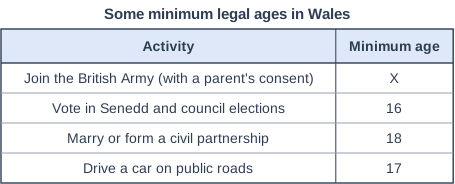
Source A is a table showing some minimum legal ages for young people in Wales.

What age should replace X?

Some minimum legal ages in Wales. Table with columns "Activity", "Minimum age". Activity: Join the British Army (with a parent's consent); Minimum age: X | Activity: Vote in Senedd and council elections; Minimum age: 16 | Activity: Marry or form a civil partnership; Minimum age: 18 | Activity: Drive a car on public roads; Minimum age: 17.

Model answer

16

Explanation

Young people can join the British Army from the age of 16 (they can start applying a few months earlier), but anyone under 18 needs the written consent of a parent or guardian, and under-18s are not sent on armed operations. The armed forces are run by the UK government, so the same age applies in every part of the UK. Some people argue the minimum age should be raised to 18.

Mark scheme
  1. 1 mark

    16

    Do not accept 17 or 18 (18 is the age at which a young person can join without a parent's consent).

Question 2

2 marks

Which two of the following are part of the legal system in Northern Ireland?

Choose two answers.

A Court of Session
B Crown Prosecution Service
C Enforcement of Judgments Office
D Procurator Fiscal
E Public Prosecution Service
F Sheriff courts

Model answer

C Enforcement of Judgments Office
E Public Prosecution Service

Explanation

Northern Ireland has its own courts and legal bodies: the Public Prosecution Service prosecutes crimes and the Enforcement of Judgments Office enforces civil court judgments, such as orders to pay debts. The Court of Session, the Procurator Fiscal and the sheriff courts are part of the Scottish system, and the Crown Prosecution Service works in England and Wales.

Mark scheme
  1. 2 marks

    C and E (Enforcement of Judgments Office; Public Prosecution Service)

    1 mark for each correct option, max 2. Accept the letters or the option texts, in either order. If more than two options are given, each extra option cancels one correct one. Count every option the student gives: with exactly two, 1 mark for each correct one; with three, the number of correct ones among them minus 1; with four or more, 0 marks.

Question 3

2 marks

Explain one reason why young people gain different legal rights and responsibilities at different ages.

Model answer

Young people gain rights gradually because they become more mature as they grow older and are better able to understand the consequences of their decisions. For example, you can start driving a car at 17 but must be supervised and pass a test, because a careless driver can seriously harm other people, so the law waits until people are older and trained.

Explanation

Legal ages reflect a balance between young people's growing maturity and the need to protect them and others. The first mark is for the reason and the second for developing it, often with an example of a legal age. Simply listing ages without saying why earns at most 1 mark.

Mark scheme
  1. 1 mark

    Identifies a reason, e.g. as young people grow older they become more mature and better able to understand the consequences of their actions; to protect young people from harm (e.g. alcohol, gambling); to protect other people (e.g. driving needs maturity and skill); some activities carry bigger responsibilities or risks than others; so young people can take on independence step by step

    Award 1 mark for identifying a reason and 1 mark for development. Credit any other valid reason.

  2. 1 mark

    Develops it, usually with an example of a legal age, e.g. so a 16-year-old can join the armed forces with parental consent, but must be 18 to join without it; so you can drive a car at 17 but must be supervised until you pass a test, because a mistake could kill someone; so buying alcohol is restricted to 18 to protect young people's health; riskier activities have higher ages

    The development must explain the reason, e.g. by showing how a particular legal age reflects it.

Question 4

8 marks

'The age of criminal responsibility in England and Wales is too low.'

Considering a range of views, to what extent do you agree or disagree with this statement?

In your answer you should consider:
- when children become able to take responsibility for their actions
- how other parts of the UK and other countries deal with children who offend.

Model answer

I agree that the age of criminal responsibility in England and Wales is too low, although there are reasonable arguments for keeping it.

The case for raising it is strong. At 10, England and Wales have one of the lowest ages in Europe. Scotland raised its age to 12 in 2021, and countries such as Germany, Italy and Spain set it at 14, which is also the minimum the UN Committee on the Rights of the Child recommends. Research shows that the parts of the brain that control impulses and judgement keep developing well into the teenage years, so a 10-year-old may not fully understand the consequences of their actions. Many young children who offend have been abused, neglected or exploited by adults, for example by gangs using children to carry drugs, so they are victims as well as offenders and need help rather than punishment. A criminal record at such a young age can also damage a child's education and job prospects for years, making further offending more likely.

On the other hand, supporters of the current age argue that most 10-year-olds know the difference between right and wrong, and that the law must protect victims and the public, especially in the rare cases where young children commit very serious crimes. They also point out that a 10-year-old is not treated like an adult: youth courts, youth offending teams and orders such as referral orders focus on rehabilitation, and many young children are dealt with outside court through diversion schemes. Early intervention, they argue, can stop children's offending becoming more serious. Northern Ireland also uses 10, so the age is not unusual within the UK.

Weighing these views, the evidence about children's development, and the fact that Scotland and most of Europe have chosen higher ages without losing the ability to deal with serious harm, convinces me that 10 is too low. Scotland's Children's Hearings System shows that children who offend can still be held to account and supervised, but through a welfare approach that tackles the causes of their behaviour. So I agree with the statement, and think the age should rise to at least 12, with serious cases still dealt with through the welfare and protection system.

Explanation

Top answers use evidence about child development, comparisons with Scotland and other countries, and the purposes of youth justice, and weigh these against public protection and the welfare focus that already exists in youth courts. A clear judgement, supported by the evidence, is needed for Level 4. One-sided answers are capped at 4.

Mark scheme
  1. 8 marks

    Levels of response (8 marks).
    Level 4 (7-8 marks): Developed and sustained analysis of a wide range of evidence and views related to the citizenship issue. Developed and reasoned justifications are given which relate to the evidence provided. The justifications put forward form a coherent argument.
    Level 3 (5-6 marks): Analysis of a range of evidence and views related to the citizenship issue. The evidence is used to support arguments but these arguments are not always completely developed, justified or evaluated. Conclusions drawn from the arguments may not be completely coherent.
    Level 2 (3-4 marks): Basic analysis of a limited range of evidence and views related to the citizenship issue. Weak arguments are made which are not necessarily related to the evidence selected. The arguments represent only a limited range of viewpoints. Some attempt is made to integrate the arguments into concluding remarks.
    Level 1 (1-2 marks): Limited evidence presented and/or evidence presented is not directly related to the citizenship issue. Insufficient range of differing viewpoints considered. Little or no attempt is made to analyse or evaluate the evidence presented. Little or no attempt is made to integrate the points made.
    0 marks: Nothing to credit.

    Max 4 if the answer considers only one side of the statement. Max 6 if the answer reaches no judgement. Indicative content (not exhaustive; credit other relevant points). Points which may be included to agree with this statement are: at 10, the age in England and Wales is one of the lowest in Europe; Scotland raised its age to 12 in 2021, and countries such as Germany, Italy and Spain set it at 14; the UN Committee on the Rights of the Child recommends an age of at least 14; research shows the parts of the brain that control impulses and judgement develop well into the teenage years and beyond, so young children may not fully understand the consequences of what they do; many children who offend have been abused, neglected or exploited by adults (e.g. in 'county lines' drug dealing), so they need help rather than prosecution; a criminal record can damage a child's future education and job prospects; a welfare approach, such as Scotland's Children's Hearings System, may tackle the causes of offending better and reduce reoffending. Points which may be included to disagree with this statement are: most 10-year-olds know the difference between right and wrong; the law needs to protect victims and the public, and very rarely young children commit very serious crimes; the youth justice system is already separate from the adult system and focused on rehabilitation (youth courts, youth offending teams, referral orders), so being responsible does not mean being treated like an adult; many young children who offend are dealt with outside court through diversion schemes; early intervention can stop offending becoming more serious; Northern Ireland also uses 10, so it is not unusual within the UK. A judgement might weigh children's development and welfare against public protection, e.g. whether raising the age, or keeping it but using welfare-based approaches, is the better way to reduce offending.

Ready to try the rest? Every answer you write is marked against the mark scheme, so you can see exactly where the marks are.

Study Helper Hints first, answers after you try

Stuck on this one? Ask for a hint and I’ll point you in the right direction, without giving the answer away. Once you’ve checked your answer, I’ll show you how the marks are awarded.