Level:
Correct: 0
Incorrect: 0
Marks: 0/0
Exam Practice
Course:
Topics:
AQA GCSE Citizenship Studies (Paper 2) Smart practice A mixed round aimed at your weak spots
Unit 1
Life in modern Britain
What are the principles and values that underpin British society?
Principles and values of British society
What do we mean by identity?
Identity and diversity in the UK
What is the role of the media and the free press?
The media and a free press
What is the UK's role in key international organisations?
The UK and international organisations
How can citizens make their voice heard and make a difference in society?
Making your voice heard in society
Unit 2
Rights and responsibilities
What laws does a society require and why?
Why society needs laws
What are a citizen's rights and responsibilities within the legal system?
The justice system: police, courts and tribunals
Legal ages and the UK's legal systems
How has the law developed over time, and how does the law protect the citizen and deal with criminals?
How rights and laws have developed
Crime and punishment
What are the universal human rights and how do we protect them?
Universal human rights
How do citizens play a part to bring about change in the legal system?
Citizens and change in the legal system
Avg
score:
–
Topics
done:
0/12

How rights and laws have developed

Practise 16 exam-style questions on How rights and laws have developed for AQA GCSE Citizenship Studies (Paper 2). Write your answer as you would in the exam and get it marked in seconds against the mark scheme, point by point, with the Study Helper on hand if you get stuck.

  • 16 questions
  • 1–8 marks each
  • Instant marking
  • No sign-up needed
16 questions, marked as you go

Sample questions with model answers

Here are 4 of the questions in this topic, each with a model answer, an explanation of why it earns the marks and the mark scheme an examiner would use.

Question 1

1 mark

Define the term 'common law'.

Model answer

Common law is law made by judges when they decide cases. Their decisions become precedents that later courts must follow.

Explanation

The mark is for the idea that the law comes from judges' decisions in cases (precedent), not from Parliament. A common mistake is to treat 'common' as meaning 'ordinary' or 'shared by everyone', which scores 0. Statute law (Acts of Parliament) is the other main source of law.

Mark scheme
  1. 1 mark

    Law made by judges through their decisions in court cases (case law / judge-made law), which later courts must follow through the system of precedent.

    Award 1 mark for a definition or an example that serves as a definition. Accept 'law developed by judges' decisions in cases', 'judge-made law' or 'law based on precedent set by judges'. Accept an example that serves as a definition, e.g. 'the rule from the 1932 snail-in-the-bottle case (Donoghue v Stevenson) that manufacturers owe a duty of care to consumers, which was created by judges rather than by Parliament'. Do not accept 'law that is common to everyone', 'law that is used most often', 'law that everyone knows' or 'law made by Parliament' (0 marks).

Question 2

2 marks

Which two of the following were set out in the Bill of Rights 1689?

Choose two answers.

A Freedom of speech and debate in Parliament
B The right of women to vote in elections
C The monarch cannot raise taxes without the consent of Parliament
D The right to join a trade union
E The right to equal pay for equal work
F The right to free legal advice at a police station

Model answer

A and C: freedom of speech and debate in Parliament, and the monarch cannot raise taxes without the consent of Parliament.

Explanation

The Bill of Rights 1689 followed the 'Glorious Revolution' and limited the powers of the monarch: free elections to Parliament, freedom of speech in parliamentary debates, and no taxes or standing army in peacetime without Parliament's consent. The other rights came much later: votes for women (1918 and 1928), full legal status for trade unions (1871), equal pay (1970) and free legal advice at a police station (the Police and Criminal Evidence Act 1984).

Mark scheme
  1. 2 marks

    A and C (Freedom of speech and debate in Parliament; The monarch cannot raise taxes without the consent of Parliament)

    1 mark for each correct option, max 2. Accept the letters or the option texts, in either order. If more than two options are given, each extra option cancels one correct one. Count every option the student gives: with exactly two, 1 mark for each correct one; with three, the number of correct ones among them minus 1; with four or more, 0 marks.

Question 3

4 marks

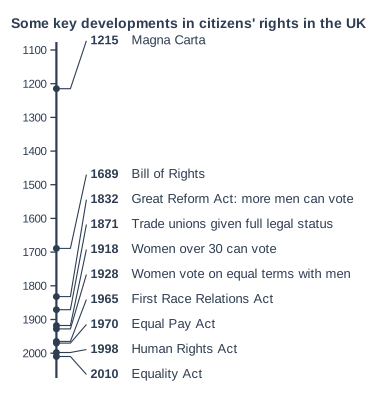
Source A is a timeline showing some key developments in citizens' rights in the UK between 1215 and 2010.

Referring to Source A, describe two ways in which citizens' rights in the UK have developed over time.

Vertical timeline titled "Some key developments in citizens' rights in the UK", running from 1100 at the top to 2050 at the bottom, with the years marked every 100 years (1100 to 2000). Events marked by dots on the line, in date order: 1215: Magna Carta; 1689: Bill of Rights; 1832: Great Reform Act: more men can vote; 1871: Trade unions given full legal status; 1918: Women over 30 can vote; 1928: Women vote on equal terms with men; 1965: First Race Relations Act; 1970: Equal Pay Act; 1998: Human Rights Act; 2010: Equality Act.

Model answer

One way rights developed is that the power of rulers was limited by law. Magna Carta in 1215 established that even the king had to obey the law, and the Bill of Rights in 1689 went further: the monarch could no longer raise taxes or keep an army in peacetime without the consent of Parliament, and MPs were given freedom of speech in their debates. This laid the foundations of the rule of law and of parliamentary democracy.

A second way is that citizens gained protection from discrimination. The first Race Relations Act in 1965 made racial discrimination in public places unlawful, and the Equal Pay Act 1970 said that women must be paid the same as men for the same work. The Equality Act 2010 brought these and many other laws together and protects people from discrimination because of nine protected characteristics, such as age, disability, race, religion and sex.

Explanation

Each way earns 1 mark for being identified from the timeline and 1 mark for development, such as explaining what the law did or adding accurate detail from your own knowledge. Two examples of the same trend (1918 and 1928 votes) count as one way. Listing dates from the source without explaining the change in rights earns no development marks.

Mark scheme
  1. 1 mark

    First way identified, e.g. the power of the monarch was limited and rulers became subject to the law (Magna Carta 1215, Bill of Rights 1689); the right to vote was extended to more people (1832, 1918, 1928); trade unions gained full legal status, protecting workers' right to organise (1871); laws were passed against discrimination (1965, 1970, 2010); human rights were made part of UK law (1998).

    Award 1 mark for each way identified and 1 mark for development (x2). The two ways must be different (e.g. 'more men could vote in 1832' and 'women could vote in 1918' are the same way: the vote was extended). Copying events or dates from the source without saying how rights changed does not earn a development mark.

  2. 1 mark

    Development of the first way: explains it or adds accurate detail from own knowledge, e.g. after the Bill of Rights the monarch could not raise taxes or keep an army in peacetime without Parliament's consent, and MPs had freedom of speech in debates; the vote was widened step by step until women voted on the same terms as men in 1928, and the voting age was lowered to 18 in 1969; the Equality Act 2010 brought together more than 100 earlier laws and protects nine characteristics; the Human Rights Act 1998 lets people use their rights under the European Convention on Human Rights in UK courts.

    Credit any accurate development that explains the way given in the first point.

  3. 1 mark

    Second, different way identified (see the first point for examples).

    Must be a different way from the first.

  4. 1 mark

    Development of the second way (see the second point for examples).

    Credit any accurate development that explains the second way.

Question 4

8 marks

'Magna Carta is the most important development in the history of citizens' rights in the UK.'

Considering a range of views, to what extent do you agree or disagree with this statement?

In your answer you should consider:
- the importance of Magna Carta (1215)
- later developments in citizens' rights, up to the Human Rights Act (1998).

Model answer

Magna Carta is often described as the foundation of citizens' rights in the UK. Sealed by King John in 1215, it established that even the king was subject to the law. Its most famous promises, that no free man would be imprisoned except by the lawful judgment of his peers or the law of the land, and that justice would not be sold, denied or delayed, are seen as the starting point of the rule of law, trial by jury and the right to a fair trial. Without this principle that rulers must obey the law, later rights would have had no foundation, and its influence spread far beyond England: in 1948 the Universal Declaration of Human Rights was described as a possible 'international Magna Carta'.

However, there are strong arguments against the statement. In 1215 Magna Carta mainly protected the barons and other 'free men'; most people were unfree peasants who gained little. It was annulled within months, had to be reissued, and almost all its clauses have since been repealed. It gave no one the vote, equality or protection at work.

Those rights came from later developments that did far more for ordinary citizens. The Bill of Rights 1689 limited the monarch in practice by giving Parliament control over taxation. The Reform Acts, the Representation of the People Act 1918 and the Equal Franchise Act 1928 slowly gave every adult the vote, turning Britain into a democracy. The Trade Union Act 1871 gave trade unions full legal status, protecting workers' right to organise, and laws such as the Equal Pay Act 1970 and the Equality Act 2010 protected people from discrimination. The Human Rights Act 1998 may be the most important in practical terms, because it gives everyone in the UK enforceable rights, such as the right to a fair trial and freedom of expression, that can be used in UK courts, and it requires public bodies like the police and councils to respect them.

Overall, I partly agree. Magna Carta is the most important development symbolically, because the principle that no one is above the law made every later right possible. But measured by how much it protects citizens today, it is less important than the Human Rights Act 1998 and the laws that extended the vote and equality to everyone. Magna Carta laid the foundation, but later developments built the rights that citizens actually rely on.

Explanation

Top answers weigh Magna Carta's real importance (the rule of law, lawful judgment, justice not delayed) against its limits in 1215 and against later developments such as the Bill of Rights, votes for all, equality laws and the Human Rights Act, then reach a reasoned judgement. A common weakness is narrating history without evaluating it, or discussing only Magna Carta, which caps the answer at 4 marks.

Mark scheme
  1. 8 marks

    Levels of response (8 marks).
    Level 4 (7-8 marks): Developed and sustained analysis of a wide range of evidence and views related to the citizenship issue. Developed and reasoned justifications are given which relate to the evidence provided. The justifications put forward form a coherent argument.
    Level 3 (5-6 marks): Analysis of a range of evidence and views related to the citizenship issue. The evidence is used to support arguments but these arguments are not always completely developed, justified or evaluated. Conclusions drawn from the arguments may not be completely coherent.
    Level 2 (3-4 marks): Basic analysis of a limited range of evidence and views related to the citizenship issue. Weak arguments are made which are not necessarily related to the evidence selected. The arguments represent only a limited range of viewpoints. Some attempt is made to integrate the arguments into concluding remarks.
    Level 1 (1-2 marks): Limited evidence presented and/or evidence presented is not directly related to the citizenship issue. Insufficient range of differing viewpoints considered. Little or no attempt is made to analyse or evaluate the evidence presented. Little or no attempt is made to integrate the points made.
    0 marks: Nothing to credit.

    Max 4 if the answer considers only one side of the statement. Max 6 if the answer reaches no judgement.
    Indicative content (not exhaustive; credit other relevant points).
    Points which may be included to agree with this statement are:
    - It established the principle that the ruler is subject to the law, the foundation of the rule of law on which every later right depends.
    - Its promise that no free man would be imprisoned or punished except by the lawful judgment of his peers or the law of the land is seen as the origin of due process, trial by jury and protection from unlawful detention (later Habeas Corpus, 1679).
    - Its promise not to sell, deny or delay justice underpins the right to a fair trial and access to justice.
    - Its symbolic influence has been huge: later documents such as the Bill of Rights 1689, the US Constitution and the Universal Declaration of Human Rights (described in 1948 as a possible 'international Magna Carta') drew on its ideas.
    - A few of its clauses are still part of the law of England and Wales today.
    Points which may be included to disagree with this statement are:
    - In 1215 it mainly protected barons and 'free men'; most ordinary people were unfree peasants and gained little.
    - It was annulled within months and had to be reissued; most of its clauses have since been repealed.
    - It gave no right to vote, no equality and no workers' rights; these came from later laws such as the Reform Acts, the Representation of the People Act 1918 and the Equal Franchise Act 1928, the Trade Union Act 1871, and anti-discrimination laws (Race Relations Act 1965, Equal Pay Act 1970, Equality Act 2010).
    - The Bill of Rights 1689 did more to limit the monarch in practice by giving Parliament control of taxation and the army.
    - The Human Rights Act 1998 gives everyone enforceable rights that can be used in UK courts and requires public bodies to respect them, which is far more practical protection today.
    A judgement might weigh Magna Carta's role as the symbolic foundation of the rule of law against the practical importance of later laws that extended rights to everyone, or argue that importance depends on whether 'importance' means influence or practical protection.

Ready to try the rest? Every answer you write is marked against the mark scheme, so you can see exactly where the marks are.

Study Helper Hints first, answers after you try

Stuck on this one? Ask for a hint and I’ll point you in the right direction, without giving the answer away. Once you’ve checked your answer, I’ll show you how the marks are awarded.