Level:
Correct: 0
Incorrect: 0
Marks: 0/0
Exam Practice
Course:
Topics:
AQA GCSE Citizenship Studies (Paper 2) Smart practice A mixed round aimed at your weak spots
Unit 1
Life in modern Britain
What are the principles and values that underpin British society?
Principles and values of British society
What do we mean by identity?
Identity and diversity in the UK
What is the role of the media and the free press?
The media and a free press
What is the UK's role in key international organisations?
The UK and international organisations
How can citizens make their voice heard and make a difference in society?
Making your voice heard in society
Unit 2
Rights and responsibilities
What laws does a society require and why?
Why society needs laws
What are a citizen's rights and responsibilities within the legal system?
The justice system: police, courts and tribunals
Legal ages and the UK's legal systems
How has the law developed over time, and how does the law protect the citizen and deal with criminals?
How rights and laws have developed
Crime and punishment
What are the universal human rights and how do we protect them?
Universal human rights
How do citizens play a part to bring about change in the legal system?
Citizens and change in the legal system
Avg
score:
–
Topics
done:
0/12

Making your voice heard in society

Practise 16 exam-style questions on Making your voice heard in society for AQA GCSE Citizenship Studies (Paper 2). Write your answer as you would in the exam and get it marked in seconds against the mark scheme, point by point, with the Study Helper on hand if you get stuck.

  • 16 questions
  • 1–8 marks each
  • Instant marking
  • No sign-up needed
16 questions, marked as you go

Sample questions with model answers

Here are 4 of the questions in this topic, each with a model answer, an explanation of why it earns the marks and the mark scheme an examiner would use.

Question 1

1 mark

Which one of the following is an example of digital exclusion acting as a barrier to participation?

Choose your answer.

  • A A person does not vote because they believe that all politicians are the same
  • B A person cannot respond to a council consultation that is only online because they have no internet access at home
  • C A person cannot vote because they did not register to vote in time
  • D A person cannot get to a public meeting because there is no bus service in the evening

Model answer

B A person cannot respond to a council consultation that is only online because they have no internet access at home

Explanation

Digital exclusion means being shut out because you cannot use the internet or digital technology, for example because of cost, a poor connection, or lack of skills or confidence. As more consultations, petitions and information move online, people without internet access (often older or poorer people) can find it harder to take part. Option A describes apathy or distrust, C missing the registration deadline and D a transport barrier: all are barriers, but not digital exclusion.

Mark scheme
  1. 1 mark

    B / A person cannot respond to a council consultation that is only online because they have no internet access at home

    Accept the letter or the option text. If more than one option is given, 0 marks.

Question 2

2 marks

Which two of the following are barriers that can stop citizens from taking part in democracy?

Choose two answers.

A Not having enough time because of work or caring responsibilities
B Being able to vote by post
C Being taught about politics at school
D Finding it hard to read information that is only given in English
E Having a local councillor who holds regular advice meetings
F Being able to sign petitions online

Model answer

A Not having enough time because of work or caring responsibilities
D Finding it hard to read information that is only given in English

Explanation

Barriers are things that make it harder for people to take part, such as lack of time (work, school, caring for family), lack of money, language difficulties, no internet access, poor disability access, lack of information or confidence, and distrust of politicians. Postal votes, citizenship lessons, councillors' advice meetings (surgeries) and online petitions are opportunities that make taking part easier.

Mark scheme
  1. 2 marks

    A and D (Not having enough time because of work or caring responsibilities; Finding it hard to read information that is only given in English)

    1 mark for each correct option, max 2. Accept the letters or the option texts, in either order. If more than two options are given, each extra option cancels one correct one. Count every option the student gives: with exactly two, 1 mark for each correct one; with three, the number of correct ones among them minus 1; with four or more, 0 marks.

Question 3

4 marks

Source A

Why residents in Kelbridge do not take part

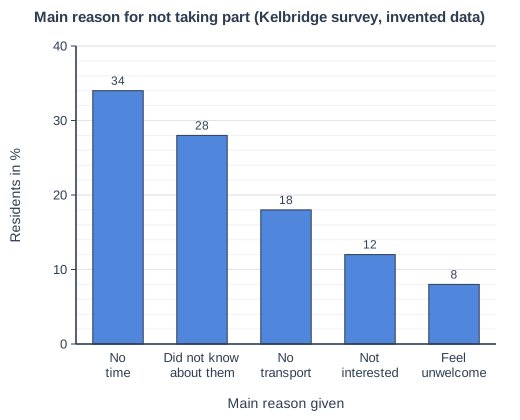
Kelbridge is an invented town. Its community association asked 400 adult residents to give the main reason why they do not take part in community activities such as volunteering, residents' meetings, council consultations or local campaigns. Source A is a bar chart showing the results (invented data).

With reference to Source A, discuss two ways the local council and community groups could reduce the barriers that stop residents in Kelbridge from taking part in their community.

Main reason for not taking part (Kelbridge survey, invented data). Bar chart of residents in % for each main reason given: No time 34, Did not know about them 28, No transport 18, Not interested 12, Feel unwelcome 8.

Model answer

The biggest barrier in Source A is time: 34% of residents say they have no time, for example because of work, shifts or caring for children or relatives. The council and community groups could offer short, flexible ways to take part, such as one-off volunteering days at weekends, meetings held at different times or online, and consultations that residents can answer from home. Providing childcare at meetings would also help parents. This would let busy residents, including carers, have a say without a regular weekly commitment.

The second barrier is information: 28% did not know the activities existed. Groups could advertise opportunities where residents already go, for example in libraries, GP surgeries, shops and places of worship, through the local newspaper and on local social media groups, and the council could run one website listing every local opportunity, with information in the main community languages. Together, time and awareness explain 62% of the answers, so tackling them would remove the main barriers. Holding events in venues across the town would also help the 18% who have no transport.

Explanation

This is marked by levels. A Level 2 answer discusses two different ways, links each one to a barrier shown in Source A (ideally using the figures) and explains how it would help residents take part. Answers that list ideas without linking them to the source, or that discuss only one way, stay in Level 1.

Mark scheme
  1. 4 marks

    Levels of response (4 marks).
    Level 2 (3-4 marks): Good application of knowledge and understanding of the concepts. Response clear and relevant to the concepts surrounding the citizenship context.
    Level 1 (1-2 marks): Basic application of knowledge and understanding of the concepts. Response muddled and lacking relevance to the concepts surrounding the citizenship context.
    0 marks: Nothing to credit.

    Max 2 if the answer makes no use of Source A. Max 2 if only one way is discussed. Indicative content (not exhaustive; credit other relevant points): the answer applies knowledge of barriers to participation to Source A. No time (34%, the biggest barrier): short or one-off opportunities rather than a regular commitment; meetings at different times (evenings, weekends) or online, with recordings; consultations that can be answered from home, online or on paper; childcare or children's activities at meetings; support for carers; employers giving staff time to volunteer. Did not know about them (28%): advertise where residents already go (libraries, GP surgeries, shops, schools and places of worship), through the local newspaper and radio, council newsletters, leaflets and local social media groups; one website, app or noticeboard listing local opportunities; information in community languages. No transport (18%): hold activities in venues across the town and on bus routes, community transport or lift-sharing, online options. Not interested (12%): show what difference taking part makes (report back on what changed), let residents choose the issues, make events social (e.g. food or family activities), personal invitations from neighbours. Feel unwelcome (8%): welcome events for newcomers, interpreters and translated information, accessible venues for disabled people, groups and organisers that reflect the whole community, buddy schemes, giving residents real influence over decisions. Time and awareness together are 62% of answers, so a strong answer may say these should be tackled first. Level 2 answers discuss two different ways, link each to a barrier in Source A and explain how it would increase participation.

Question 4

8 marks

'Barriers to participation mean that only some groups in society really have their voices heard.'

Considering a range of views, to what extent do you agree or disagree with this statement?

In your answer you should consider:
- the opportunities citizens have to take part in democracy
- the barriers that stop some groups from taking part.

Model answer

I partly agree with this statement. There are real barriers that mean some groups are heard more than others, but I do not think only some groups are heard, because citizens have many opportunities to take part and the barriers can be overcome.

The case for agreeing is strong. Turnout is much lower among younger people and people on low incomes than among older and wealthier people, so politicians have a reason to focus on the groups who vote most. Practical barriers make this worse: people working long hours or caring for relatives have little time, some people lack internet access as more information moves online, and some disabled people and people with limited English find it harder to take part. Photo ID is now needed at polling stations in UK general elections and local elections in England, and some people without accepted ID have been turned away. Groups with money and contacts, such as large businesses, can also afford professional lobbyists, while ordinary citizens cannot. Because MPs and councillors do not fully reflect the population, some groups feel that politics is 'not for people like us', which deepens apathy.

However, there are more opportunities to participate than ever. As well as voting, citizens can contact their MP or councillor, sign and start petitions, use social media to campaign, answer council consultations, volunteer and join pressure groups. Postal and proxy votes help people who cannot get to a polling station. 16 and 17-year-olds can already vote in Scottish Parliament and Senedd elections, and a bill in Parliament would extend this to UK elections. Groups who find it hard to speak for themselves are supported by charities and trade unions that act as advocates, and ordinary people have changed policy, for example the 2020 campaign that persuaded the government to extend free school meal support into the holidays. Many people who do not take part choose not to, rather than being stopped.

Weighing these arguments, the barriers are serious for particular groups, especially young people, poorer people and disabled people, and they do make some voices louder than others. But the evidence that ordinary people's campaigns succeed shows that most citizens can be heard if they use the opportunities available. So the statement goes too far: the problem is unequal influence rather than most people being silenced, and it should be tackled through better citizenship education, accessible voting and outreach by councils and charities.

Explanation

This 8-mark question is marked by levels. Top answers analyse a wide range of evidence on both sides (who votes and who does not, practical barriers, voter ID, lobbying power, and the many ways to take part) and reach a supported judgement. An answer that only lists barriers is capped at 4; an answer that discusses both sides but never says how far it agrees is capped at 6.

Mark scheme
  1. 8 marks

    Levels of response (8 marks).
    Level 4 (7-8 marks): Developed and sustained analysis of a wide range of evidence and views related to the citizenship issue. Developed and reasoned justifications are given which relate to the evidence provided. The justifications put forward form a coherent argument.
    Level 3 (5-6 marks): Analysis of a range of evidence and views related to the citizenship issue. The evidence is used to support arguments but these arguments are not always completely developed, justified or evaluated. Conclusions drawn from the arguments may not be completely coherent.
    Level 2 (3-4 marks): Basic analysis of a limited range of evidence and views related to the citizenship issue. Weak arguments are made which are not necessarily related to the evidence selected. The arguments represent only a limited range of viewpoints. Some attempt is made to integrate the arguments into concluding remarks.
    Level 1 (1-2 marks): Limited evidence presented and/or evidence presented is not directly related to the citizenship issue. Insufficient range of differing viewpoints considered. Little or no attempt is made to analyse or evaluate the evidence presented. Little or no attempt is made to integrate the points made.
    0 marks: Nothing to credit.

    Max 4 if the answer considers only one side of the statement. Max 6 if the answer reaches no judgement. Indicative content (not exhaustive; credit other relevant points). Points which may be included to agree with this statement are: turnout is lower among some groups, such as younger people and people on low incomes, so politicians may pay more attention to the groups who vote most; practical barriers such as lack of time, money, transport, internet access, disability access or confidence in English stop some people taking part; photo ID is now needed to vote at polling stations in UK general elections and local elections in England, and some people without accepted ID have been turned away; under-18s cannot vote in UK general elections (at the time of writing) or local elections in England; groups with money and contacts (large businesses, well-funded insider groups) find it easier to lobby decision-makers than ordinary citizens; MPs and councillors do not fully reflect the population, so some groups feel 'politics is not for people like us'; distrust and apathy lead many to believe their voice makes no difference. Points which may be included to disagree with this statement are: there are more ways to take part than ever (voting, contacting MPs and councillors, petitions, social media campaigns, joining pressure groups, volunteering, public consultations); the law protects participation (postal and proxy votes, help for disabled voters, the Equality Act 2010); 16 and 17-year-olds can vote in Scottish Parliament, Senedd and Scottish and Welsh council elections, and the Representation of the People Bill (not yet law) would extend votes at 16 to UK Parliament elections and to local elections in England and Northern Ireland; charities, trade unions and pressure groups give a voice to groups who find it hard to speak for themselves (advocacy); ordinary people's campaigns have succeeded (e.g. the 2020 free school meals campaign, local campaigns that save libraries or win crossings); many people choose not to take part rather than being prevented. A judgement might weigh how serious the barriers are for particular groups against the range of opportunities, e.g. that barriers do not silence most citizens but make some voices louder than others, so more needs to be done (civic education, accessible voting, outreach).

Ready to try the rest? Every answer you write is marked against the mark scheme, so you can see exactly where the marks are.

Study Helper Hints first, answers after you try

Stuck on this one? Ask for a hint and I’ll point you in the right direction, without giving the answer away. Once you’ve checked your answer, I’ll show you how the marks are awarded.