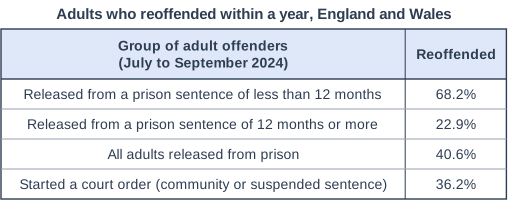
Source C is a table of Ministry of Justice figures for adult offenders in England and Wales who were released from prison, or who started a court order, between July and September 2024. It shows the percentage who reoffended within a year (committed an offence that led to a conviction or caution). The Ministry of Justice warns that these rates do not take account of differences between the offenders who receive each type of sentence. In 2024-25 it cost about £57,000 to keep one person in prison for a year.
'Short prison sentences do not work, so most offenders should be given community sentences instead.'
Considering a range of views, to what extent do you agree or disagree with this statement?
You should refer to Source C in your answer.
Model answer
Source C gives strong support to the first part of the statement. 68.2% of adults released from prison sentences of less than 12 months reoffended within a year, compared with 36.2% of those who started a court order such as a community order. That is almost twice the rate. One explanation is that a short sentence is too short for an offender to complete education or drug treatment in prison, but long enough for them to lose their job, home and family support, the very things that help people stop offending. Prisons can also act as 'schools for crime', where minor offenders meet more serious criminals. Short sentences are also expensive: Source C says a prison place costs about £57,000 a year, far more than supervising someone in the community. A community order can still punish the offender through unpaid work and curfews, make them pay back the community, and include drug or alcohol treatment that tackles the reasons they offend. This is why Scotland has a presumption against prison sentences of 12 months or less, and why, since March 2026, courts in England and Wales must normally suspend prison sentences of 12 months or less.
However, there are important arguments on the other side. The Ministry of Justice itself warns that these figures do not compare like with like. People given short prison sentences have often already been given community sentences and kept reoffending, so their higher reoffending rate may reflect who they are, not the sentence. Prison also protects the public, even if only for a few months, which matters to victims of persistent offenders, for example in cases of domestic abuse or repeated burglary. Many victims and members of the public see community sentences as a 'soft option', and if people lose confidence in sentencing, the justice system loses legitimacy. Community sentences also rely on a well-staffed probation service to supervise offenders, and Source C shows that more than a third of adults on court orders still reoffend. Finally, the statement says 'most offenders': for serious or dangerous crimes, longer prison sentences are needed, and Source C shows the lowest reoffending rate (22.9%) for people released from sentences of 12 months or more.
Overall, I largely agree. The evidence in Source C, together with the cost, suggests that short prison sentences often do more harm than good and that community sentences should be used for most low-level offenders. But the Ministry of Justice's warning means the figures cannot prove this on their own, and courts must keep the option of prison for serious, dangerous or persistent offenders where protecting the public comes first.
Explanation
Top answers use the figures in Source C accurately on both sides, including the Ministry of Justice's warning that the groups are not directly comparable, and combine them with knowledge of the purposes of sentencing, cost, rehabilitation and public protection before reaching a judgement. Answers that ignore Source C or argue only one side are capped at 4 marks.