
Level:
Correct: 0
Incorrect: 0
Marks: 0/0
Exam Practice
Course:
Topics:
Avg
score:
–
Topics
done:
0/18

Warm up and cool down

Practise 20 exam-style questions on Warm up and cool down for OCR GCSE Physical Education (Paper 1). Write your answer as you would in the exam and get it marked in seconds against the mark scheme, point by point, with the Study Helper on hand if you get stuck.

  • 20 questions
  • 1–6 marks each
  • Instant marking
  • No sign-up needed
20 questions, marked as you go

Sample questions with model answers

Here are 4 of the questions in this topic, each with a model answer, an explanation of why it earns the marks and the mark scheme an examiner would use.

Question 1

1 mark

Which one of the following statements about the effects of a warm up is false?

Choose your answer.

  • it increases the pliability of ligaments and tendons
  • it decreases blood flow to the working muscles
  • it increases the speed of muscle contraction
  • it raises body temperature

Model answer

It decreases blood flow to the working muscles.

Explanation

A warm up increases blood flow and oxygen delivery to the working muscles, so this statement is false. The other three options are all physical benefits of a warm up named in the specification. Read 'false' questions carefully: a common mistake is to choose the first true statement.

Mark scheme
  1. 1 mark

    it decreases blood flow to the working muscles / decreases blood flow

    The other three statements are true effects of a warm up, so they are not the answer. If more than one option is given, 0 marks.
Question 2

2 marks

Describe two effects of a warm up on a performer's muscles.

Model answer

A warm up increases the temperature of the muscles, so they become more elastic and pliable and less likely to tear. It also increases the speed of muscle contraction, so the performer can move more quickly and powerfully.

Explanation

Warm muscles are more elastic, contract faster and more strongly, and receive more blood and oxygen. OCR mark schemes do not credit vague wording such as 'loosens the muscles' or 'warms up the muscles'. A warm up only reduces the risk of injury; it cannot prevent it.

Mark scheme
  1. 2 marks

    Any two of:
    1. Increases muscle temperature
    2. Increases flexibility / elasticity / pliability of the muscles OR increases range of movement
    3. Increases the speed (and strength) of muscle contraction
    4. Increases blood flow / oxygen to the muscles
    5. Reduces the risk of muscle injury, e.g. strains or tears

    1 mark per point. Mark the first two answers only. Do not accept: 'warms up the muscles' on its own = TV; 'loosens the muscles' = TV; 'prevents injury' = TV (accept 'reduces the risk of injury'); 'more blood to the body' = TV.

Question 3

2 marks

Stretching can be part of both a warm up and a cool down.

Explain why a performer stretches in each.

Model answer

In the warm up, stretching increases the flexibility of the muscles and the range of movement at the joints, so the body is ready for the activity and is less likely to suffer a muscle strain. In the cool down, stretching aids recovery and reduces muscle soreness and stiffness after the exercise.

Explanation

Stretching does a different job in each: in the warm up it prepares the muscles and joints for the activity; in the cool down it helps the muscles recover. OCR's cool down benefits include 'aids recovery by stretching muscles' and 'reduces the risk of muscle soreness and stiffness'. Answers that give the same reason for both score only one mark.

Mark scheme
  1. 1 mark

    Warm up: to increase the flexibility of the muscles / the range of movement at joints ready for the activity OR to reduce the risk of muscle injury / strains during the activity

    Must be clear that this refers to the warm up.

  2. 1 mark

    Cool down: to aid recovery / to reduce muscle soreness or stiffness / to maintain or improve flexibility after the activity

    Must be clear that this refers to the cool down. Do not accept: 'reduces the risk of injury' on its own for the cool down = TV.

Question 4

4 marks

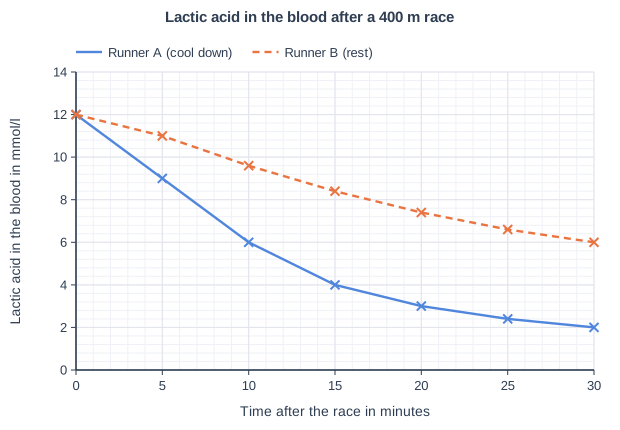
A sports scientist tested two 400 m runners after a race. Runner A completed a cool down of light jogging and stretching. Runner B sat down and rested. The graph shows the scientist's results for the level of lactic acid in each runner's blood after the race.

Using data from the graph, compare the two runners and explain how runner A's cool down caused the difference.

Lactic acid in the blood after a 400 m race. Line graph of lactic acid in the blood in mmol/l (y-axis, 0 to 14) against time after the race in minutes (x-axis, 0 to 30). "Runner A (cool down)" joins the points (0, 12), (5, 9), (10, 6), (15, 4), (20, 3), (25, 2.4), (30, 2). "Runner B (rest)" (dashed) joins the points (0, 12), (5, 11), (10, 9.6), (15, 8.4), (20, 7.4), (25, 6.6), (30, 6).

Model answer

Runner A's lactic acid level falls much faster than runner B's: after 30 minutes A's level is 2 mmol/l but B's is still 6 mmol/l, although both started at 12 mmol/l. A's light jogging kept the heart rate and breathing rate raised, so blood and oxygen kept circulating through the muscles. This sped up the removal of lactic acid, so runner A is less likely to have sore, stiff muscles and will recover more quickly.

Explanation

A cool down speeds up recovery because low intensity exercise keeps the circulation raised, which delivers oxygen and removes lactic acid faster than resting. Both runners started at the same level, so the difference is caused by what they did after the race. OCR does not credit 'removes lactic acid' without 'faster' or 'helps', because lactic acid is removed eventually even without a cool down.

Mark scheme
  1. 1 mark

    Runner A's lactic acid level falls faster / is lower than runner B's after the race, with data, e.g. at 30 minutes A is 2 mmol/l and B is 6 mmol/l

    Must use data from the graph for both runners at the same time (accept readings within 0.5 mmol/l). Both started at 12 mmol/l. A comparison with no data = TV.

  2. 3 marks

    Any three of:
    1. Light jogging / low intensity exercise keeps heart rate / breathing rate raised OR maintains the circulation of blood
    2. So more oxygen is delivered to the muscles / blood keeps flowing through the muscles
    3. So lactic acid / waste products are removed (from the muscles) faster
    4. So runner A has less muscle soreness / stiffness OR recovers more quickly

    1 mark per point. Max 3. Do not accept: 'the cool down removes lactic acid' without faster / speeds up = TV; 'prevents lactic acid building up' = TV; 'reduces oxygen debt' = TV.

Ready to try the rest? Every answer you write is marked against the mark scheme, so you can see exactly where the marks are.

Study Helper Hints first, answers after you try

Stuck on this one? Ask for a hint and I’ll point you in the right direction, without giving the answer away. Once you’ve checked your answer, I’ll show you how the marks are awarded.