Practise 22 exam-style questions on Synovial joints, movements and joint components for OCR GCSE Physical Education (Paper 1). Write your answer as you would in the exam and get it marked in seconds against the mark scheme, point by point, with the Study Helper on hand if you get stuck.
22 questions
1–6 marks each
Instant marking
No sign-up needed
20 questions, marked as you go
Sample questions with model answers
Here are 4 of the questions in this topic, each with a model answer, an explanation of why it earns the marks and the mark scheme an examiner would use.
Question 1
1 mark
What is the role of a ligament?
Choose your answer.
Connects bone to bone
Connects muscle to bone
Covers the ends of bones
Lubricates the joint
Model answer
Connects bone to bone
Explanation
A ligament is a tough band of connective tissue that connects bone to bone, holding the joint together and keeping it stable. Tendons connect muscle to bone, cartilage covers the ends of bones, and synovial fluid lubricates the joint. Mixing up ligaments and tendons is the most common mistake.
Mark scheme
1 mark
Connects bone to bone
If more than one option is given, 0 marks.
Question 2
2 marks
Describe the difference between flexion and extension at a joint.
Model answer
Flexion is a movement that decreases the angle at a joint, such as bending the elbow. Extension is a movement that increases the angle at a joint, such as straightening the elbow.
Explanation
Flexion decreases the angle between the bones at a joint and extension increases it. Both happen at hinge joints (knee, elbow) and at ball and socket joints (shoulder, hip). Using the angle at the joint gives a precise answer; 'bending' and 'straightening' are acceptable but less precise.
Mark scheme
1 mark
flexion: decreasing the angle (between the bones) at a joint
Accept: bending (a limb) at a joint = BOD.
1 mark
extension: increasing the angle (between the bones) at a joint
Accept: straightening (a limb) at a joint = BOD. Accept a correct practical example that makes the difference clear, e.g. bending the knee to bring the heel up (flexion) and straightening it to kick (extension), for one mark only if a definition is missing.
Question 3
2 marks
A golfer turns the hips as they swing the club through to strike the ball.
Identify the type of movement at the hips, and explain why this movement is possible at the hip joint.
Model answer
The movement is rotation. It is possible because the hip is a ball and socket joint, so the rounded head of the femur can turn within the socket of the pelvis.
Explanation
Rotation is a turning movement of a bone around its own long axis. The hip is a ball and socket joint, which allows rotation as well as flexion, extension, abduction, adduction and circumduction. Hinge joints such as the knee cannot perform rotation in OCR's specification. 'Twisting' is a description, not the technical term.
Mark scheme
1 mark
rotation
Do not accept: circumduction = X. Do not accept: 'turning / twisting' = TV.
1 mark
the hip is a ball and socket joint (so the head of the femur can turn in the socket of the pelvis / movement in all directions is possible)
Do not accept: hinge joint = X.
Question 4
4 marks
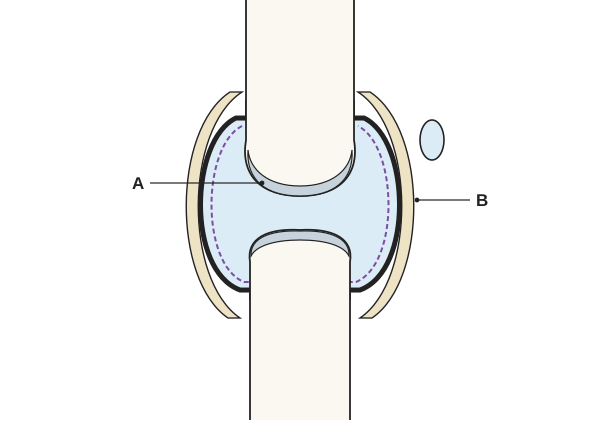
The diagram shows a simplified synovial joint.
Identify the parts labelled A and B, and describe the role of each.
Model answer
A is cartilage. It covers the ends of the bones, reducing friction and absorbing shock so the bones do not rub together. B is a ligament. It connects bone to bone, holding the joint together and keeping it stable so it does not dislocate.
Explanation
Cartilage is the smooth layer covering the ends of the bones inside the joint; it reduces friction and absorbs shock. Ligaments are bands outside the joint that connect bone to bone and keep the joint stable. Students often swap ligaments and tendons - tendons connect muscle to bone.
Mark scheme
1 mark
(A) cartilage
Accept: articular cartilage / hyaline cartilage. Do not accept: synovial membrane / synovial fluid = X.
1 mark
(role of A) reduces friction (between the ends of the bones) / absorbs shock / stops the bones rubbing together / allows smooth movement
Credit the role only if the part identified is cartilage, or if the role clearly matches A even with a wrong name = BOD. Do not accept: 'protects the bone' on its own = TV.
1 mark
(B) ligament
Do not accept: tendon = X.
1 mark
(role of B) connects bone to bone / stabilises the joint / holds the joint together / prevents dislocation / restricts unwanted movement
Do not accept: 'connects muscle to bone' = X. Do not accept: 'stabilises the movement' = TV.
Ready to try the rest? Every answer you write is marked against the mark scheme, so you can see exactly where the marks are.
Ctrl + Enter to check
Study HelperHints first, answers after you try
Stuck on this one? Ask for a hint and I’ll point you in the right direction, without giving the answer away. Once you’ve checked your answer, I’ll show you how the marks are awarded.