Practise 22 exam-style questions on Location of the major bones for OCR GCSE Physical Education (Paper 1). Write your answer as you would in the exam and get it marked in seconds against the mark scheme, point by point, with the Study Helper on hand if you get stuck.
22 questions
1–6 marks each
Instant marking
No sign-up needed
20 questions, marked as you go
Sample questions with model answers
Here are 4 of the questions in this topic, each with a model answer, an explanation of why it earns the marks and the mark scheme an examiner would use.
Question 1
1 mark
A hockey player is struck on the front of the shin by the ball.
Which bone lies just under the skin at the front of the shin?
Choose your answer.
Femur
Fibula
Patella
Tibia
Model answer
Tibia
Explanation
The tibia is the thicker bone of the lower leg, on the inside, and its front edge lies just under the skin of the shin - which is why hockey and football players wear shin pads. The fibula is the thinner bone on the outside of the lower leg. The patella is at the front of the knee and the femur is the thigh bone, so neither is at the shin.
Mark scheme
1 mark
Tibia
If more than one option is given, 0 marks. Accept shin bone = BOD.
Question 2
2 marks
State whether each of these statements is true or false.
Statement 1: The ulna is the forearm bone on the little-finger side.
Statement 2: The metatarsals are found in the palm of the hand.
Model answer
Statement 1 is true. Statement 2 is false - the metatarsals are in the foot; the bones of the palm are the metacarpals.
Explanation
The ulna is on the little-finger side of the forearm and the radius is on the thumb side, so statement 1 is true. The metatarsals are the long bones in the middle of the foot; the matching bones in the palm of the hand are the metacarpals. Remember: 'carpal' bones are in the hand and 'tarsal' bones are in the foot.
Mark scheme
1 mark
(Statement 1) true
Answers must be linked to the correct statement.
1 mark
(Statement 2) false
Accept a correction instead of the word false, e.g. 'the metacarpals are in the palm' or 'the metatarsals are in the foot' = BOD.
Question 3
3 marks
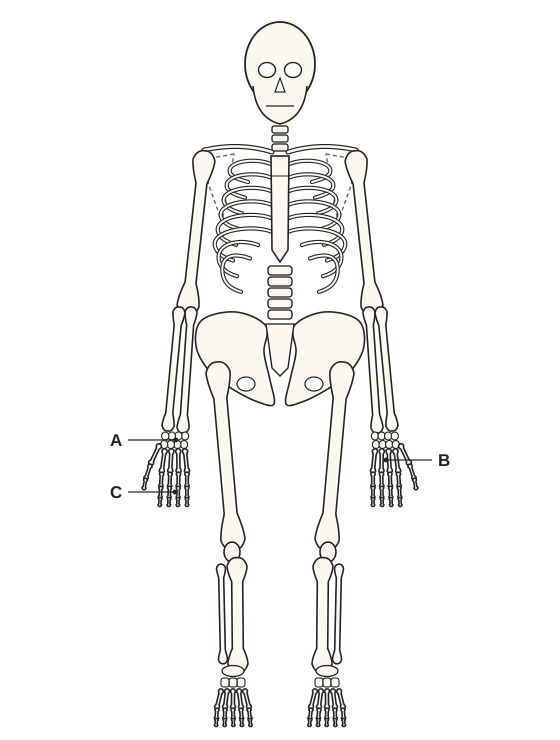
The diagram shows a human skeleton. Labels A, B and C point to bones of the wrist and hand.
Identify the bones labelled A, B and C.
Model answer
A is the carpals, B is the metacarpals and C is the phalanges.
Explanation
Moving from the wrist to the fingertips, the hand has three groups of bones: the carpals (small bones of the wrist), the metacarpals (long thin bones of the palm) and the phalanges (bones of the fingers and thumb). The most common mistake is to use the foot names, tarsals and metatarsals, for the hand.
Mark scheme
1 mark
A: carpals
Accept carpal (singular). Do not accept tarsals = X (bones of the ankle). Answers must be linked to the correct letter.
1 mark
B: metacarpals
Accept metacarpal (singular). Do not accept metatarsals = X (bones of the foot).
1 mark
C: phalanges
Accept phalanx (singular) or recognisable misspellings, e.g. phalanxes. Accept finger bones = BOD.
Question 4
4 marks
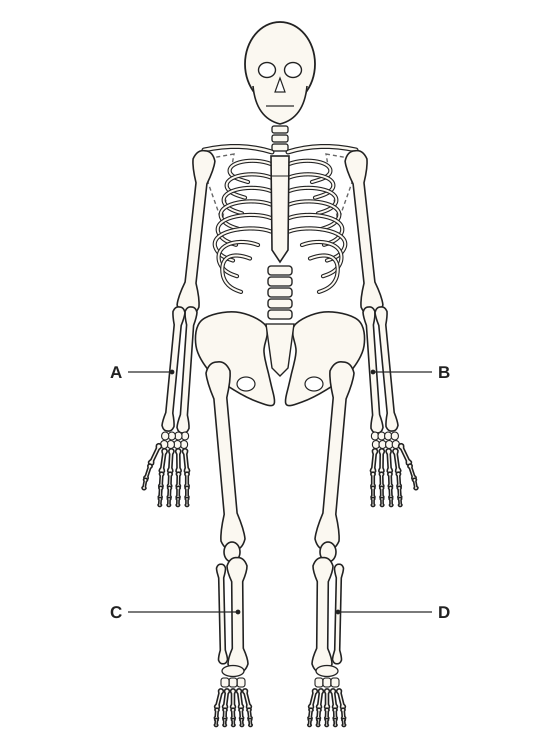
The diagram shows a human skeleton standing with the palms facing forward.
Identify the bones labelled A, B, C and D.
Model answer
A is the radius, B is the ulna, C is the tibia and D is the fibula.
Explanation
With the palms facing forward, the radius is the forearm bone on the thumb side (the outside of the forearm) and the ulna is on the little-finger side (nearer the body). In the lower leg the tibia is the thicker bone on the inside (the shin bone) and the fibula is the thinner bone on the outside. Students often swap each pair, so learn one bone of each pair and the other follows.
Mark scheme
1 mark
A: radius
Do not accept ulna = X. Answers must be linked to the correct letter.
1 mark
B: ulna
Do not accept radius = X.
1 mark
C: tibia
Accept shin bone = BOD. Do not accept fibula = X.
1 mark
D: fibula
Do not accept tibia = X. Accept recognisable misspellings, e.g. fibia.
Ready to try the rest? Every answer you write is marked against the mark scheme, so you can see exactly where the marks are.
Ctrl + Enter to check
Study HelperHints first, answers after you try
Stuck on this one? Ask for a hint and I’ll point you in the right direction, without giving the answer away. Once you’ve checked your answer, I’ll show you how the marks are awarded.