Practise 20 exam-style questions on Location of the major muscle groups for OCR GCSE Physical Education (Paper 1). Write your answer as you would in the exam and get it marked in seconds against the mark scheme, point by point, with the Study Helper on hand if you get stuck.
20 questions
1–6 marks each
Instant marking
No sign-up needed
20 questions, marked as you go
Sample questions with model answers
Here are 4 of the questions in this topic, each with a model answer, an explanation of why it earns the marks and the mark scheme an examiner would use.
Question 1
1 mark
Which muscle is located across the front of the chest?
Choose your answer.
Abdominals
Deltoid
Pectorals
Trapezius
Model answer
Pectorals
Explanation
The pectorals are the large muscles across the front of the upper chest; they pull the arms forwards and across the body, for example in a chest pass. The deltoid covers the shoulder, the abdominals run down the front of the stomach below the chest, and the trapezius is mainly on the upper back and neck.
Mark scheme
1 mark
Pectorals
If more than one option is given, 0 marks. Accept pectoral / pectoralis major. Do not accept: pecs = TV.
Question 2
2 marks
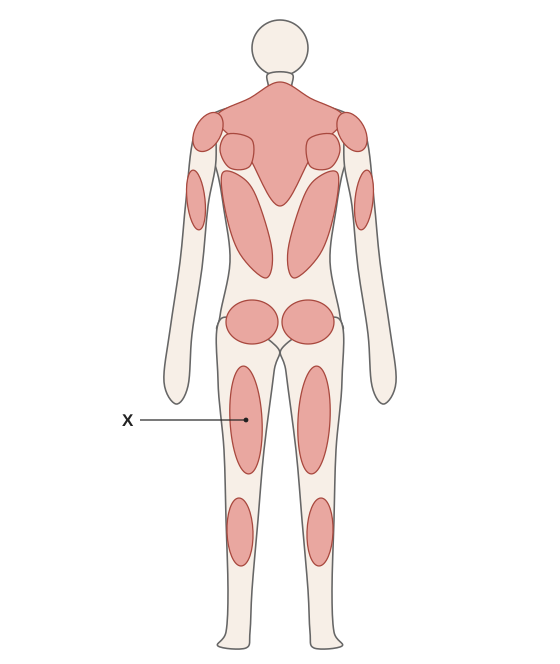
The diagram shows the back view of a human body.
Identify the muscle group labelled X, and give a practical example of its use in physical activity or sport.
Model answer
X is the hamstrings. A footballer uses the hamstrings to bend the knee, bringing the heel up behind the body before kicking the ball.
Explanation
The hamstrings run down the back of the thigh. They bend (flex) the knee and help to drive the thigh backwards at the hip, so they work hard in sprinting and in the backswing of a kick. Naming a sport is not enough: the example must describe the action the muscle produces.
Mark scheme
1 mark
(X) hamstrings
Accept hamstring. Do not accept: quadriceps / gastrocnemius = X.
1 mark
(practical example) bending the knee, e.g. bringing the heel up behind the body before kicking a ball / the recovery phase of the leg in sprinting / OR extending the hip, e.g. driving the leg back when sprinting
The example must describe an action, not just name a sport, e.g. 'football' = TV. Credit the example only if it matches the hamstrings (bending the knee or driving the thigh backwards).
Question 3
2 marks
A swimmer is performing front crawl.
Name the muscle on the side of the back that pulls the arm down and back through the water, and the muscle on top of the shoulder that lifts the arm out of the water.
Model answer
The latissimus dorsi pulls the arm down and back through the water, and the deltoid lifts the arm out of the water.
Explanation
The latissimus dorsi, on the side of the back, pulls the arm down and back towards the body, which is the main pulling action in swimming strokes. The deltoid, the rounded muscle on top of the shoulder, lifts the arm. Students often give the trapezius for the pull, but it is on the upper back and moves the shoulders rather than pulling the arm through the water.
Mark scheme
1 mark
(Pulls the arm down and back) latissimus dorsi
Do not accept: lats = TV. Do not accept: trapezius = X.
1 mark
(Lifts the arm out of the water) deltoid
Accept deltoids. Answers must be linked to the correct action. If reversed, 0 marks.
Question 4
4 marks
A netball player performs a chest pass, pushing the ball away from the chest with both hands.
Name two muscles that are used to push the ball away, and describe the location of each.
Model answer
The pectorals, which lie across the upper chest, push the arms forward away from the body. The triceps, on the back of the upper arm, straighten the elbows to push the ball away.
Explanation
In a chest pass, the pectorals (across the chest) bring the arms forward and the triceps (back of the upper arm) straighten the elbows. The deltoid on the top of the shoulder also helps. A common error is to name the biceps, which bend the elbow and so are not the muscle that pushes the ball away.
Mark scheme
1 mark
first muscle: pectorals / triceps / deltoid
Mark the first two muscles given. Do not accept: biceps = X (bends the elbow). Do not accept: pecs = TV.
1 mark
correct location of the first muscle: pectorals - across the (upper) chest / triceps - back of the upper arm / deltoid - top of the shoulder
Only award if the muscle in the previous point was credited.
1 mark
second, different muscle: pectorals / triceps / deltoid
Must be different from the first muscle.
1 mark
correct location of the second muscle
Only award if the muscle in the previous point was credited. Locations as for the first muscle.
Ready to try the rest? Every answer you write is marked against the mark scheme, so you can see exactly where the marks are.
Ctrl + Enter to check
Study HelperHints first, answers after you try
Stuck on this one? Ask for a hint and I’ll point you in the right direction, without giving the answer away. Once you’ve checked your answer, I’ll show you how the marks are awarded.