Practise 18 exam-style questions on Functions of the skeleton for OCR GCSE Physical Education (Paper 1). Write your answer as you would in the exam and get it marked in seconds against the mark scheme, point by point, with the Study Helper on hand if you get stuck.
18 questions
1–6 marks each
Instant marking
No sign-up needed
18 questions, marked as you go
Sample questions with model answers
Here are 4 of the questions in this topic, each with a model answer, an explanation of why it earns the marks and the mark scheme an examiner would use.
Question 1
1 mark
Where in the skeleton are blood cells produced?
Choose your answer.
Bone marrow
Cartilage
Ligaments
Tendons
Model answer
Bone marrow
Explanation
Blood cells are made in the bone marrow, the soft tissue inside bones such as the femur, sternum, ribs and pelvis. Cartilage covers the ends of bones, ligaments join bone to bone and tendons join muscle to bone - none of them produces blood cells.
Mark scheme
1 mark
Bone marrow
If more than one option is given, 0 marks. Accept 'marrow' = BOD.
Question 2
2 marks
Using a practical example from rugby, explain how the ribs provide protection.
Model answer
The ribs form a hard cage around the heart and lungs. When a rugby player is tackled and an opponent's shoulder hits their chest, the ribs take the force of the impact so the heart and lungs are not damaged.
Explanation
Protection means bones surrounding vital organs so that a blow is taken by the bone rather than the organ. The ribs form a cage around the heart and lungs, which matters in rugby when a player is tackled or lands on the ground. Writing only 'the ribs protect the heart' does not explain how, so it is too vague for credit.
Mark scheme
1 mark
the ribs form a (rigid) cage / shell around the heart and lungs / vital organs
Accept: framework / barrier / shield around the heart / lungs = BOD. Do not accept: 'protects the heart / lungs' on its own = TV (repeats the question without describing how).
1 mark
(rugby example) the ribs absorb / take the force of the impact when the player is tackled / lands on the ground / is hit by an opponent's shoulder, so the heart / lungs are not damaged
The example must be from rugby and must involve an impact to the chest or side. Do not accept: 'in rugby' on its own = TV.
Question 3
2 marks
An archer stands still and upright while aiming at the target.
Describe how the skeleton provides posture for the archer.
Model answer
The vertebrae hold the archer's back straight and keep the body upright in the correct shape. This lets the archer hold a still, balanced position with the body lined up with the bow and target, so they can aim accurately.
Explanation
Posture is the skeleton holding the body in its correct shape - for example the spine keeping the back straight and the body upright. For an archer, a still and upright position gives a stable base for an accurate shot. Saying good posture just 'looks better' does not describe the function.
Mark scheme
1 mark
the skeleton gives the body its correct shape / the vertebrae / spine keep the back straight / the skeleton keeps the body upright
Do not accept: framework for muscle attachment (support, not posture) = TV.
1 mark
(applied) so the archer can hold a stable / balanced / still position / keep the body lined up with the bow and target / aim accurately
Must be applied to the archer. Do not accept: 'looks good' / 'looks aesthetic' = TV (does not describe the function).
Question 4
3 marks
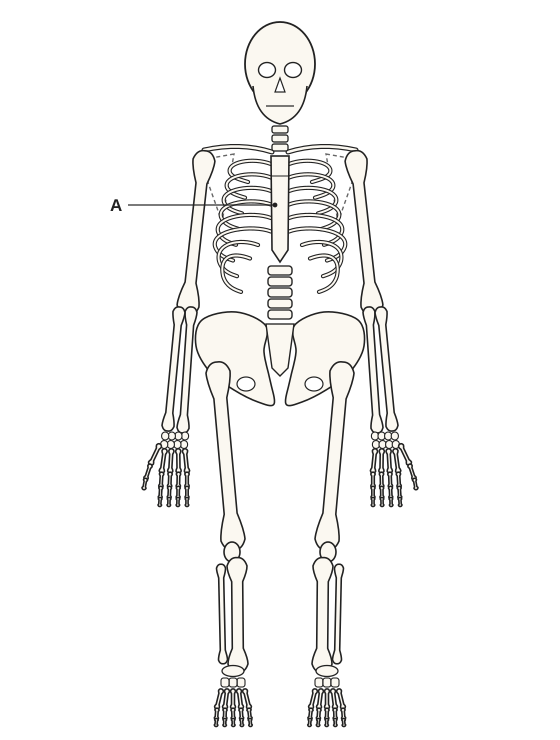
The diagram shows a human skeleton.
Identify the bone labelled A. Explain two functions of the skeleton that bone A provides.
Model answer
Bone A is the sternum. It provides protection, because together with the ribs it forms a cage at the front of the chest that shields the heart and lungs from impact. It also produces blood cells, because it contains red bone marrow where red and white blood cells are made.
Explanation
The sternum is the flat bone down the centre of the chest. With the ribs it protects the heart and lungs, and like other flat bones it contains red bone marrow that makes blood cells. Simply naming a function without saying how the sternum provides it does not score, and the sternum is not a lever, so movement is not credited.
Mark scheme
1 mark
(A) sternum
Accept: breastbone = BOD. If the bone is wrong, the functions can still be credited if they are correct for the sternum.
1 mark
protection: (with the ribs) it forms a cage / shield at the front of the chest around the heart / lungs
Do not accept: 'protects the chest' = TV (the organs must be named or implied as vital organs).
1 mark
blood cell production: it contains (red) bone marrow which produces blood cells
Max 3 (1 for the bone, max 2 for two different functions). Accept also: support - provides a framework that the ribs / pectorals attach to; storage of minerals - it stores calcium / phosphorus, which can be released into the blood when needed. Do not accept: movement (the sternum is not used as a lever) = X. Do not accept a function named with no explanation, e.g. 'protection' on its own = TV.
Ready to try the rest? Every answer you write is marked against the mark scheme, so you can see exactly where the marks are.
Ctrl + Enter to check
Study HelperHints first, answers after you try
Stuck on this one? Ask for a hint and I’ll point you in the right direction, without giving the answer away. Once you’ve checked your answer, I’ll show you how the marks are awarded.