Level:
Correct: 0
Incorrect: 0
Marks: 0/0
Exam Practice
Course:
Topics:
Avg
score:
–
Topics
done:
0/18

The respiratory system and gas exchange

Practise 21 exam-style questions on The respiratory system and gas exchange for OCR GCSE Physical Education (Paper 1). Write your answer as you would in the exam and get it marked in seconds against the mark scheme, point by point, with the Study Helper on hand if you get stuck.

  • 21 questions
  • 1–6 marks each
  • Instant marking
  • No sign-up needed
20 questions, marked as you go

Sample questions with model answers

Here are 4 of the questions in this topic, each with a model answer, an explanation of why it earns the marks and the mark scheme an examiner would use.

Question 1

1 mark

A gymnast has a breathing rate of 14 breaths per minute and a tidal volume of 0.5 litres.

What is her minute ventilation?

Choose your answer.

  • 0.04 litres per minute
  • 7 litres per minute
  • 14.5 litres per minute
  • 28 litres per minute

Model answer

7 litres per minute

Explanation

Minute ventilation = breathing rate × tidal volume = 14 × 0.5 = 7 litres per minute. The wrong options come from common slips: 14.5 adds the two values, 28 divides 14 by 0.5, and 0.04 divides 0.5 by 14. Always multiply the number of breaths in a minute by the volume of each breath.

Mark scheme
  1. 1 mark

    7 litres per minute

    If more than one option is given, 0 marks. Accept 7 / 7 l/min.
Question 2

2 marks

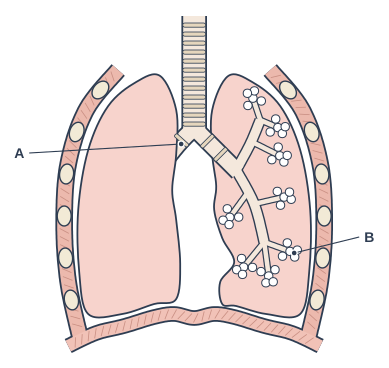
The diagram shows the respiratory system.

Identify the structures labelled A and B.

Diagram of the breathing system in the chest, seen from the front. A tube with rings runs down from the top and divides into two tubes, one to each lung. The lung on the right of the drawing is shown cut open: inside it the tube divides into smaller and smaller branches, each ending in a cluster of tiny rounded sacs. The lung on the left of the drawing is drawn whole. Down each side of the lungs is a curved wall made of a row of small oval bones (in section) with muscle between them, and a dome-shaped sheet of muscle lies beneath the lungs. Label A points to one of the two tubes that the ringed tube divides into, entering the lung on the left; label B points to a cluster of tiny rounded sacs at the end of one of the smallest tubes in the cut-open lung.

Model answer

A is a bronchus (one of the bronchi). B is the alveoli.

Explanation

The trachea divides into two bronchi, one going into each lung. Inside the lungs the bronchi branch into bronchioles, which end in clusters of tiny air sacs called alveoli. Students often mix up bronchi and bronchioles: the bronchi are the two large tubes that branch from the trachea, and the bronchioles are the much smaller branches inside the lungs.

Mark scheme
  1. 1 mark

    A: bronchus / bronchi

    Accept phonetic spellings if clear. Do not accept: bronchiole(s); trachea; lung.

  2. 1 mark

    B: alveoli / alveolus

    Accept 'air sacs' = BOD. Accept phonetic spellings if clear. Do not accept: bronchioles; capillaries; lungs.

Question 3

2 marks

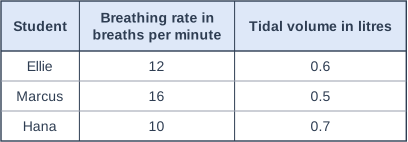
A PE teacher measured the breathing of three students sitting at rest. The table shows the results.

Identify which student has the highest minute ventilation at rest. Show your working.

Table with columns "Student", "Breathing rate in breaths per minute", "Tidal volume in litres". Student: Ellie; Breathing rate in breaths per minute: 12; Tidal volume in litres: 0.6 | Student: Marcus; Breathing rate in breaths per minute: 16; Tidal volume in litres: 0.5 | Student: Hana; Breathing rate in breaths per minute: 10; Tidal volume in litres: 0.7.

Model answer

Minute ventilation = breathing rate × tidal volume.
Ellie: 12 × 0.6 = 7.2 litres per minute
Marcus: 16 × 0.5 = 8.0 litres per minute
Hana: 10 × 0.7 = 7.0 litres per minute
Marcus has the highest minute ventilation.

Explanation

You cannot pick the answer just from the highest breathing rate or the largest tidal volume - Hana has the deepest breaths but the lowest minute ventilation. Multiply breathing rate by tidal volume for each student and compare. Marcus breathes less deeply than the others but takes more breaths, so he moves the most air per minute.

Mark scheme
  1. 1 mark

    Minute ventilations calculated (breathing rate × tidal volume): Ellie 7.2, Marcus 8.0, Hana 7.0 litres per minute

    All three values needed for this mark. Units not required here.

  2. 1 mark

    Marcus

    Working (minute ventilation calculations) must be seen for this mark: 'Marcus' with no working scores 0, as the question asks for working. ft: the student with the highest of their own calculated values.

Question 4

3 marks

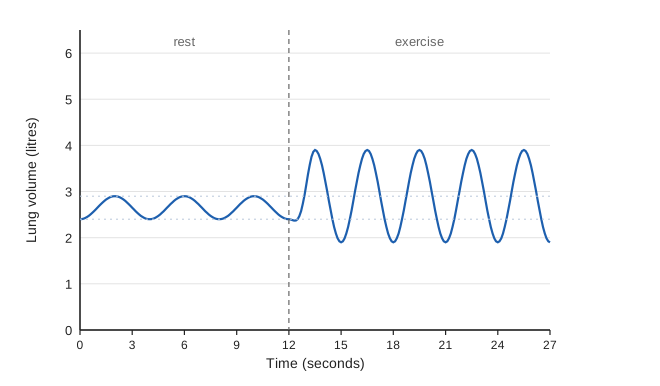
The graph is a spirometer trace of a performer's breathing at rest and then during exercise. At rest, the performer's tidal volume is 0.5 litres.

Use the trace to calculate the performer's minute ventilation at rest. Show how you used the trace, and give the unit in your answer.

Spirometer trace of lung volume (litres, 0 to 6) against time: small, regular breaths at rest, then from the dashed line onwards deeper, faster breaths during exercise. The time axis is marked in seconds.

Model answer

At rest one breath takes 4 seconds (3 breaths in the first 12 seconds), so the breathing rate is 60 ÷ 4 = 15 breaths per minute. Minute ventilation = breathing rate × tidal volume = 15 × 0.5 = 7.5 litres per minute.

Explanation

First find the breathing rate from the time axis: count the time for one complete breath (peak to peak) and work out how many fit into 60 seconds. Then use minute ventilation = breathing rate × tidal volume. A common mistake is to count the breaths shown on the trace (3) and use that as the breathing rate - the trace shows only 12 seconds of rest, not a whole minute.

Mark scheme
  1. 1 mark

    Breathing rate at rest = 15 breaths per minute (each breath takes 4 seconds / 3 breaths in 12 seconds, so 60 ÷ 4 = 15)

    Award for 15 breaths per minute seen, or for a correct reading of 4 seconds per breath / 3 breaths in 12 seconds.

  2. 1 mark

    Minute ventilation = breathing rate × tidal volume / 15 × 0.5

    ecf from their breathing rate (e.g. 16 × 0.5).

  3. 1 mark

    7.5 litres per minute

    Unit required: accept l/min / L/min / litres/minute / dm³ per minute. ecf: their breathing rate × 0.5 with a unit. The question asks students to show how they used the trace: answer only (7.5 litres per minute with no breathing rate or working shown) scores 0.

Ready to try the rest? Every answer you write is marked against the mark scheme, so you can see exactly where the marks are.

Study Helper Hints first, answers after you try

Stuck on this one? Ask for a hint and I’ll point you in the right direction, without giving the answer away. Once you’ve checked your answer, I’ll show you how the marks are awarded.