Practise 20 exam-style questions on Short-term effects of exercise for OCR GCSE Physical Education (Paper 1). Write your answer as you would in the exam and get it marked in seconds against the mark scheme, point by point, with the Study Helper on hand if you get stuck.
20 questions
1–6 marks each
Instant marking
No sign-up needed
20 questions, marked as you go
Sample questions with model answers
Here are 4 of the questions in this topic, each with a model answer, an explanation of why it earns the marks and the mark scheme an examiner would use.
Question 1
1 mark
During a cycle race, Owen's heart rate doubles from its resting value, and his stroke volume also increases.
Which one of these describes the change in his cardiac output?
Choose your answer.
It stays the same
It increases, but by less than double
It doubles
It more than doubles
Model answer
It more than doubles
Explanation
Cardiac output = stroke volume × heart rate. Doubling the heart rate on its own would double cardiac output, and stroke volume rises as well, so cardiac output more than doubles - for example, 70 ml × 70 bpm = 4.9 litres per minute at rest, but 100 ml × 140 bpm = 14 litres per minute in the race. Choosing 'it doubles' forgets that stroke volume also increases during exercise.
Mark scheme
1 mark
It more than doubles
If more than one option is given, 0 marks. Accept a clear short form, e.g. 'more than double'.
Question 2
2 marks
Describe the short-term effect of exercise on muscle temperature, and explain how this effect can help a performer.
Model answer
Exercise increases muscle temperature, because working muscles release heat when they contract. Warmer muscles contract faster and more strongly and are more pliable, so a sprinter can drive out of the blocks more powerfully with less risk of a muscle strain.
Explanation
Working muscles produce heat, so their temperature rises during exercise. This is one reason a warm up helps: warm muscles contract faster and more forcefully and stretch more easily. Be precise - say the muscles reduce the risk of injury, not that they prevent it.
Mark scheme
1 mark
Muscle temperature increases
Accept 'muscles get warmer'. Do not accept 'body temperature increases' on its own.
1 mark
Muscles contract faster / more strongly / become more pliable (elastic) / reduced risk of injury
Accept a practical example of the benefit, e.g. 'a sprinter can drive out of the blocks more powerfully'. Do not accept 'prevents injury' (reduces, not prevents).
Question 3
3 marks
Describe how the short-term effects of exercise increase the amount of oxygen delivered to the working muscles.
Model answer
Breathing rate and tidal volume increase, so minute ventilation rises and more oxygen is taken into the lungs and diffuses into the blood. Heart rate and stroke volume increase, so cardiac output rises and more oxygenated blood is pumped out each minute. Blood is also redistributed, so a greater share of it goes to the working muscles.
Explanation
Oxygen delivery depends on three systems working together: the respiratory system takes in more oxygen, the heart pumps more blood, and the blood vessels send more of that blood to the working muscles. A good answer covers more than one system - three different points about the heart alone score only one mark.
Mark scheme
1 mark
Breathing rate / tidal volume / minute ventilation increases, so more oxygen is taken into the lungs
Accept 'more air breathed in per minute'.
1 mark
Heart rate / stroke volume / cardiac output increases, so more blood is pumped to the muscles per minute
Accept 'the heart pumps more blood'.
1 mark
Blood is redistributed to the working muscles (away from the digestive system) / vasodilation of blood vessels to the muscles
1 mark
More gas exchange / diffusion of oxygen into the blood at the alveoli
Max 3. One mark per different effect; do not credit heart rate, stroke volume and cardiac output as separate marks.
Question 4
3 marks
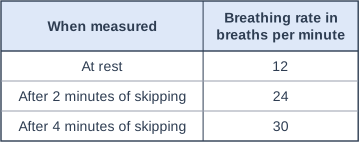
A student recorded his breathing rate at rest and while skipping. The table shows the results.
Calculate the percentage increase in his breathing rate from rest to after 4 minutes of skipping, and explain why his breathing rate increased.
Model answer
Increase = 30 - 12 = 18 breaths per minute. Percentage increase = 18 ÷ 12 × 100 = 150%. His breathing rate increased because his working muscles needed more oxygen, and more carbon dioxide had to be removed from his body, so he needed to breathe in and out more air each minute.
Explanation
Percentage increase = increase ÷ starting value × 100, so always divide by the resting value, not the final value. Breathing rate rises during exercise so that more oxygen enters the lungs and more carbon dioxide is breathed out. Common slips are dividing by 30 (60%) or calculating 30 as a percentage of 12 (250%).
Mark scheme
1 mark
Increase = 30 - 12 = 18 breaths per minute, and 18 ÷ 12 × 100 seen
Award for the correct method.
1 mark
150%
Correct answer with no working scores both calculation marks. Do not accept 250% (30 ÷ 12 × 100) or 60% (18 ÷ 30 × 100).
1 mark
His working muscles need more oxygen / more carbon dioxide needs to be removed, so more air must be breathed in and out
Do not accept 'because he is tired' or 'because he is working harder' on its own.
Ready to try the rest? Every answer you write is marked against the mark scheme, so you can see exactly where the marks are.
Ctrl + Enter to check
Study HelperHints first, answers after you try
Stuck on this one? Ask for a hint and I’ll point you in the right direction, without giving the answer away. Once you’ve checked your answer, I’ll show you how the marks are awarded.