
Level:
Correct: 0
Incorrect: 0
Marks: 0/0
Exam Practice
Course:
Topics:
Avg
score:
–
Topics
done:
0/18

Types of training

Practise 23 exam-style questions on Types of training for OCR GCSE Physical Education (Paper 1). Write your answer as you would in the exam and get it marked in seconds against the mark scheme, point by point, with the Study Helper on hand if you get stuck.

  • 23 questions
  • 1–6 marks each
  • Instant marking
  • No sign-up needed
20 questions, marked as you go

Sample questions with model answers

Here are 4 of the questions in this topic, each with a model answer, an explanation of why it earns the marks and the mark scheme an examiner would use.

Question 1

1 mark

Which weight training programme would best improve muscular endurance?

Choose your answer.

  • 1 repetition, maximum weight
  • 2 sets of 6 repetitions, heavy weight
  • 3 sets of 4 repetitions, heavy weight
  • 3 sets of 20 repetitions, light weight

Model answer

3 sets of 20 repetitions, light weight

Explanation

Muscular endurance is developed by lifting light weights for a high number of repetitions, so the muscles contract many times. Heavy weights for a low number of repetitions develop strength, and a single maximum lift is a 1RM test rather than a training programme.

Mark scheme
  1. 1 mark

    3 sets of 20 repetitions, light weight

    Accept: a clear short form, e.g. '3 sets of 20' / 'light weight, high repetitions'. If more than one option is given, 0 marks.
Question 2

2 marks

Describe what is meant by High Intensity Interval Training (HIIT). Give a practical example of a HIIT session.

Model answer

HIIT is training in which short bursts of very high-intensity exercise are alternated with short periods of low-intensity exercise or rest. For example, a performer could sprint for 30 seconds and then walk for 30 seconds, repeating this eight times.

Explanation

HIIT is a form of interval training: the work periods are very hard and the recovery periods are short and easy. A good example gives both parts and shows they are repeated. Saying 'high intensity' alone is not enough, because the alternation with recovery is what makes it HIIT.

Mark scheme
  1. 1 mark

    Short bursts of high-intensity (near maximal) exercise alternated with short periods of low-intensity exercise or rest

    Accept: high-intensity periods alternated with low/moderate-intensity periods. Do not accept: 'high intensity training' on its own = TV.

  2. 1 mark

    A practical example, e.g. 30 seconds of sprinting followed by 30 seconds of walking, repeated eight times / 20 seconds of fast burpees followed by 10 seconds of rest, repeated / sprinting on an exercise bike for 20 seconds then pedalling slowly for 40 seconds, repeated

    The example must show both the high-intensity periods and the recovery periods. Do not accept: a steady run = X.

Question 3

3 marks

Describe how a circuit training session is organised.

Model answer

Circuit training is a series of different exercises set up at stations around a sports hall. The performer works at each station for a set time, such as 40 seconds, then rests for 20 seconds before moving to the next station. The stations work different muscle groups in turn, for example press-ups, then step-ups, then sit-ups, and the whole circuit can be repeated two or three times.

Explanation

Circuit training is a form of interval training: work at each station alternates with rest. Because the stations can be chosen freely, a circuit can target general fitness or the specific needs of a sport. The key features are stations, a set time or number of repetitions, and rest between them.

Mark scheme
  1. 1 mark

    A number of different exercises are set up at stations (in a circuit/around a room)

    Max 3 marks.

  2. 1 mark

    The performer completes each station for a set time or a set number of repetitions

    Accept: e.g. 30 seconds at each station.

  3. 1 mark

    There is a rest period between stations (and/or between circuits)

  4. 1 mark

    Performers move round the stations in order / the whole circuit may be repeated (e.g. two or three times)

  5. 1 mark

    Stations work different muscle groups or components of fitness in turn / stations can be chosen to suit the sport (e.g. skill stations)

    Accept: examples of stations, e.g. press-ups, sit-ups, step-ups, burpees, shuttle runs = BOD for this point (one example is enough).

Question 4

4 marks

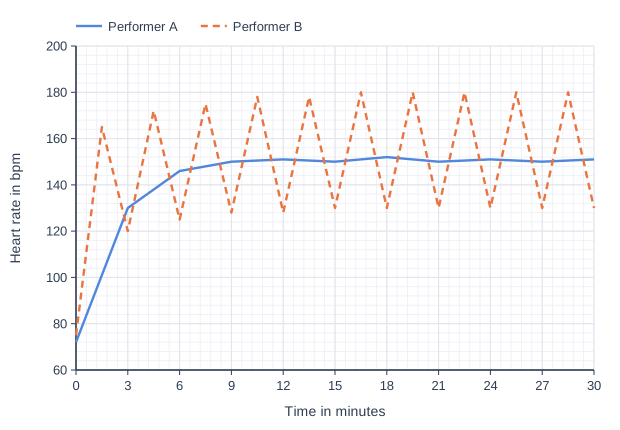
The graph shows the heart rates of two performers, A and B, during different 30-minute training sessions. The data is invented.

One performer did continuous training and the other did interval training.

Identify which performer did each type of training. Justify each answer using data from the graph.

Line graph of heart rate in bpm (y-axis, 60 to 200) against time in minutes (x-axis, 0 to 30). "Performer A" joins the points (0, 72), (3, 130), (6, 146), (9, 150), (12, 151), (15, 150), (18, 152), (21, 150), (24, 151), (27, 150), (30, 151). "Performer B" (dashed) joins the points (0, 75), (1.5, 165), (3, 120), (4.5, 172), (6, 125), (7.5, 175), (9, 128), (10.5, 178), (12, 128), (13.5, 178), (15, 130), (16.5, 180), (18, 130), (19.5, 180), (21, 130), (22.5, 180), (24, 130), (25.5, 180), (27, 130), (28.5, 180), (30, 130).

Model answer

Performer A did continuous training. Their heart rate rises to about 150 bpm in the first few minutes and then stays steady at about 150 bpm for the rest of the session, which shows they were working at a steady pace without rest. Performer B did interval training. Their heart rate goes up to peaks of about 180 bpm and then drops to about 130 bpm, again and again every 3 minutes, which shows periods of work alternated with periods of recovery.

Explanation

A steady, flat heart rate trace shows a constant intensity with no rest, which is continuous training. A regular zig-zag of high peaks and lower troughs shows repeated work and recovery periods, which is interval training. Fartlek would show changes in heart rate too, but in an irregular pattern without set rest periods. Always quote heart rate values from the graph.

Mark scheme
  1. 1 mark

    Performer A did continuous training

    If the two performers are the wrong way round, 0 marks for identification, but the justification marks may still be awarded for correct descriptions of the data.

  2. 1 mark

    A's heart rate rises to about 150 bpm and stays steady at about 150 bpm for the rest of the session (from about 6 or 9 minutes to 30 minutes), showing a steady pace with no rest

    Data must be used. Accept values from 145 to 155 bpm.

  3. 1 mark

    Performer B did interval training

    Accept: HIIT = BOD. Do not accept: fartlek = X.

  4. 1 mark

    B's heart rate rises to peaks of about 170-180 bpm and falls to about 120-130 bpm in a regular repeated pattern (every 3 minutes), showing work periods alternated with rest/recovery periods

    Data must be used. Accept: peaks of 180 bpm and troughs of 130 bpm.

Ready to try the rest? Every answer you write is marked against the mark scheme, so you can see exactly where the marks are.

Study Helper Hints first, answers after you try

Stuck on this one? Ask for a hint and I’ll point you in the right direction, without giving the answer away. Once you’ve checked your answer, I’ll show you how the marks are awarded.