Practise 20 exam-style questions on Lever systems and mechanical advantage for OCR GCSE Physical Education (Paper 1). Write your answer as you would in the exam and get it marked in seconds against the mark scheme, point by point, with the Study Helper on hand if you get stuck.
20 questions
1–6 marks each
Instant marking
No sign-up needed
20 questions, marked as you go
Sample questions with model answers
Here are 4 of the questions in this topic, each with a model answer, an explanation of why it earns the marks and the mark scheme an examiner would use.
Question 1
1 mark
In a lever system in the body, what provides the effort?
Choose your answer.
The bones
The joint
The muscles
The weight of the body part
Model answer
The muscles
Explanation
In the body the bones act as the levers, the joint is the fulcrum (pivot), the muscles contracting provide the effort, and the weight of the body part plus anything it holds is the load (resistance). Students often mix up the joint and the effort: the joint is where the lever turns, not what makes it move.
Mark scheme
1 mark
The muscles
Accept 'muscles' or 'muscle contraction'. If more than one option is given, 0 marks.
Question 2
2 marks
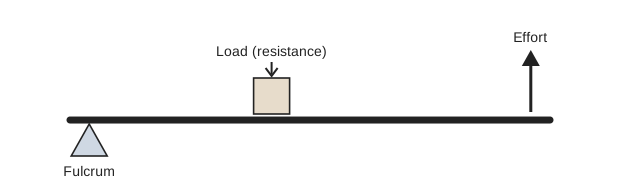
The diagram shows a lever system.
Identify the class of lever shown, and give a practical example from physical activity or sport of where this class of lever operates in the body.
Model answer
It is a second class lever. An example is the ankle when a sprinter pushes off the blocks, rising onto the toes of the front foot.
Explanation
With the load between the fulcrum and the effort, the diagram shows a second class lever. In the body this is the ankle when you rise onto your toes: the ball of the foot is the fulcrum, body weight is the load and the gastrocnemius pulls up on the heel as the effort. Writing just 'the ankle' or 'sprinting' is too vague - give the action.
Mark scheme
1 mark
Second (class lever)
The diagram shows the fulcrum at one end, the load in the middle and the effort at the other end. Accept 2nd / 2.
1 mark
(Example) the ankle when rising onto the toes / pushing up onto the toes, e.g. a sprinter pushing off the blocks / a netball player standing on tiptoe to intercept / taking off for a jump / a calf raise
The example must be an action at the ankle (plantar flexion / rising onto the toes / pushing off the ground). 'The ankle' on its own, or a sport on its own (e.g. 'sprinting'), is too vague. This point can be credited even if the class is wrong, if the example is a correct second class lever.
Question 3
3 marks
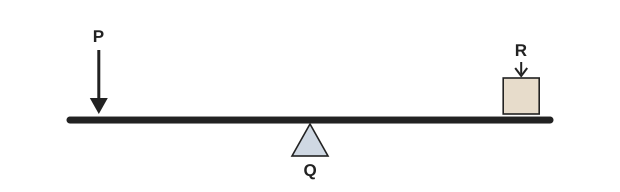
The diagram shows the first class lever at the neck when a footballer heads a ball.
Identify the parts of the lever labelled P, Q and R.
Model answer
P is the effort, Q is the fulcrum and R is the load (resistance).
Explanation
In lever diagrams the triangle is the fulcrum (pivot), the block with a downward arrow is the load (resistance) and the separate arrow is the effort. At the neck the fulcrum is the joint at the top of the spine, the effort comes from the neck muscles and the load is the weight of the head, so the fulcrum sits in the middle - a first class lever.
Mark scheme
1 mark
(P) effort
P is the arrow pushing down on the left end of the bar. Accept: 'muscle (contraction)' or 'force' (benefit of the doubt).
1 mark
(Q) fulcrum
Q is the triangle in the centre. Accept: pivot / joint.
1 mark
(R) load / resistance
R is the block at the right end. Accept: 'weight (of the head)'.
Question 4
4 marks
A basketball player catches a pass and pulls the ball into her chest by flexing her elbows.
Analyse the lever system operating at the elbow during this movement.
Model answer
The elbow acts as a third class lever. The fulcrum is the elbow joint, the effort comes from the biceps contracting, and the load is the weight of the forearm, hands and ball, so the effort lies between the fulcrum and the load. This gives a mechanical disadvantage, because the effort arm is shorter than the load arm, but it allows a large range of movement and speed, so she can pull the ball in to her chest quickly.
Explanation
To analyse a lever, name its class, identify the fulcrum, effort and load, describe their arrangement and say whether it has a mechanical advantage. At the elbow the biceps attaches just below the joint, so the effort is in the middle and the lever is third class. Naming the triceps as the effort is a common error - the triceps extends the elbow.
Mark scheme
1 mark
Third class lever
Max 4 from the six points.
1 mark
(Fulcrum) the elbow (joint)
1 mark
(Effort) the biceps (contracting)
Do not accept: 'muscles' on its own (too vague). Do not accept: triceps.
1 mark
(Load) the weight of the forearm / hand and the ball
Accept: 'the ball' or 'the forearm' (benefit of the doubt).
1 mark
The effort is between the fulcrum and the load / F-E-L arrangement
1 mark
It has a mechanical disadvantage / the effort arm is shorter than the load arm, BUT it allows a large range of movement / speed, so she can bring the ball in quickly
Max 4.
Ready to try the rest? Every answer you write is marked against the mark scheme, so you can see exactly where the marks are.
Ctrl + Enter to check
Study HelperHints first, answers after you try
Stuck on this one? Ask for a hint and I’ll point you in the right direction, without giving the answer away. Once you’ve checked your answer, I’ll show you how the marks are awarded.