
Level:
Correct: 0
Incorrect: 0
Marks: 0/0

Reducing unwanted energy transfers

Practise 15 exam-style questions on Reducing unwanted energy transfers for OCR GCSE Combined Science (Physics Paper 12). Write your answer as you would in the exam and get it marked in seconds against the mark scheme, point by point, with the Study Helper on hand if you get stuck.

  • 15 questions
  • 1–6 marks each
  • Instant marking
  • No sign-up needed
15 questions, marked as you go

Sample questions with model answers

Here are 4 of the questions in this topic, each with a model answer, an explanation of why it earns the marks and the mark scheme an examiner would use.

Question 1

1 mark

The moving parts of a sewing machine are oiled. The machine then sews the same seam at the same speed as before.

Which of these is now smaller?

Choose your answer.

  • A the efficiency of the machine
  • B the energy wasted each second
  • C the kinetic energy of the needle
  • D the time taken to sew the seam

Model answer

B

Explanation

Lubrication reduces friction between surfaces that slide over each other. Less energy is then dissipated by heating (and by sound), so less energy is wasted each second while the useful output stays the same. This also means that the efficiency of the machine goes up, not down.

Mark scheme
  1. 1 mark

    B / the energy wasted each second

    The only correct answer is B: the oil lubricates the moving parts, reducing the friction between them, so less work is done against friction and less energy is transferred to the thermal store of the machine (and by sound) each second. A is not correct because less energy is wasted for the same useful output, so the efficiency increases; C is not correct because the needle moves at the same speed, so its kinetic energy is the same; D is not correct because the seam is sewn at the same speed, so it takes the same time. ALLOW the letter or the option. If more than one option is given, do not award the mark.
Question 2

2 marks

The walls and door of an electric oven contain a thick layer of glass wool, which has a low thermal conductivity.

Explain how this layer reduces the energy that must be supplied to the oven to cook a meal.

Model answer

The glass wool has a low thermal conductivity and is thick, so it reduces the rate at which energy is transferred from the hot inside of the oven through the walls and door to the kitchen. Less energy is wasted heating the kitchen, so less energy has to be supplied to keep the oven at its cooking temperature while the meal cooks.

Explanation

Thermal insulation reduces unwanted energy transfers: here, energy that would otherwise heat the kitchen. While the oven stays at a steady temperature, the energy supplied each second balances the energy lost each second, so reducing the loss reduces the energy that must be supplied. Insulation never stops energy transfer completely.

Mark scheme
  1. 1 mark

    it reduces the rate of energy transfer (by heating) from the inside of the oven, through its walls and door, to the kitchen / less energy is wasted heating the kitchen

    ALLOW reduces heat loss from the oven / keeps the inside hot with less energy escaping / reduces energy transfer by conduction through the walls. IGNORE 'keeps the heat in' on its own. DO NOT ALLOW stops all energy transfer.

  2. 1 mark

    so less energy needs to be supplied (each second) to keep the oven at its cooking temperature / a greater fraction of the energy supplied heats the food

    ALLOW the oven reaches its cooking temperature with less energy supplied / the oven is more efficient. AW.

Question 3

3 marks

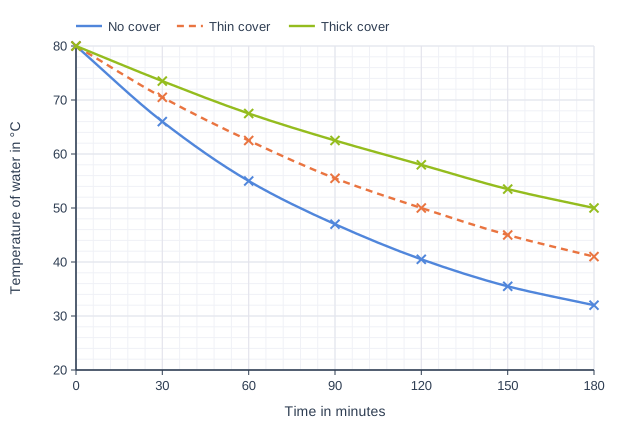
A student compares fleece covers for a hot-water bottle. Each time, she fills the same hot-water bottle with the same volume of water at 80 °C and records its temperature every 30 minutes.

She tests the bottle with no cover, with a thin fleece cover and with a thick fleece cover made of the same fleece.

The graph shows her results.

Describe and explain how the thickness of the cover affects the rate of cooling. Use data from the graph.

Line graph of temperature of water in °C (y-axis, 20 to 80) against time in minutes (x-axis, 0 to 180). "No cover" is a smooth curve through (0, 80), (30, 66), (60, 55), (90, 47), (120, 40.5), (150, 35.5), (180, 32). "Thin cover" (dashed) is a smooth curve through (0, 80), (30, 70.5), (60, 62.5), (90, 55.5), (120, 50), (150, 45), (180, 41). "Thick cover" is a smooth curve through (0, 80), (30, 73.5), (60, 67.5), (90, 62.5), (120, 58), (150, 53.5), (180, 50).

Model answer

The thicker the cover, the more slowly the water cools. After 180 minutes the water is at 32 °C with no cover, 41 °C with the thin cover and 50 °C with the thick cover, so it has fallen by 48 °C, 39 °C and 30 °C. Fleece traps air and has a low thermal conductivity, and a thicker layer of it reduces the rate at which energy is transferred from the hot water to the surroundings.

Explanation

Describe the pattern first, then support it with readings taken at the same time for different covers, then explain it in terms of the thickness and thermal conductivity of the cover reducing the rate of energy transfer. Each curve also gets less steep as the water cools, because the temperature difference with the room gets smaller.

Mark scheme
  1. 1 mark

    the thicker the cover, the lower the rate of cooling / the more slowly the water cools

    ALLOW the thick cover keeps the water hottest for longest. IGNORE 'the thick cover is better' on its own.

  2. 1 mark

    correct use of data: for example, after 180 minutes the temperature is 32 °C with no cover, 41 °C with the thin cover and 50 °C with the thick cover / the temperature falls by 48 °C, 39 °C and 30 °C in 180 minutes

    At least two correct readings (or temperature falls) at the same time, for different covers. ALLOW readings within 1 °C of the plotted values.

  3. 1 mark

    a thicker layer of fleece (which traps air and has a low thermal conductivity) reduces the rate of energy transfer from the water to the surroundings

    The explanation must refer to the thickness (or the low thermal conductivity) reducing the rate of energy transfer. ALLOW reduces the rate at which energy is transferred by heating. ALLOW fleece (or the trapped air) is a poor conductor of heat / a thicker cover reduces energy transfer by conduction. IGNORE 'keeps the heat in'. IGNORE comments that the rate of cooling decreases as the water cools.

Question 4

4 marks

The belt of a treadmill (running machine) slides over a flat board called the deck. The manufacturer recommends putting a special lubricant between the belt and the deck every few months.

A gym technician measures the current in the treadmill's motor before and after lubricating the deck, with the belt moving at the same speed and the same runner on it:
• before lubricating: 7.8 A
• after lubricating: 6.2 A.

The motor is connected to the 230 V mains supply.

Calculate the energy saved during a 40-minute run after the deck has been lubricated.

Model answer

power before = 230 V × 7.8 A = 1794 W
power after = 230 V × 6.2 A = 1426 W
power saved = 1794 − 1426 = 368 W
time = 40 × 60 = 2400 s
energy saved = 368 W × 2400 s = 883 200 J (about 880 kJ)

Explanation

The lubricant reduces the friction between the belt and the deck, so less energy is wasted heating them and the motor needs a smaller current for the same useful output. Find the power saved with power = potential difference × current, then multiply by the time in seconds. Leaving the time in minutes gives an answer 60 times too small.

Mark scheme
  1. 1 mark

    recall: power = potential difference × current; for example power before = 230 × 7.8 = 1794 (W) / power after = 230 × 6.2 = 1426 (W); or a correct final answer of 883 200 J with no working

    An answer of 883 200 J (or 880 kJ, or 8.8 × 10⁵ J) with no working scores 4 marks. ALLOW the equation in any form. ALLOW 3 marks for 14 720 J (time used in minutes instead of seconds). ALLOW 0.245 kW h (0.368 kW × 0.667 h) for 4 marks.

  2. 1 mark

    power saved = 1794 − 1426 = 368 (W) / 230 × (7.8 − 6.2) = 368 (W); or a correct final answer of 883 200 J with no working

    ALLOW ECF from an incorrect power.

  3. 1 mark

    recall: energy transferred = power × time; time = 40 × 60 = 2400 s; energy saved = 368 × 2400; or a correct final answer of 883 200 J with no working

    ALLOW the energies before and after found separately: 1794 × 2400 = 4 305 600 (J) and 1426 × 2400 = 3 422 400 (J). ALLOW ECF from an incorrect power saved.

  4. 1 mark

    883 200 (J)

    ALLOW 880 000 J / 883 kJ / 8.8 × 10⁵ J in any typed form, for example 8.8E5.

Ready to try the rest? Every answer you write is marked against the mark scheme, so you can see exactly where the marks are.

Study Helper Hints first, answers after you try

Stuck on this one? Ask for a hint and I’ll point you in the right direction, without giving the answer away. Once you’ve checked your answer, I’ll show you how the marks are awarded.