
Level:
Correct: 0
Incorrect: 0
Marks: 0/0

Practical skills: analysing and evaluating results

Practise 16 exam-style questions on Practical skills: analysing and evaluating results for OCR GCSE Combined Science (Physics Paper 12). Write your answer as you would in the exam and get it marked in seconds against the mark scheme, point by point, with the Study Helper on hand if you get stuck.

  • 16 questions
  • 1–6 marks each
  • Instant marking
  • No sign-up needed
16 questions, marked as you go

Sample questions with model answers

Here are 4 of the questions in this topic, each with a model answer, an explanation of why it earns the marks and the mark scheme an examiner would use.

Question 1

1 mark

A student records the count rate from a radioactive source as she adds sheets of card, one at a time, in front of the source. Her Geiger-Müller tube stays in the same place throughout. She forgets to subtract the background count rate from each reading.

What effect does this have on her results?

Choose your answer.

  • A None of the count rates is affected, because background radiation is random.
  • B All of the count rates are spread out more widely.
  • C All of the count rates are too high by about the same amount.
  • D All of the count rates are too low by about the same amount.

Model answer

C

The Geiger-Müller tube counts the background radiation as well as the radiation from the source, so every reading is too high by about the background count rate.

Explanation

A systematic error shifts every reading in the same direction by about the same amount. Background radiation is always present, so the background count rate must be measured without the source and subtracted from every reading. Random variation in the background is a separate, random error.

Mark scheme
  1. 1 mark

    C / all of the count rates are too high by about the same amount

    The only correct answer is C: the tube detects background radiation as well as the radiation from the source, so every reading includes the background count rate and is too high by about that amount (a systematic error). A is not correct because, although the background varies randomly, its average value is added to every reading; B is not correct because not subtracting a roughly constant background does not make the spread of the readings bigger; D is not correct because the background adds counts to the readings, it does not remove them. ALLOW the letter or the option. If more than one option is given, do not award the mark.
Question 2

2 marks

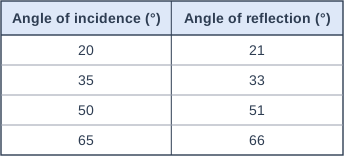
A student shines a ray of light at a plane mirror and measures the angle of reflection for four angles of incidence. She estimates that each angle she measures has an uncertainty of ±2°, because the ray is quite wide.

The table shows her results.

Explain whether her results support the hypothesis that the angle of reflection is equal to the angle of incidence.

Table with columns "Angle of incidence (°)", "Angle of reflection (°)". Angle of incidence (°): 20; Angle of reflection (°): 21 | Angle of incidence (°): 35; Angle of reflection (°): 33 | Angle of incidence (°): 50; Angle of reflection (°): 51 | Angle of incidence (°): 65; Angle of reflection (°): 66.

Model answer

The angle of reflection is within 1° or 2° of the angle of incidence each time: 21° for 20°, 33° for 35°, 51° for 50° and 66° for 65°. All of these differences are within her uncertainty of ±2°, and the angle of reflection is sometimes bigger and sometimes smaller, so the differences are random. The results support the hypothesis.

Explanation

Measured values are never exactly equal, so a hypothesis is supported if the differences are no bigger than the uncertainty in the measurements. Here every difference is 2° or less and they go both ways, so they are random errors, not evidence against the law of reflection.

Mark scheme
  1. 1 mark

    the angle of reflection differs from the angle of incidence by only 1° or 2° each time (1°, 2°, 1°, 1°)

    Max 1 if no data from the table are used. ALLOW a correct comparison of two or more pairs of angles.

  2. 1 mark

    these differences are within the uncertainty of ±2° (and the angle of reflection is sometimes larger and sometimes smaller), so the results support the hypothesis

    ALLOW 'the differences are random / are due to the width of the ray, so the angles are equal within the uncertainty'. DO NOT ALLOW 'the results do not support the hypothesis because the angles are not exactly the same'.

Question 3

3 marks

A student compares a filament lamp and an LED lamp. She connects each lamp in turn to a plug-in power meter. In a dark room she measures the light intensity 30 cm in front of each lamp with a light meter.

Filament lamp: power 60 W, light intensity 720 lux
LED lamp: power 8.5 W, light intensity 690 lux

The packaging of the LED lamp says: 'This lamp is about seven times as efficient at producing light as a filament lamp.'

Evaluate this claim. Use calculations from the student's results.

Model answer

Filament lamp: 720 ÷ 60 = 12 lux per watt
LED lamp: 690 ÷ 8.5 = 81 lux per watt
81 ÷ 12 = 6.8, so the LED lamp gives about 7 times as much light for each watt of input power. Her results support the claim.
However, she measured the light at only one point in front of each lamp, and the lamps may spread their light differently, and she took only one reading for each, so the comparison is only an estimate.

Explanation

The light meter reading per watt of input power compares how much useful output (light) each lamp gives for the same input, so it compares their efficiency at producing light. The calculation gives about 6.8. A good evaluation also points out the limits of the evidence: one position, one reading and slightly different light levels.

Mark scheme
  1. 1 mark

    light intensity per watt: filament lamp 720 ÷ 60 = 12 lux/W and LED lamp 690 ÷ 8.5 = 81 lux/W

    Max 2 if no calculations are used. ALLOW the power needed for each lux: 0.083 W/lux and 0.012 W/lux. ALLOW a comparison of power for the same light: the LED gives nearly the same light (690 lux and 720 lux) for 8.5 W instead of 60 W.

  2. 1 mark

    81 ÷ 12 = 6.8, which is about 7, so her results support the claim

    ALLOW 6.7 to 7.1. ALLOW 60 ÷ 8.5 = 7.1 (with the light nearly the same) as support for the claim. ALLOW ECF from incorrect values in marking point 1.

  3. 1 mark

    but the light meter measured the light at only one point (in one direction), and the lamps may spread their light differently / only one reading was taken for each lamp, so this is only an estimate

    ALLOW 'the light intensity is not exactly the same for the two lamps'. ALLOW 'she should measure at several positions / repeat the readings'.

Question 4

5 marks

A student models a car braking on a rough road surface. A trolley rolls along a level runway onto a strip of carpet. A card 5.0 cm long on the trolley passes through two light gates on the carpet, 0.40 m apart. A data logger records the time for which the card blocks each light gate:

• first light gate: 0.0333 s
• second light gate: 0.0556 s

The mass of the trolley is 0.60 kg.

Calculate the mean force from the carpet that slows the trolley between the two light gates.

Use the equation: (final velocity)² − (initial velocity)² = 2 × acceleration × distance

Model answer

initial velocity = 0.050 m ÷ 0.0333 s = 1.50 m/s
final velocity = 0.050 m ÷ 0.0556 s = 0.90 m/s
0.90² − 1.50² = 2 × a × 0.40
0.81 − 2.25 = 0.80 × a
a = −1.44 ÷ 0.80 = −1.8 m/s²
force = mass × acceleration = 0.60 × 1.8 = 1.08 N, so the mean force is about 1.1 N

Explanation

Each light gate gives a speed from card length ÷ time, with the card length in metres. Then rearrange (final velocity)² − (initial velocity)² = 2 × acceleration × distance to find the deceleration, and use force = mass × acceleration. The energy route (kinetic energy lost = work done by the carpet) gives the same answer. A common error is to forget to square the velocities.

Mark scheme
  1. 1 mark

    speeds: initial velocity = 0.050 ÷ 0.0333 = 1.50 m/s and final velocity = 0.050 ÷ 0.0556 = 0.90 m/s; or a correct final answer of 1.1 N (1.08 N) with no working

    An answer of 1.1 N or 1.08 N with no working scores 5 marks. ALLOW 1.5 m/s and 0.9 m/s. Speeds of 150 cm/s and 90 cm/s are correct but must be converted to m/s before marking point 2.

  2. 1 mark

    substitution: 0.90² − 1.50² = 2 × a × 0.40; or a correct final answer of 1.1 N (1.08 N) with no working

    ALLOW the energy route: loss of kinetic energy = ½ × 0.60 × (1.50² − 0.90²) = 0.432 J for marking points 2 and 3, then force = 0.432 ÷ 0.40 (work done = force × distance) for marking point 4.

  3. 1 mark

    acceleration = −1.8 m/s² / deceleration = 1.8 m/s²; or a correct final answer of 1.1 N (1.08 N) with no working

    ALLOW −1.80 or −1.81 m/s². IGNORE the sign. ALLOW 0.432 J (kinetic energy lost) on the energy route.

  4. 1 mark

    recall and use of force = mass × acceleration: 0.60 × 1.8; or a correct final answer of 1.1 N (1.08 N) with no working

    ALLOW ECF from an incorrect acceleration. ALLOW 0.432 ÷ 0.40 on the energy route.

  5. 1 mark

    evaluation: 1.1 (N)

    ALLOW 1.08 N or 1.09 N. ALLOW 2 marks for 0.45 N (from (0.90 − 1.50) ÷ (2 × 0.40), with no squares: marking points 1 and 4 only). IGNORE the sign.

Ready to try the rest? Every answer you write is marked against the mark scheme, so you can see exactly where the marks are.

Study Helper Hints first, answers after you try

Stuck on this one? Ask for a hint and I’ll point you in the right direction, without giving the answer away. Once you’ve checked your answer, I’ll show you how the marks are awarded.