
Level:
Correct: 0
Incorrect: 0
Marks: 0/0

Nuclei and isotopes

Practise 15 exam-style questions on Nuclei and isotopes for OCR GCSE Combined Science (Physics Paper 12). Write your answer as you would in the exam and get it marked in seconds against the mark scheme, point by point, with the Study Helper on hand if you get stuck.

  • 15 questions
  • 1–6 marks each
  • Instant marking
  • No sign-up needed
15 questions, marked as you go

Sample questions with model answers

Here are 4 of the questions in this topic, each with a model answer, an explanation of why it earns the marks and the mark scheme an examiner would use.

Question 1

1 mark

Argon, calcium, chlorine and potassium are all found dissolved in sea water.

Which of these nuclei contains the most neutrons?

Choose your answer.

  • A ³⁷₁₇Cl
  • B ⁴⁰₁₈Ar
  • C ³⁹₁₉K
  • D ⁴⁰₂₀Ca

Model answer

B

Explanation

The number of neutrons is the mass number minus the atomic number: Cl-37 has 20, Ar-40 has 22, K-39 has 20 and Ca-40 has 20. The nucleus with the largest mass number does not always have the most neutrons: Ar-40 and Ca-40 have the same mass number, but calcium has 2 more protons and so 2 fewer neutrons.

Mark scheme
  1. 1 mark

    B / ⁴⁰₁₈Ar

    The only correct answer is B: number of neutrons = mass number − atomic number = 40 − 18 = 22. A is not correct because 37 − 17 = 20 neutrons; C is not correct because 39 − 19 = 20 neutrons; D is not correct because 40 − 20 = 20 neutrons: it has the same mass number as B but more protons, so fewer neutrons. ALLOW the letter, the symbol or argon-40. If more than one option is given, do not award the mark.
Question 2

2 marks

Silicon-28, ²⁸₁₄Si, and silicon-30, ³⁰₁₄Si, are isotopes of silicon.

A student says: 'A silicon-30 nucleus has a relative charge of +16, because it has two more particles than a silicon-28 nucleus.'

Explain why the student is wrong.

Model answer

The two extra particles in a silicon-30 nucleus are neutrons: it has 16 neutrons and silicon-28 has 14. Neutrons have no charge, so the charge of both nuclei comes only from their 14 protons. A silicon-30 nucleus has a relative charge of +14, the same as silicon-28.

Explanation

Isotopes of an element have the same atomic number (number of protons) and different mass numbers. The difference in mass number is a difference in the number of neutrons, which adds mass but no charge. A common error is to think that every particle in the nucleus adds to its charge.

Mark scheme
  1. 1 mark

    the two extra particles are neutrons / silicon-30 has 16 neutrons and silicon-28 has 14 neutrons

    ALLOW isotopes differ only in their numbers of neutrons. IGNORE references to electrons.

  2. 1 mark

    neutrons have no charge, so a silicon-30 nucleus has the same relative charge as a silicon-28 nucleus, +14 / the charge comes only from the 14 protons (atomic number 14)

    The idea that neutrons are uncharged (or that only protons are charged) is needed, with the charge +14 or 'the same charge as silicon-28'. DO NOT ALLOW neutrons have a negative charge / neutrons cancel some of the charge.

Question 3

3 marks

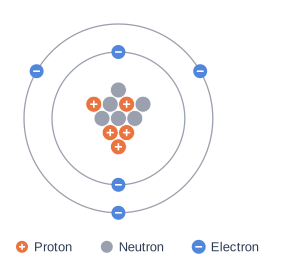
The diagram shows a model of an atom of element E.

Give the atomic number and the mass number of this atom.

A different atom of element E has a mass number of 10. Give the number of neutrons in its nucleus and the relative charge of its nucleus.

Diagram of the nuclear model of an atom: a nucleus of 5 protons (+) and 6 neutrons, with 5 electrons (−) on 2 energy levels (2, 3 from the inside out). A key shows: orange circle with + = proton, grey circle = neutron, blue circle with − = electron.

Model answer

The nucleus has 5 protons and 6 neutrons, so the atomic number is 5 and the mass number is 5 + 6 = 11.

The other atom is an isotope of the same element, so its nucleus also has 5 protons.
Number of neutrons = 10 − 5 = 5
Relative charge of its nucleus = +5, the same as in the diagram, because the charge comes from the 5 protons.

Explanation

The atomic number is the number of protons and the mass number is the number of protons plus neutrons; electrons are not counted in either. An atom of the same element always has the same number of protons, so its nucleus has the same charge, and a different mass number means a different number of neutrons. A common error is to count the electrons in the mass number.

Mark scheme
  1. 1 mark

    atomic number 5 and mass number 11

    Both values are needed for the mark. ALLOW proton number 5 and nucleon number 11. DO NOT ALLOW atomic number 11 and mass number 5 (the wrong way round) / mass number 16 (adding the electrons).

  2. 1 mark

    (number of neutrons =) 10 − 5 = 5

    ALLOW ECF from their atomic number (10 − their atomic number). DO NOT ALLOW 6 (the number of neutrons in the atom in the diagram).

  3. 1 mark

    (relative charge of the nucleus =) +5

    ALLOW 5+ / positive 5. No reason is needed (the question says "Give"). ALLOW ECF from their atomic number. DO NOT ALLOW +10 / +6 / 0.

Question 4

4 marks

Hydrogen-2, ²₁H, is an isotope of hydrogen. In heavy water, every hydrogen atom is hydrogen-2. In ordinary water, almost every hydrogen atom is hydrogen-1, ¹₁H. In both, every oxygen atom is oxygen-16, ¹⁶₈O.

A water molecule contains two hydrogen atoms and one oxygen atom. Almost all the mass of each atom is in its nucleus, and a proton and a neutron have about the same mass.

• The density of ordinary ice is 920 kg/m³.
• The density of ordinary liquid water is 1000 kg/m³.
• In ice, heavy water molecules are arranged in the same way as ordinary water molecules, and each molecule takes up the same volume.

Estimate the density of ice made from heavy water.

Predict whether a cube of heavy-water ice floats or sinks in ordinary liquid water. Give a reason.

Model answer

The mass of a molecule is proportional to the total number of protons and neutrons in its nuclei.
Ordinary water molecule: 1 + 1 + 16 = 18
Heavy water molecule: 2 + 2 + 16 = 20

Each molecule takes up the same volume, so the density increases in the same ratio as the mass:
density of heavy-water ice = 920 × 20 ÷ 18 = 1022 kg/m³ (about 1020 kg/m³)

The cube of heavy-water ice sinks, because its density (about 1020 kg/m³) is greater than the density of ordinary liquid water (1000 kg/m³).

Explanation

Density = mass ÷ volume. The only difference between the molecules is the extra neutron in each hydrogen-2 nucleus, which makes each molecule heavier without changing its size, so the same volume of ice has more mass (measured heavy-water ice is about 1018 kg/m³, close to this estimate). A common error is to double the density because hydrogen-2 has twice the mass of hydrogen-1: most of the mass of a water molecule is in the oxygen nucleus, which is unchanged.

Mark scheme
  1. 1 mark

    total number of protons and neutrons in the nuclei of one molecule (so its relative mass): ordinary water 1 + 1 + 16 = 18 and heavy water 2 + 2 + 16 = 20; or a correct final answer of any value from 1020 to 1023 kg/m³ with no working

    An answer from 1020 to 1023 kg/m³ with no working scores marking points 1, 2 and 3. ALLOW a heavy water molecule has 20/18 (10/9 or 1.11) times the mass of an ordinary water molecule (each hydrogen-2 nucleus has one extra neutron). ALLOW 18 and 20 described as the relative masses of the molecules.

  2. 1 mark

    the volume is the same, so the density increases in the same ratio as the mass: (density =) 920 × 20 ÷ 18; or a correct final answer of any value from 1020 to 1023 kg/m³ with no working

    ALLOW 920 × 1.11 / 920 × 10 ÷ 9. ALLOW ECF from incorrect molecular masses (for example 920 × 19 ÷ 18 = 971 kg/m³ if only one hydrogen atom is changed). DO NOT ALLOW 920 × 2 (doubling the density) or 1000 × 20 ÷ 18 = 1111 kg/m³ (the density of liquid water used instead of the density of ice), which score 0 for marking points 2 and 3.

  3. 1 mark

    evaluation: 1022 (kg/m³) / 1020 (kg/m³)

    ALLOW any value from 1020 to 1023 kg/m³ (1021 comes from 920 × 1.11). ALLOW 1.02 × 10³ kg/m³. IGNORE units.

  4. 1 mark

    (it) sinks, because its density is greater than the density of ordinary liquid water

    ALLOW its density is greater than 1000 kg/m³. ALLOW ECF from their density: floats if their value is less than 1000 kg/m³, sinks if it is greater. A prediction with no comparison of densities does not score.

Ready to try the rest? Every answer you write is marked against the mark scheme, so you can see exactly where the marks are.

Study Helper Hints first, answers after you try

Stuck on this one? Ask for a hint and I’ll point you in the right direction, without giving the answer away. Once you’ve checked your answer, I’ll show you how the marks are awarded.