
Level:
Correct: 0
Incorrect: 0
Marks: 0/0

Electron arrangements and radiation

Practise 14 exam-style questions on Electron arrangements and radiation for OCR GCSE Combined Science (Physics Paper 12). Write your answer as you would in the exam and get it marked in seconds against the mark scheme, point by point, with the Study Helper on hand if you get stuck.

  • 14 questions
  • 1–6 marks each
  • Instant marking
  • No sign-up needed
14 questions, marked as you go

Sample questions with model answers

Here are 4 of the questions in this topic, each with a model answer, an explanation of why it earns the marks and the mark scheme an examiner would use.

Question 1

1 mark

In an experiment, a scientist ionises some calcium atoms. A calcium atom has 20 protons and 20 electrons. Each calcium ion formed has lost two outer electrons.

The charge on one electron is −1.6 × 10⁻¹⁹ C.

What is the charge on one of these calcium ions?

Choose your answer.

  • A −3.2 × 10⁻¹⁹ C
  • B +1.6 × 10⁻¹⁹ C
  • C +3.2 × 10⁻¹⁹ C
  • D +3.2 × 10⁻¹⁸ C

Model answer

C

Explanation

An atom has no overall charge because it has equal numbers of protons and electrons. When it loses electrons, the ion is left with a positive charge equal in size to the charge of the electrons it lost: 2 × 1.6 × 10⁻¹⁹ C = 3.2 × 10⁻¹⁹ C. Common errors are to give the negative sign of the lost electrons, or the charge of the whole nucleus.

Mark scheme
  1. 1 mark

    C / +3.2 × 10⁻¹⁹ C

    The only correct answer is C: the atom was neutral (20 positive protons and 20 negative electrons), so after losing two electrons it has two more protons than electrons and a charge of +2 × 1.6 × 10⁻¹⁹ = +3.2 × 10⁻¹⁹ C. A is not correct because it is the charge of the two electrons that were lost, not of the ion left behind; B is not correct because it counts only one lost electron; D is not correct because it is the charge of all 20 protons in the nucleus (20 × 1.6 × 10⁻¹⁹ C) and ignores the 18 electrons still in the ion. ALLOW the letter or the option. If more than one option is given, do not award the mark.
Question 2

2 marks

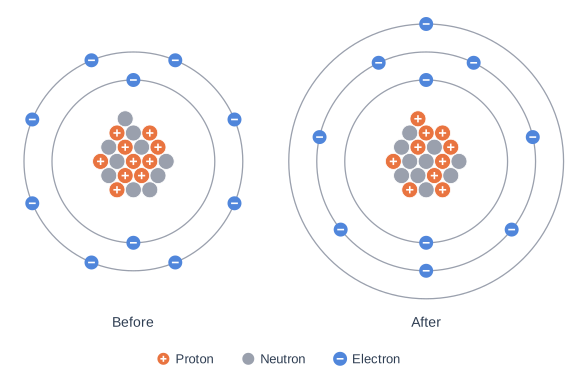
The diagram shows models of a neon atom before and after it absorbs energy from electromagnetic radiation.

Describe the change shown in the diagram. Explain whether the particle shown after the change is an atom or an ion.

Diagram of two atoms side by side. Left - Before: a nucleus of 10 protons (+) and 10 neutrons, with 10 electrons (−) on 2 energy levels (2, 8 from the inside out). Right - After: a nucleus of 10 protons (+) and 10 neutrons, with 10 electrons (−) on 3 energy levels (2, 7, 1 from the inside out). A key shows: orange circle with + = proton, grey circle = neutron, blue circle with − = electron.

Model answer

One electron has moved from the second energy level out to a third energy level, further from the nucleus, so the atom is excited. The particle is still an atom, not an ion, because it still has 10 electrons and 10 protons, so it has no overall charge.

Explanation

Count the electrons on each energy level: 2 and 8 before, 2, 7 and 1 after, so one electron has moved out to a higher energy level. The total is still 10 electrons, equal to the 10 protons, so the particle is neutral. An ion forms only when an electron leaves the atom completely.

Mark scheme
  1. 1 mark

    one electron has moved from the second energy level to a (new) third energy level, further from the nucleus / to a higher energy level (the electron has been excited)

    ALLOW one electron has moved to an outer / higher energy level or shell. DO NOT ALLOW the electron has left the atom or an electron has been gained. IGNORE references to the nucleus (it has not changed).

  2. 1 mark

    (it is still) an atom, because it still has 10 electrons and 10 protons / the same number of electrons as protons, so it has no overall charge

    ALLOW (it is an atom) because no electron has been lost or gained. DO NOT ALLOW 'atom' with no reason. DO NOT ALLOW ion.

Question 3

3 marks

The electrons in a lead atom are arranged at different distances from the nucleus.

Visible light can excite only the outer electrons, which are furthest from the nucleus. X-rays can also excite the inner electrons, which are closest to the nucleus.

Explain why X-rays can excite the inner electrons but visible light cannot.

Model answer

The inner electrons are closest to the positive nucleus, so they are attracted to it much more strongly than the outer electrons are. This means that much more energy is needed to move an inner electron to a higher energy level.
X-rays have a much higher frequency than visible light, so they transfer much more energy: enough to excite an inner electron. Visible light transfers only enough energy to excite the outer electrons, which are held less strongly.

Explanation

Link the distance of an electron from the nucleus to how strongly it is held: the closer it is to the positive nucleus, the more energy is needed to move it to a higher energy level. Then compare the energy transferred by the two radiations: X-rays have a much higher frequency than visible light, so they transfer much more energy. Saying only that X-rays are 'stronger' or 'more penetrating' does not explain the difference.

Mark scheme
  1. 1 mark

    the inner electrons are closer to the (positive) nucleus, so they are attracted (held) more strongly (than the outer electrons)

    ALLOW the outer electrons are further from the nucleus, so they are held less strongly: ORA (allow the reverse argument). ALLOW the nucleus attracts the inner electrons more strongly.

  2. 1 mark

    (so) more energy is needed to excite an inner electron / to move an inner electron to a higher energy level (than an outer electron)

    ALLOW an outer electron needs less energy to move to a higher energy level: ORA (allow the reverse argument). ALLOW more energy is needed to move an inner electron further from the nucleus.

  3. 1 mark

    X-rays have a (much) higher frequency / shorter wavelength than visible light, so they transfer (much) more energy, enough to excite an inner electron (visible light transfers too little energy)

    ALLOW X-rays carry more energy than visible light / are more energetic. DO NOT ALLOW X-rays travel faster than visible light. IGNORE X-rays are more penetrating / stronger, unless linked to the energy transferred.

Question 4

4 marks

Changes in atoms and in nuclei can produce electromagnetic radiation over a wide range of frequencies.

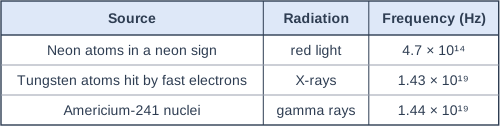
The table shows the frequency of the radiation from three sources.

Calculate how many times greater the X-ray frequency is than the red-light frequency. Give your answer to 2 significant figures.

The X-rays and the gamma rays have almost the same frequency. Explain why one is called X-rays and the other is called gamma rays.

Table with columns "Source", "Radiation", "Frequency (Hz)". Source: Neon atoms in a neon sign; Radiation: red light; Frequency (Hz): 4.7 × 10¹⁴ | Source: Tungsten atoms hit by fast electrons; Radiation: X-rays; Frequency (Hz): 1.43 × 10¹⁹ | Source: Americium-241 nuclei; Radiation: gamma rays; Frequency (Hz): 1.44 × 10¹⁹.

Model answer

1.43 × 10¹⁹ ÷ 4.7 × 10¹⁴ = 30 426, so the frequency of the X-rays is 3.0 × 10⁴ times the frequency of the red light (2 significant figures).
Gamma rays are produced by changes in a nucleus. X-rays are produced by changes involving the electrons of atoms, outside the nucleus (here, electrons in the tungsten atoms moving between energy levels). The two kinds of radiation are named by where they come from, so they can have almost the same frequency.

Explanation

Divide the larger frequency by the smaller one; the standard form powers show at once that the answer is tens of thousands. Changes in the electron arrangements of atoms can produce radiation from visible light up to X-rays, and changes in nuclei produce gamma rays, so the frequency ranges of X-rays and gamma rays overlap. The name tells you the source of the radiation, not its frequency.

Mark scheme
  1. 1 mark

    1.43 × 10¹⁹ ÷ 4.7 × 10¹⁴ (= 30 426); or a correct final answer of 3.0 × 10⁴ with no working

    An answer of 3.0 × 10⁴ with no working scores marking points 1 and 2. ALLOW 30 000 for 2 marks. ALLOW 30 426 or 3.04 × 10⁴ for marking point 1 only (not given to 2 significant figures). An answer of 3.3 × 10⁻⁵ (red light ÷ X-rays) scores 0 for the calculation.

  2. 1 mark

    3.0 × 10⁴ (times) (to 2 significant figures)

    ALLOW 30 000. ALLOW ECF for the significant-figure mark from a valid calculation shown. ALLOW typed forms such as 3.0E4 or 3.0 times 10 to the power 4.

  3. 1 mark

    gamma rays are emitted by changes in (the energy of) a nucleus / come from the nucleus

    ALLOW gamma rays come from unstable nuclei / from radioactive decay.

  4. 1 mark

    X-rays come from changes in the electrons / the electron arrangement of atoms (outside the nucleus), so the radiation is named by where it comes from, not by its frequency

    ALLOW X-rays are produced by electrons / by electrons changing energy level / by the fast electrons hitting the target. ALLOW the frequency ranges of X-rays and gamma rays overlap. The idea of naming by source is not needed if both origins are given.

Ready to try the rest? Every answer you write is marked against the mark scheme, so you can see exactly where the marks are.

Study Helper Hints first, answers after you try

Stuck on this one? Ask for a hint and I’ll point you in the right direction, without giving the answer away. Once you’ve checked your answer, I’ll show you how the marks are awarded.