
Level:
Correct: 0
Incorrect: 0
Marks: 0/0
Exam Practice
Course:
Topics:
Avg
score:
–
Topics
done:
0/27

Refraction and wave interactions

Practise 14 exam-style questions on Refraction and wave interactions for Edexcel GCSE Combined Science (Physics Paper 1). Write your answer as you would in the exam and get it marked in seconds against the mark scheme, point by point, with the Study Helper on hand if you get stuck.

  • 14 questions
  • 1–6 marks each
  • Instant marking
  • No sign-up needed
14 questions, marked as you go

Sample questions with model answers

Here are 4 of the questions in this topic, each with a model answer, an explanation of why it earns the marks and the mark scheme an examiner would use.

Question 1

1 mark

When a wave crosses the boundary between two substances, the change in its direction is described using the normal.

State what is meant by the normal.

Model answer

The normal is a line drawn at 90° to the boundary at the point where the wave crosses it.

Explanation

The normal is drawn at right angles to the boundary (surface), and the angles of incidence and refraction are measured from it. A common mistake is to say the normal is at 90° to the wave or ray instead of to the boundary.

Mark scheme
  1. 1 mark

    a line at 90° to the boundary / surface (where the wave crosses it) (1)

    accept a line perpendicular / at right angles to the boundary / surface. do not accept a line at 90° to the wave / ray / wavefront. do not accept a line parallel to the boundary. ignore 'an imaginary line' or 'a dashed line' unless the 90° to the boundary idea is given.
Question 2

2 marks

Water waves travel more slowly in shallow water than in deep water.

A student paints a straight line across the bottom of a ripple tank. The water is the same depth on both sides of the line. Straight waves cross the line at an angle.

Explain why the waves do not change direction as they cross the line.

Model answer

The water is the same depth on both sides of the line, so the waves travel at the same speed on both sides. Waves only change direction (refract) when their speed changes at a boundary, so the waves carry straight on across the line.

Explanation

Refraction happens because a wave changes speed when it crosses into a different medium; for water waves the speed depends on the depth. A painted line does not change the depth, so it is not a real boundary for the waves and nothing changes. Answers that just say 'the line is not a barrier' miss the link to speed.

Mark scheme
  1. 1 mark

    the depth is the same on both sides (of the line), so the speed of the waves does not change (1)

    An explanation linking. accept the waves travel at the same speed on both sides of the line. do not accept 'the waves slow down at the line'.

  2. 1 mark

    waves only change direction / refract when their speed changes (1)

    accept refraction is caused by a change in speed / no change in speed means no refraction. accept refraction only happens at a boundary where the speed of the waves changes. do not accept 'the line is not a boundary' or 'the medium is the same on both sides' on its own: the link to a change in speed is needed for this mark. ignore 'the line is only paint'.

Question 3

3 marks

On a still night, the air near the ground can be colder than the air higher up. Sound travels at about 332 m/s in the cold air near the ground and at about 338 m/s in the warmer air above it.

Sound from a festival stage travels upwards at an angle from the cold air into the warmer air.

Explain how the direction of the sound changes as it passes into the warmer air, and why this can help people far from the stage to hear it.

Model answer

Sound travels faster in the warmer air, so as it crosses into the warmer air it speeds up and bends away from the normal. Its path becomes less steep (closer to the horizontal), so it is bent back towards the ground instead of escaping upwards. More of the sound stays near the ground, so people a long way from the stage can hear it.

Explanation

Refraction depends on the change in speed: a wave that speeds up bends away from the normal, and one that slows down bends towards it. Here the normal to the boundary between the air layers is vertical, so bending away from it turns the sound back towards the ground. A common wrong answer is that the sound is reflected by the warm air, or that it is easier to hear at night only because it is quieter.

Mark scheme
  1. 1 mark

    the sound speeds up (as it passes into the warmer air) (1)

    An explanation linking. accept it travels faster in the warmer air / from 332 m/s to 338 m/s.

  2. 1 mark

    so it bends / refracts away from the normal (1)

    accept it bends away from the vertical / towards the horizontal. do not accept bends towards the normal.

  3. 1 mark

    so the sound travels less steeply upwards / is bent back towards the ground, so more of it stays near the ground (and reaches people far away) (1)

    accept less sound escapes upwards into the sky. ignore 'sound is louder at night' or 'it is quieter at night' without the refraction idea. do not accept sound is reflected off the warm air.

Question 4

4 marks

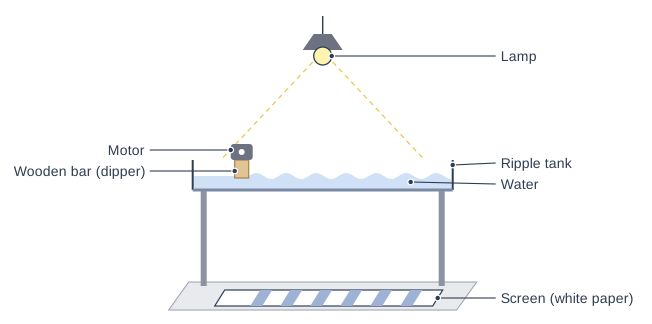
The diagram shows a ripple tank. A student also has a flat sheet of clear plastic that can be placed on the bottom of the tank, under the water, to make a region of shallower water.

Describe how the ripple tank and the plastic sheet can be used to show that water waves change direction when they travel into shallower water.

Diagram of a ripple tank, seen from the side. A shallow tray of water stands on legs. A wooden bar driven by a motor touches the water at one end and sends ripples along it. A lamp above the tray shines down through the water onto white paper on the floor, which shows evenly spaced bright and dark lines parallel to the bar. Labelled parts: Lamp, Motor, Wooden bar (dipper), Water, Ripple tank, Screen (white paper).

Model answer

Place the plastic sheet on the bottom of the tank so that the water above it is shallow, with the edge of the sheet at an angle to the wooden bar. Switch on the lamp and the motor so the bar makes straight waves. Look at the bright lines on the white paper under the tank: over the sheet the lines are closer together and point in a different direction, so the waves have changed direction at the edge of the sheet. Mark the positions of the lines on the paper (or photograph them) and measure the angles they make with the edge of the sheet on each side to compare the directions.

Explanation

The edge of the sheet must be at an angle to the waves; if it is parallel to the wooden bar the waves slow down but do not change direction. The bright lines on the paper are images of the wavefronts, so marking or photographing them lets the directions be compared. Weak answers describe measuring the wave speed instead of showing the change of direction.

Mark scheme
  1. 1 mark

    place the plastic sheet in the tank so that the water above it is shallower (1)

    A description including any four from the seven points; max 4. accept put the sheet under the water to make a shallow region.

  2. 1 mark

    with the edge of the sheet at an angle to the wooden bar / to the wavefronts (1)

    accept the boundary is not parallel to the waves. do not accept the edge of the sheet parallel to the bar (the waves would not change direction).

  3. 1 mark

    switch on the motor (and the lamp) to make straight waves / ripples (1)

    accept the wooden bar vibrates to make the waves.

  4. 1 mark

    observe the pattern of bright lines (wavefronts) on the white paper / screen below the tank (1)

    accept look at the shadows of the waves on the paper.

  5. 1 mark

    the wavefronts change direction / bend where they cross the edge of the sheet (1)

    accept the lines point in a different direction over the sheet.

  6. 1 mark

    the wavefronts are closer together over the sheet / in the shallow water (1)

    accept the wavelength is shorter in the shallow water.

  7. 1 mark

    mark the wavefronts on the paper / take a photograph (or use a stroboscope to freeze the pattern) and measure the angles on each side of the boundary (with a protractor) (1)

    accept trace the lines on the paper and compare their directions. ignore 'repeat the experiment' on its own.

Ready to try the rest? Every answer you write is marked against the mark scheme, so you can see exactly where the marks are.

Study Helper Hints first, answers after you try

Stuck on this one? Ask for a hint and I’ll point you in the right direction, without giving the answer away. Once you’ve checked your answer, I’ll show you how the marks are awarded.