
Level:
Correct: 0
Incorrect: 0
Marks: 0/0
Exam Practice
Course:
Topics:
Avg
score:
–
Topics
done:
0/27

Newton's first and second laws and weight

Practise 17 exam-style questions on Newton's first and second laws and weight for Edexcel GCSE Combined Science (Physics Paper 1). Write your answer as you would in the exam and get it marked in seconds against the mark scheme, point by point, with the Study Helper on hand if you get stuck.

  • 17 questions
  • 1–6 marks each
  • Instant marking
  • No sign-up needed
17 questions, marked as you go

Sample questions with model answers

Here are 4 of the questions in this topic, each with a model answer, an explanation of why it earns the marks and the mark scheme an examiner would use.

Question 1

1 mark

Bathroom scales measure the size of the downward force on them. They divide this force by 10 N/kg and display the result as a mass in kg.

Imogen has a mass of 60 kg. The gravitational field strength on Mars is 3.7 N/kg.

What reading would the scales display if Imogen stood on them on Mars?

Choose your answer.

  • A 16 kg
  • B 22 kg
  • C 60 kg
  • D 222 kg

Model answer

B - 22 kg. Her weight on Mars is 60 × 3.7 = 222 N, and the scales display 222 ÷ 10 = 22 kg.

Explanation

Scales like these measure weight, which is a force, and only display a mass because they assume g = 10 N/kg. Imogen's mass is the same on Mars, but her weight is proportional to the gravitational field strength, so the reading falls to 3.7/10 of 60 kg. Choosing 60 kg forgets that the scales respond to weight, not mass.

Mark scheme
  1. 1 mark

    B / 22 kg (1)

    The only correct answer is B: the scales measure Imogen's weight on Mars, W = m × g = 60 × 3.7 = 222 N, and display 222 ÷ 10 = 22.2, about 22 kg. A is not correct because it divides her mass by the gravitational field strength on Mars (60 ÷ 3.7 = 16) instead of multiplying; C is not correct because 60 kg is her mass, which is the same on Mars, but the scales respond to the force on them (her weight), not to her mass; D is not correct because 222 is her weight on Mars in newtons, before the scales divide it by 10 N/kg. Accept the letter or the option. If more than one option is given, do not award the mark.
Question 2

2 marks

Describe how a student could measure the weight of a bag of apples in the laboratory.

Model answer

First check that the newtonmeter reads zero with nothing on it. Then hang the bag of apples from the hook of the newtonmeter, wait until it stops moving and read the scale at eye level. The reading in newtons is the weight of the bag.

Explanation

Weight is a force, so it is measured with a newtonmeter (force meter), which reads in newtons. The reading should be taken when the bag is still, so that the spring's pull exactly balances the weight. A balance gives a reading in kilograms or grams, which is a mass and would still need multiplying by g.

Mark scheme
  1. 1 mark

    hang the bag from a newtonmeter / force meter / spring balance (1)

    A description including any two from the three points; max 2. Accept 'a forcemeter calibrated in newtons'. Alternative: 'measure the mass on a (top-pan) balance and calculate weight = mass × 10 N/kg' scores 1 mark only. Do not accept 'put it on scales' alone.

  2. 1 mark

    wait until the bag is still and read the scale (in newtons) / read the scale at eye level (1)

    Accept 'read the force in N when the bag stops moving'.

  3. 1 mark

    check the newtonmeter reads zero before hanging the bag / adjust the zero (1)

    Accept 'use a newtonmeter with a suitable range'.

Question 3

3 marks

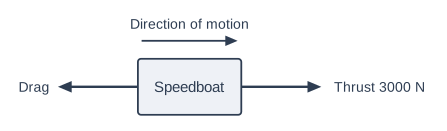
The diagram shows the horizontal forces acting on a speedboat. The force arrows are not drawn to scale.

The speedboat has a mass of 800 kg. It is accelerating at 2.5 m/s².

Calculate the drag force on the speedboat.

Free body diagram: a box labelled "Speedboat" with 2 force arrows. An arrow labelled "Thrust 3000 N" starts at the object and points to the right; an arrow labelled "Drag" starts at the object and points to the left. A separate arrow labelled "Direction of motion" points to the right.

Model answer

Resultant force = m × a = 800 × 2.5 = 2000 N (forwards)
Resultant force = thrust − drag, so 2000 = 3000 − drag
Drag = 3000 − 2000 = 1000 N

Explanation

F = m × a gives the resultant force, not any single force. Here the resultant (2000 N forwards) is the thrust minus the drag, so the drag is 3000 − 2000 = 1000 N. A common error is to give the resultant force as the answer.

Mark scheme
  1. 1 mark

    substitution: (resultant force =) 800 × 2.5 (1)

    F = m × a must be recalled. Award full marks for the correct answer without working.

  2. 1 mark

    resultant force = 2000 (N) (1)

    An answer of 2000 N given as the drag scores this mark and the first mark only (the resultant force is not the drag).

  3. 1 mark

    drag = 3000 − 2000 = 1000 (N) (1)

    Allow ecf from their resultant force. Do not accept 3000 + 2000 = 5000 (N).

Question 4

4 marks

A fully loaded lorry of mass 4.0 × 10⁴ kg pulls away from rest on a level road. The driving force on the lorry is 1.4 × 10⁴ N. The total resistive force on the lorry is 2.0 × 10³ N.

Assume that the forces stay constant.

Calculate how long the lorry takes to speed up to 15 m/s.

Model answer

Resultant force = 1.4 × 10⁴ − 2.0 × 10³ = 1.2 × 10⁴ N
a = F ÷ m = 1.2 × 10⁴ ÷ 4.0 × 10⁴ = 0.30 m/s²
t = (v − u) ÷ a = (15 − 0) ÷ 0.30 = 50 s

Explanation

Only the resultant force (driving force minus resistive force) accelerates the lorry, so subtract first - taking care that 2.0 × 10³ N is 2000 N, not 20 000 N - then use a = F ÷ m and t = (v − u) ÷ a. The large mass of a loaded lorry is why it accelerates slowly, at only 0.30 m/s².

Mark scheme
  1. 1 mark

    resultant force = 1.4 × 10⁴ − 2.0 × 10³ = 1.2 × 10⁴ (N) (1)

    Accept 12 000 (N). An answer of 50 (s) with no working scores 4 marks.

  2. 1 mark

    acceleration = 1.2 × 10⁴ ÷ 4.0 × 10⁴ = 0.30 (m/s²) (1)

    F = m × a must be recalled. Allow ecf from their resultant force only if it was found by subtracting the forces. Using 1.4 × 10⁴ N as the resultant (a = 0.35 m/s²) is a wrong step: it scores 0 for the first two marks, and then only the substitution mark below (ecf).

  3. 1 mark

    substitution: (t =) (15 − 0) ÷ 0.30 (1)

    Allow ecf from their acceleration.

  4. 1 mark

    evaluation: 50 (s) (1)

    Allow ecf from their acceleration only if the first mark was awarded. 43 (s) (from 1.4 × 10⁴ N) scores 1 mark only. 50 to any other power of ten (e.g. from a power of ten slip with the standard form) scores 3 marks.

Ready to try the rest? Every answer you write is marked against the mark scheme, so you can see exactly where the marks are.

Study Helper Hints first, answers after you try

Stuck on this one? Ask for a hint and I’ll point you in the right direction, without giving the answer away. Once you’ve checked your answer, I’ll show you how the marks are awarded.