
Level:
Correct: 0
Incorrect: 0
Marks: 0/0
Exam Practice
Course:
Topics:
Avg
score:
–
Topics
done:
0/27

Reaction times and stopping distances

Practise 20 exam-style questions on Reaction times and stopping distances for Edexcel GCSE Combined Science (Physics Paper 1). Write your answer as you would in the exam and get it marked in seconds against the mark scheme, point by point, with the Study Helper on hand if you get stuck.

  • 20 questions
  • 1–6 marks each
  • Instant marking
  • No sign-up needed
20 questions, marked as you go

Sample questions with model answers

Here are 4 of the questions in this topic, each with a model answer, an explanation of why it earns the marks and the mark scheme an examiner would use.

Question 1

1 mark

A cycle helmet has a thick layer of foam inside a hard plastic shell. In a crash, the foam is crushed as the cyclist's head comes to a stop.

How does the foam reduce the force on the cyclist's head?

Choose your answer.

  • A it increases the time taken to stop
  • B it reduces the change in speed
  • C it increases the deceleration
  • D it reduces the mass of the head

Model answer

A - it increases the time taken to stop.

Explanation

The head has the same change in velocity whether or not it wears a helmet. Crushing foam makes the stopping take longer, so the deceleration is smaller and, from F = m × a, the force on the head is smaller. A common error is to think that safety features reduce the speed change itself.

Mark scheme
  1. 1 mark

    A / it increases the time taken to stop (1)

    The only correct answer is A. As the foam is crushed, the head takes longer to stop, so its deceleration is smaller and the force on it (F = m × a) is smaller. B is not correct because the head still goes from the same speed to rest, so the change in speed is the same; C is not correct because the foam decreases the deceleration, which is what reduces the force; D is not correct because the mass of the head does not change. Accept the letter or the option. If more than one option is given, do not award the mark.
Question 2

2 marks

In a ruler-drop test, one student holds a ruler above another student's open thumb and finger and then drops it. The second student grabs the falling ruler the moment they see it move.

The student dropping the ruler waits a different length of time before each drop and gives no warning.

Explain why.

Model answer

If the drops always came after the same wait, or after a warning, the catcher could predict when the ruler will fall and start closing their fingers early. The distance fallen, and so the measured reaction time, would then be shorter than the catcher's true reaction time. Varying the wait means the catcher can only react to seeing the ruler move.

Explanation

A reaction time is the time between a stimulus and the response, so the catcher must not be able to anticipate the stimulus. Random delays with no warning make the measurement valid. Answers that just say 'to make it fair' or 'more accurate' do not explain how anticipation would affect the result.

Mark scheme
  1. 1 mark

    so the catcher cannot predict / anticipate when the ruler will be dropped (1)

    An explanation linking two points. accept so the catcher has to react only to seeing the ruler start to fall

  2. 1 mark

    otherwise the catcher could start to close their fingers before / as the ruler is released, so the measured reaction time would be too short / would not be a true (valid) reaction time (1)

    accept the results would be lower than the person's real reaction time; ignore 'to make it a fair test' on its own; ignore 'more accurate' unless explained

Question 3

3 marks

A delivery van is driven along a test track at the same speed twice, first when it is empty and then when it is fully loaded with parcels. Each time, the driver brakes and the brakes produce the same braking force.

Explain why the braking distance is longer when the van is fully loaded.

Model answer

When the van is fully loaded its mass is greater. The braking force is the same, so from F = m × a its deceleration is smaller. The van therefore takes longer to slow down from the same speed and travels a greater distance while it is braking.

Explanation

Mass is one of the factors that affect stopping distance. Newton's second law shows that the same force gives a smaller deceleration to a larger mass, so the loaded van travels further before it stops; equivalently, it has more kinetic energy to lose. The mass of the vehicle does not affect the thinking distance.

Mark scheme
  1. 1 mark

    the loaded van has a greater mass (1)

    An explanation linking three points.

  2. 1 mark

    (for the same force) the deceleration is smaller (because a = F ÷ m / F = m × a) (1)

    accept 'it slows down more slowly'; allow 'the loaded van has more kinetic energy (at the same speed), so the brakes must transfer more energy' for this mark

  3. 1 mark

    so the van takes longer to stop and travels further while braking (1)

    accept takes more time to stop so covers a greater distance; ignore 'it is heavier so it is harder to stop' with no reference to deceleration or energy

Question 4

4 marks

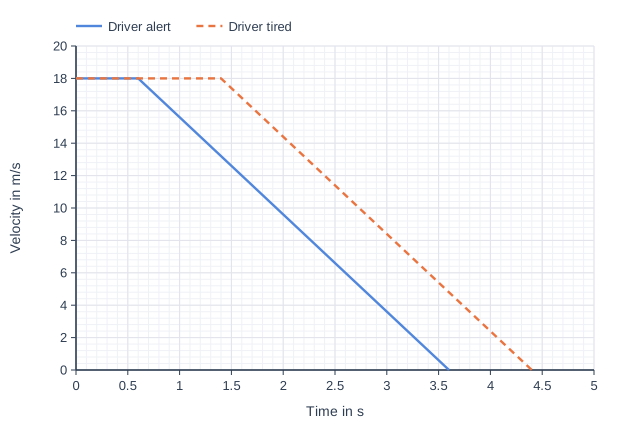
The graph shows how the velocity of a car changes from the moment the driver sees a hazard until the car stops. One line is for the driver when alert. The other line is for the same driver when tired. The car is braked in the same way each time.

Use the graph to calculate how much further the car travels before stopping when the driver is tired.

Line graph of velocity in m/s (y-axis, 0 to 20) against time in s (x-axis, 0 to 5). "Driver alert" joins the points (0, 18), (0.6, 18), (3.6, 0). "Driver tired" (dashed) joins the points (0, 18), (1.4, 18), (4.4, 0).

Model answer

The car moves at 18 m/s during the reaction time and then decelerates in the same way, taking 3.0 s to stop, in both cases.
Alert: stopping distance = 18 × 0.6 + ½ × 18 × 3.0 = 10.8 + 27 = 37.8 m
Tired: stopping distance = 18 × 1.4 + ½ × 18 × 3.0 = 25.2 + 27 = 52.2 m
Extra distance = 52.2 - 37.8 = 14.4 m

Explanation

The distance travelled is the area under a velocity-time graph. The flat part is the thinking distance and the sloping part is the braking distance; because the car is braked in the same way, the two triangles are identical, so the extra distance is only the extra thinking distance, 18 m/s × 0.8 s = 14.4 m. A common error is to find the gradient instead of the area.

Mark scheme
  1. 1 mark

    reaction times read from the graph: 0.6 s (alert) and 1.4 s (tired) / a difference of 0.8 s (1)

    An answer of 14.4 (m) with no working scores 4 marks. may be seen in the calculation

  2. 1 mark

    thinking distance from area of a rectangle / speed × time, e.g. 18 × 0.6 = 10.8 (m) or 18 × 1.4 = 25.2 (m) or 18 × 0.8 (1)

    allow ecf from misread times

  3. 1 mark

    braking distances are the same in both cases / both stopping distances found: 37.8 (m) and 52.2 (m) (1)

    braking distance = area of triangle = ½ × 18 × 3 = 27 m for both; this mark is implied by the method 18 × (1.4 - 0.6)

  4. 1 mark

    14.4 (m) (1)

    accept 14 m; allow ecf from their readings

Ready to try the rest? Every answer you write is marked against the mark scheme, so you can see exactly where the marks are.

Study Helper Hints first, answers after you try

Stuck on this one? Ask for a hint and I’ll point you in the right direction, without giving the answer away. Once you’ve checked your answer, I’ll show you how the marks are awarded.