
Level:
Correct: 0
Incorrect: 0
Marks: 0/0
Exam Practice
Course:
Topics:
Avg
score:
–
Topics
done:
0/27

Activity and half-life

Practise 16 exam-style questions on Activity and half-life for Edexcel GCSE Combined Science (Physics Paper 1). Write your answer as you would in the exam and get it marked in seconds against the mark scheme, point by point, with the Study Helper on hand if you get stuck.

  • 16 questions
  • 1–6 marks each
  • Instant marking
  • No sign-up needed
16 questions, marked as you go

Sample questions with model answers

Here are 4 of the questions in this topic, each with a model answer, an explanation of why it earns the marks and the mark scheme an examiner would use.

Question 1

1 mark

A sample of a radioactive isotope is left for three half-lives.

What fraction of the original undecayed nuclei has decayed?

Choose your answer.

  • A 1/8
  • B 3/8
  • C 3/4
  • D 7/8

Model answer

D - 7/8.

Explanation

Halve three times: 1 → 1/2 → 1/4 → 1/8 of the nuclei remain undecayed, so the net decline is 7/8 of the original nuclei. Read the question carefully: option A is the fraction remaining, not the fraction that has decayed.

Mark scheme
  1. 1 mark

    D / 7/8 (1)

    The only correct answer is D: after three half-lives 1/2 × 1/2 × 1/2 = 1/8 of the nuclei are undecayed, so 1 - 1/8 = 7/8 have decayed. A is not correct because 1/8 is the fraction that has not decayed; B is not correct because it is 3 × 1/8, which does not describe repeated halving; C is not correct because 3/4 have decayed after two half-lives, not three. Accept the letter or the option. If more than one option is given, do not award the mark.
Question 2

2 marks

Sample P contains 5.0 × 10¹² undecayed nuclei of magnesium-28, which has a half-life of 21 hours.
Sample Q contains 5.0 × 10¹² undecayed nuclei of caesium-137, which has a half-life of 30 years.

Explain which sample has the greater activity.

Model answer

Sample P has the greater activity. Both samples have the same number of undecayed nuclei, but half of the magnesium-28 nuclei decay in only 21 hours, while it takes 30 years for half of the caesium-137 nuclei to decay. So many more nuclei decay each second in sample P, and the activity is the number of nuclei that decay each second.

Explanation

Activity depends on how quickly the nuclei decay as well as on how many undecayed nuclei there are. With equal numbers of nuclei, the isotope with the much shorter half-life has far more decays each second, so it has the greater activity (although its activity also falls much faster). Common errors are to say that equal numbers of nuclei must give equal activities, or that the longer-lived caesium-137 is 'more radioactive'.

Mark scheme
  1. 1 mark

    An explanation linking: half of the magnesium-28 nuclei decay in 21 hours, but it takes 30 years for half of the caesium-137 nuclei to decay / the nuclei in P decay much faster because P has a (much) shorter half-life (1)

    'P' with no reason scores 0. Accept 'P, because magnesium-28 has the shorter half-life' for this mark.

  2. 1 mark

    so (many) more nuclei decay each second in P, so P has the greater activity (1)

    This mark needs the idea that activity is the number of nuclei decaying per second (more decays per second in P). Do not accept 'Q, because its nuclei last longer', 'they have the same activity because they have the same number of nuclei' or 'P is more dangerous' as the reason.

Question 3

3 marks

Strontium-90 has a half-life of 29 years.

A student says: 'A strontium-90 nucleus that has not decayed yet will decay 29 years from now.'

Explain why the student is wrong and explain what the half-life of strontium-90 does tell us.

Model answer

Radioactive decay is random, so it is impossible to predict when a particular strontium-90 nucleus will decay - it could decay in the next second or not for hundreds of years. The half-life is a statistical value for very large numbers of nuclei: it tells us that, in a sample containing a very large number of strontium-90 nuclei, half of them will decay in 29 years, so the activity halves every 29 years.

Explanation

A single nucleus decays at random, so its decay time cannot be predicted. Half-life describes what happens to a very large number of nuclei: about half decay in each half-life, so the activity of a sample can be predicted. The student has applied a statistical idea to one nucleus.

Mark scheme
  1. 1 mark

    (radioactive) decay is random (1)

    Any three from the four points; max 3.

  2. 1 mark

    so it is not possible to predict when a particular nucleus will decay / the nucleus could decay at any time (1)

    Accept 'it might decay in the next second or not for hundreds of years'.

  3. 1 mark

    half-life tells us that half of a (very) large number of strontium-90 nuclei will decay in 29 years / the activity of a (large) sample halves every 29 years (1)

    Do not accept 'half of each nucleus decays in 29 years'.

  4. 1 mark

    half-life is a statistical / average value that only applies to (very) large numbers of nuclei (1)

    Accept 'with large numbers of nuclei the decay can be predicted'.

Question 4

4 marks

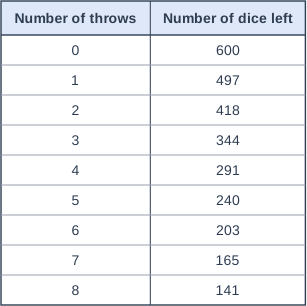
A class models radioactive decay with 600 dice. The dice are thrown, and every dice showing a six is removed ('decays'). The remaining dice are thrown again, and so on.

The table shows the class's results.

Use the results to estimate the 'half-life' of the dice in throws. Explain two ways in which this model is like radioactive decay.

Table with columns "Number of throws", "Number of dice left". Number of throws: 0; Number of dice left: 600 | Number of throws: 1; Number of dice left: 497 | Number of throws: 2; Number of dice left: 418 | Number of throws: 3; Number of dice left: 344 | Number of throws: 4; Number of dice left: 291 | Number of throws: 5; Number of dice left: 240 | Number of throws: 6; Number of dice left: 203 | Number of throws: 7; Number of dice left: 165 | Number of throws: 8; Number of dice left: 141.

Model answer

Half of 600 is 300. After 3 throws 344 dice are left and after 4 throws 291 are left, so 300 dice are left after about 3.8 throws: the 'half-life' is about 3.8 throws.
The model is like radioactive decay because you cannot predict which dice will show a six, just as you cannot predict when a particular nucleus will decay. Also, every dice has the same chance (1 in 6) of being removed in each throw, just as each undecayed nucleus has the same chance of decaying in a given time, so the number removed falls as fewer dice remain, like the activity of a source.

Explanation

Find when the number left falls to half of 600: 300 lies between throw 3 (344) and throw 4 (291), nearer to 4, so the 'half-life' is about 3.8 throws. Each dice has a fixed chance of 'decaying' each throw, and which ones do so is random, like nuclei; with large numbers the overall pattern is predictable. Giving 3 throws is a common error: after 3 throws more than half the dice are still left.

Mark scheme
  1. 1 mark

    half of 600 is 300 (dice) / uses any pair of values where one is half the other (1)

    MP1 and MP2 are for the estimate. An answer in the range for MP2 with no working scores MP1 and MP2.

  2. 1 mark

    'half-life' = about 3.8 throws (1)

    Accept any value from 3.5 to 4.0 throws. Do not accept 3 (the number left after 3 throws is 344, more than 300) or 4.5 or more.

  3. 1 mark

    you cannot predict which dice will show a six (or when a particular dice will be removed), just as you cannot predict when a particular nucleus will decay / both are random (1)

    MP3 to MP6: any two from four; max 2. Each must link the dice to radioactive decay.

  4. 1 mark

    each dice has the same chance (1 in 6) of being removed in each throw, just as each nucleus has the same chance of decaying in a given time (1)

    Accept 'the probability of decay stays the same for every dice / nucleus'.

  5. 1 mark

    the number removed in each throw falls as fewer dice are left, just as the activity falls as fewer undecayed nuclei are left (1)

    Accept 'about one sixth of the remaining dice are removed each throw'.

  6. 1 mark

    with a large number of dice the overall pattern is predictable / the 'half-life' is the same whatever number you start from, as for a large number of nuclei (1)

    Accept 'from 418 to about 209 also takes about 4 throws'.

Ready to try the rest? Every answer you write is marked against the mark scheme, so you can see exactly where the marks are.

Study Helper Hints first, answers after you try

Stuck on this one? Ask for a hint and I’ll point you in the right direction, without giving the answer away. Once you’ve checked your answer, I’ll show you how the marks are awarded.