
Level:
Correct: 0
Incorrect: 0
Marks: 0/0
Exam Practice
Course:
Topics:
Avg
score:
–
Topics
done:
0/27

Nuclear radiation and background radiation

Practise 16 exam-style questions on Nuclear radiation and background radiation for Edexcel GCSE Combined Science (Physics Paper 1). Write your answer as you would in the exam and get it marked in seconds against the mark scheme, point by point, with the Study Helper on hand if you get stuck.

  • 16 questions
  • 1–6 marks each
  • Instant marking
  • No sign-up needed
16 questions, marked as you go

Sample questions with model answers

Here are 4 of the questions in this topic, each with a model answer, an explanation of why it earns the marks and the mark scheme an examiner would use.

Question 1

1 mark

A sealed radioactive source is placed in front of a Geiger-Müller (G-M) tube connected to a counter. After the background count rate has been subtracted, the count rate due to the source is 480 counts per minute. Each nucleus that decays gives out one particle.

How many nuclei in the source decay each second?

Choose your answer.

  • A exactly 8
  • B fewer than 8
  • C more than 8
  • D 480

Model answer

C - more than 8.

Explanation

A G-M tube counts only the radiation that enters it. The source gives out particles in all directions, so many of them miss the tube, and some that enter may not be counted. So the corrected count rate, 480 ÷ 60 = 8 counts per second, is less than the number of nuclei that decay each second.

Mark scheme
  1. 1 mark

    C / more than 8 (1)

    The only correct answer is C: the count rate is 480 ÷ 60 = 8 counts per second, but the source gives out particles in all directions, so only some of them enter the G-M tube (and not every particle that enters is necessarily counted); so more than 8 nuclei must decay each second. A is not correct because it assumes that every particle given out is detected; B is not correct because, with the background subtracted, the tube cannot count more particles from the source than the source gives out; D is not correct because 480 is the number of counts in one minute, not one second, and it also assumes that every particle is detected. Accept the letter or the option. If more than one option is given, do not award the mark.
Question 2

2 marks

Airline pilots and cabin crew receive a larger dose of background radiation each year than most people who work at ground level.

Explain why.

Model answer

Pilots and cabin crew spend many hours at high altitude, where they are exposed to more cosmic rays from space. At ground level much of this radiation has been absorbed by the atmosphere, but at cruising height there is much less air above them to absorb it.

Explanation

Cosmic rays come from space. The atmosphere absorbs much of this radiation, so the dose from cosmic rays increases with altitude, and people who fly for a living receive more of it. Being 'closer to the Sun' is not the reason - a few kilometres makes no difference to the distance from the Sun.

Mark scheme
  1. 1 mark

    An explanation linking: (at high altitude) they are exposed to more cosmic rays / cosmic radiation (from space) (1)

    Accept 'radiation from space' or 'radiation from the Sun (and stars)'. Ignore UV. Do not accept radiation from the aircraft's engines, radar or electronics.

  2. 1 mark

    (because) there is less atmosphere above them to absorb (the cosmic rays) / the atmosphere absorbs cosmic rays before they reach the ground (1)

    Accept 'less air to shield them'. Do not accept 'they are closer to the Sun' (the change in distance is far too small to matter) or 'the air is thinner so there is less oxygen'.

Question 3

3 marks

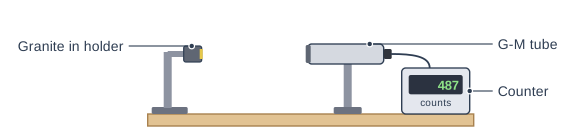
A geologist places a small piece of granite in a holder in front of a Geiger-Müller (G-M) tube connected to a counter, as shown in the diagram.

With no granite present, the counter recorded 112 counts in 5 minutes.
With the granite in place, the counter recorded 487 counts in 10 minutes.

Calculate the count rate due to the granite alone, in counts per minute.

Diagram of a radioactive source and a Geiger-Müller tube with a counter. A radioactive source on the left points at the window of a Geiger-Müller tube on the right, which is connected to a counter showing 487. There is nothing between the source and the tube. The label "Granite in holder" points to the small capsule on a holder at the left; the label "G-M tube" points to the long tube on a stand pointing at the capsule, with a cable to the box; the label "Counter" points to the box with a display at the right, connected to the tube by a cable.

Model answer

Background count rate = 112 ÷ 5 = 22.4 counts per minute
Count rate with the granite = 487 ÷ 10 = 48.7 counts per minute
Count rate due to the granite = 48.7 - 22.4 = 26.3 counts per minute

Explanation

The two counts were recorded over different times, so first turn each into a count rate (counts per minute). Then subtract the background count rate from the count rate with the sample in place. Subtracting 112 from 487 directly is the common error, because 112 counts were recorded in only 5 minutes.

Mark scheme
  1. 1 mark

    (background count rate =) 112 ÷ 5 = 22.4 (counts per minute) (1)

    An answer of 26.3 (counts per minute) with no working scores 3 marks. Allow ecf from MP1 and MP2 for MP3.

  2. 1 mark

    (count rate with sample =) 487 ÷ 10 = 48.7 (counts per minute) (1)

    (487 - 112) ÷ 10 = 37.5 scores 0: counts measured over different times cannot be subtracted.

  3. 1 mark

    (48.7 - 22.4 =) 26.3 (counts per minute) (1)

    Allow 26. The question asks for counts per minute: a correct value given in counts per second (0.44 counts per second) scores MP1 and MP2 only.

Question 4

4 marks

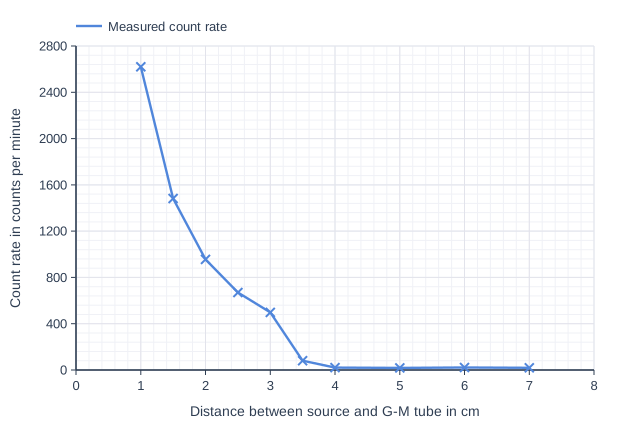
A teacher places a sealed source that emits only alpha particles in front of a G-M tube. She measures the count rate at different distances between the source and the tube. The graph shows her results.

Use the graph to estimate the range of the alpha particles in air. Explain why the count rate does not fall to zero, and why alpha particles have such a short range in air.

Line graph of count rate in counts per minute (y-axis, 0 to 2800) against Distance between source and G-M tube in cm (x-axis, 0 to 8). "Measured count rate" joins the points (1, 2620), (1.5, 1482), (2, 956), (2.5, 670), (3, 498), (3.5, 80), (4, 21), (5, 18), (6, 22), (7, 19).

Model answer

The count rate falls sharply between 3.0 cm and 3.5 cm and is down to a steady low value by 4.0 cm, so the range of the alpha particles is about 3.5 cm. Beyond this the count rate stays at about 20 counts per minute, which is the background radiation the G-M tube detects all the time, so it does not fall to zero. Alpha particles are strongly ionising, so they ionise many air molecules and lose their energy very quickly, which means they stop after only a few centimetres of air.

Explanation

Between 1 cm and 3 cm the count rate falls gradually because the alpha particles spread out, but just beyond 3.0 cm it suddenly drops, and from 4.0 cm it stays at about 20 counts per minute, so the range is about 3.5 cm. The steady count that remains is background radiation, which is always present - a common error is to think some alpha particles are still reaching the tube. Alpha particles have a short range because they are the most strongly ionising radiation: every ionisation takes some of their energy.

Mark scheme
  1. 1 mark

    range = about 3.5 cm / any value from 3.2 cm to 4.0 cm (1)

    The count rate falls sharply between 3.0 cm and 3.5 cm and is at the background level by 4.0 cm. Accept 'between 3 cm and 4 cm'. Do not accept 3.0 cm or less (the count rate at 3.0 cm is still far above the background), 1.0 cm or 1.5 cm (where the count rate falls because the radiation spreads out), or 7 cm.

  2. 1 mark

    (beyond the range) the G-M tube still detects background radiation / the readings of about 20 counts per minute are the background count (1)

    Accept 'radiation from other sources such as rocks or cosmic rays is still detected'. Do not accept 'some alpha particles still reach the tube'.

  3. 1 mark

    alpha particles are (very / strongly) ionising / they ionise many air molecules (1)

    An explanation linking MP3 and MP4. Accept 'they have a large charge (and mass) so they collide with or ionise many atoms'. Do not accept 'alpha particles are big so the air blocks them' without ionisation.

  4. 1 mark

    so they lose (all) their energy in a short distance / quickly (and stop) (1)

    Accept 'each ionisation takes some of their energy, so they soon have none left'.

Ready to try the rest? Every answer you write is marked against the mark scheme, so you can see exactly where the marks are.

Study Helper Hints first, answers after you try

Stuck on this one? Ask for a hint and I’ll point you in the right direction, without giving the answer away. Once you’ve checked your answer, I’ll show you how the marks are awarded.