
Level:
Correct: 0
Incorrect: 0
Marks: 0/0
Exam Practice
Course:
Topics:
Avg
score:
–
Topics
done:
0/27

Radioactive decay and nuclear equations

Practise 16 exam-style questions on Radioactive decay and nuclear equations for Edexcel GCSE Combined Science (Physics Paper 1). Write your answer as you would in the exam and get it marked in seconds against the mark scheme, point by point, with the Study Helper on hand if you get stuck.

  • 16 questions
  • 1–6 marks each
  • Instant marking
  • No sign-up needed
16 questions, marked as you go

Sample questions with model answers

Here are 4 of the questions in this topic, each with a model answer, an explanation of why it earns the marks and the mark scheme an examiner would use.

Question 1

1 mark

Helium-5 nuclei (⁵₂He) are very unstable. Each one decays by emitting a neutron.

Which nucleus is formed?

Choose your answer.

  • A ⁵₃Li
  • B ⁴₁H
  • C ⁵₁H
  • D ⁴₂He

Model answer

D (helium-4)

Explanation

Emitting a neutron lowers the mass number by 1 but does not change the number of protons, so the nucleus becomes a lighter isotope of the same element. Balance the equation: ⁵₂He → ⁴₂He + ¹₀n, with mass numbers 5 = 4 + 1 and atomic numbers 2 = 2 + 0.

Mark scheme
  1. 1 mark

    D / ⁴₂He (1)

    The only correct answer is D: a neutron has a mass number of 1 and no charge (atomic number 0), so the mass number falls by 1 from 5 to 4 and the atomic number stays at 2 - the nucleus formed is helium-4. A is not correct because it treats the decay as β⁻ decay (atomic number up by 1, mass number unchanged); B is not correct because it lowers the atomic number as well, as if a proton had been emitted; C is not correct because it keeps the mass number and lowers the atomic number, as in β⁺ decay. Accept the letter, or helium-4 / He-4 / 4 2 He. If more than one option is given, do not award the mark.
Question 2

2 marks

Potassium-40 is a radioactive isotope found in rocks and in the human body. The equation for its β⁻ decay is:

⁴⁰₁₉K → ⁴⁰₂₀Ca + ⁰₋₁e

Show that this equation is balanced for mass number and for charge.

Model answer

Mass numbers: left side 40; right side 40 + 0 = 40. These are equal.
Charge (atomic numbers): left side 19; right side 20 + (-1) = 19. These are equal.
So the equation is balanced for mass number and for charge.

Explanation

A nuclear equation is balanced when the mass numbers (top) add up to the same total on each side and the atomic numbers, which show the charge, also add up to the same total. The beta particle's -1 is what makes the charges balance: the nucleus gains a proton (+1) while the emitted electron carries -1. Writing 'it balances' without the sums does not answer a 'show that' question.

Mark scheme
  1. 1 mark

    mass numbers: 40 (on the left) = 40 + 0 (on the right) (1)

    This is a 'show that' question, so the working must be seen: a statement such as 'both sides balance' with no working (no numbers) scores 0. Mark the two points independently. allow the sums written in words, e.g. 'the top numbers are 40 on the left and 40 + 0 = 40 on the right'.

  2. 1 mark

    charge / atomic numbers: 19 (on the left) = 20 + (-1) (on the right) (1)

    allow 20 - 1 = 19; the -1 for the electron must be used; do not accept 19 = 20 + 1 or a statement that the electron's charge is ignored.

Question 3

3 marks

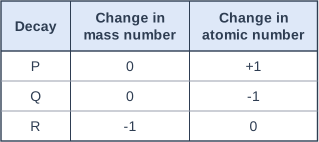
The table shows how the mass number and the atomic number of a nucleus change in three different radioactive decays, P, Q and R. In each decay, one particle is emitted.

Name the particle emitted in each decay, P, Q and R.

Table with columns "Decay", "Change in mass number", "Change in atomic number". Decay: P; Change in mass number: 0; Change in atomic number: +1 | Decay: Q; Change in mass number: 0; Change in atomic number: -1 | Decay: R; Change in mass number: -1; Change in atomic number: 0.

Model answer

P: the mass number is unchanged and the atomic number increases by 1, so a β⁻ particle (an electron) is emitted.
Q: the mass number is unchanged and the atomic number decreases by 1, so a positron (β⁺) is emitted.
R: the mass number decreases by 1 and the atomic number is unchanged, so a neutron is emitted.

Explanation

Work out what the emitted particle must carry away: for P, a mass number of 0 and a charge of -1 (an electron); for Q, a mass number of 0 and a charge of +1 (a positron); for R, a mass number of 1 and no charge (a neutron). An alpha particle would lower the mass number by 4 and the atomic number by 2, and a gamma ray changes neither.

Mark scheme
  1. 1 mark

    P: (beta-minus particle /) electron / β⁻ (1)

    Mark P, Q and R independently. allow beta particle / β / ⁰₋₁e for P; do not accept positron, proton or 'beta-plus' for P.

  2. 1 mark

    Q: positron / β⁺ / beta-plus particle (1)

    allow ⁰₊₁e; do not accept electron, 'beta' with no indication that it is positive, or proton.

  3. 1 mark

    R: neutron (1)

    allow ¹₀n; do not accept proton, alpha particle or gamma.

Question 4

4 marks

Bismuth-212 (²¹²₈₃Bi) nuclei decay in two different ways. About 64% decay by β⁻ emission and about 36% decay by alpha emission. Both of the nuclei formed then decay to lead-208 (²⁰⁸₈₂Pb), which is stable.

(atomic numbers: Tl = 81, Pb = 82, Bi = 83, Po = 84)

Give the mass number and the atomic number of the nucleus formed by each type of bismuth-212 decay, and deduce the type of decay by which each of these nuclei forms lead-208.

Model answer

β⁻ decay: the mass number stays 212 and the atomic number rises by 1 to 84, forming polonium-212 (²¹²₈₄Po).
Alpha decay: the mass number falls by 4 to 208 and the atomic number falls by 2 to 81, forming thallium-208 (²⁰⁸₈₁Tl).
Polonium-212 to lead-208: mass number down 4 and atomic number down 2, so this is alpha decay.
Thallium-208 to lead-208: mass number unchanged and atomic number up 1, so this is β⁻ decay.

Explanation

Apply the rules for each decay: β⁻ gives (A, Z + 1) and alpha gives (A - 4, Z - 2). Both routes give out one alpha particle and one β⁻ particle in total, only in a different order, so both end at lead-208. Check each step by balancing the mass numbers and atomic numbers.

Mark scheme
  1. 1 mark

    β⁻ decay of bismuth-212 forms a nucleus with mass number 212 and atomic number 84 (polonium-212) (1)

    Mark each point independently, with ECF for MP3 and MP4 from the student's nuclei. both numbers are needed for MP1; the name of the element is not required, but do not accept a wrong element name with correct numbers if it contradicts them.

  2. 1 mark

    alpha decay of bismuth-212 forms a nucleus with mass number 208 and atomic number 81 (thallium-208) (1)

    both numbers are needed for MP2; do not accept 210 or 85.

  3. 1 mark

    polonium-212 (212, 84) forms lead-208 by alpha decay (mass number down 4, atomic number down 2) (1)

    allow ECF: the decay that changes the student's MP1 nucleus into ²⁰⁸₈₂Pb in one step, if one exists.

  4. 1 mark

    thallium-208 (208, 81) forms lead-208 by β⁻ decay (mass number unchanged, atomic number up 1) (1)

    allow ECF: the decay that changes the student's MP2 nucleus into ²⁰⁸₈₂Pb in one step, if one exists; do not accept β⁺ / positron.

Ready to try the rest? Every answer you write is marked against the mark scheme, so you can see exactly where the marks are.

Study Helper Hints first, answers after you try

Stuck on this one? Ask for a hint and I’ll point you in the right direction, without giving the answer away. Once you’ve checked your answer, I’ll show you how the marks are awarded.